Showing posts with label dandelion. Show all posts

Thursday, March 20, 2025

Celebrate the Spring Equinox with Three Unique Herbs

As the days grow longer and nature awakens, the Spring Equinox is the perfect time to embrace renewal and balance. What better way to celebrate than with fresh, vibrant herbs? Here are a few ways to welcome the season with the power of nature’s green gifts.


Herbs of Renewal and Balance

Spring is a season of fresh starts, and certain herbs embody this energy beautifully:
🌿 Parsley – A symbol of cleansing and new beginnings, parsley is packed with nutrients and vitality.
🌼 Dandelion – This resilient herb supports detoxification and represents transformation, making it ideal for spring.
💜 Violet – Delicate yet strong, violets bring a sense of balance and harmony to the season.

Create an Herb-Inspired Centerpiece

Bring the freshness of spring indoors with an herb-inspired centerpiece. Fill a rustic basket or ceramic bowl with small pots of parsley, dandelion greens, and violets. Add sprigs of rosemary for a touch of fragrance, and tuck in a few bright flowers for color. This living arrangement not only looks beautiful but also provides fresh herbs to snip and use in seasonal dishes.

Go on a Spring Herb Foraging Walk

Take advantage of the season’s renewal by heading outdoors for a spring herb foraging walk. Look for young dandelion greens, violets, chickweed, or wild garlic along trails or in your own backyard. These fresh finds can be used in teas, salads, or homemade remedies. Foraging is a great way to connect with nature and appreciate the gifts of spring—just be sure to forage responsibly and avoid areas treated with pesticides.


Recipe: Violet Syrup

For a full step by step see this how to post from my herb freind Tina Sams of The Essential Herbal: Violet Syrup.

Here is a quick recipe:

Simple Violet Syrup (for treating coughs, colds and headaches)

  • 2 cups boiling water
  • 1 cup packed fresh violet flowers and leaves
  • 2 lb. sugar

Pour boiling water over fresh crushed flowers and leaves cover and let stand for 12 hours. Strain and squeeze through cloth, add sugar and boil for 1 hour or until syrupy. Store in glass jars. 

Recipe: Dandelion and Parsley Pesto

Celebrate the equinox with a fresh, herbal pesto that’s perfect for spreading on bread, mixing into pasta, or drizzling over roasted veggies.

  • 1 cup dandelion greens (washed and dried)
  • 1 cup fresh parsley leaves
  • ½ cup nuts (walnuts or pine nuts work well)
  • 2 cloves garlic
  • ½ cup olive oil
  • ¼ cup grated Parmesan (or nutritional yeast for a vegan option)
  • Juice of ½ lemon
  • Salt and pepper to taste

Directions:

  1. Blend dandelion greens, parsley, nuts, and garlic in a food processor until finely chopped.
  2. Slowly drizzle in olive oil while blending until smooth.
  3. Add Parmesan (or nutritional yeast), lemon juice, salt, and pepper. Blend again to combine.
  4. Adjust seasoning as needed and enjoy!

This pesto is a perfect way to welcome the changing season with the bright flavors of spring. How do you celebrate the Spring Equinox? Let us know in the comments!

Monday, May 20, 2024

Medicinal Bladder Infection Tea - Tea of the Month

This is a tea you will have to craft at home and probably will have to dig up a few of those pesky dandelions from your yard to make, but you will appreciate the effects.


Bladder Infections Tea

  • 1 ½ oz dried Goldenrod
  • 1/4 oz Juniper Berries*
  • 3/4 oz chopped Dandelion root
  • 3/4 oz chopped Rose Hips

Pour 1 cup boiling water over 2 tsp of mixture. Steep 10 minutes & strain.

*NOTE: Juniper berries can become toxic, so only drink 2 cups of this mixture daily for no more than 3 days.

Friday, April 28, 2023

Five herbs to put Spring in your Spring!

Spring is a time for renewal, and herbs can play a big role in refreshing and rejuvenating your body, mind, and home. Here are a few herbs that are perfect for spring:

  • Ø  Lemon balm: This herb has a bright, lemony scent and flavor that's perfect for spring. It's also a natural mood booster, making it great for those days when you need a little extra help to shake off the winter blues. Lemon balm can be used in cooking, teas, and as a bath infusion. Add fresh or dried lemon balm to marinades, dressings, and sauces for a lemony flavor boost. Steep fresh or dried leaves in hot water to make a soothing tea.

  • Ø  Dandelion: Dandelions are often considered a weed, but they're actually packed with nutrition and have a variety of medicinal properties. The leaves can be used in salads, and the roots can be roasted and used as a coffee substitute. Dandelion tea is a great detoxifying herbal tea and the root is also used as a liver tonic. Use the leaves in salads, or roast the roots to make a coffee substitute. Dandelion tea is a great detoxifying herbal tea and the root is also used as a liver tonic.

  • Ø  Chives: These delicate herbs are one of the first to appear in the spring, and their mild onion flavor makes them a great addition to a variety of dishes. They can be used fresh or dried and are a great source of Vitamin K. Add fresh or dried chives to eggs, soups, and salads for a mild onion flavor.

  • Ø  Rosemary: This woody herb is a classic in Mediterranean cuisine and is perfect for spring grilling. It is also good for digestion and improving memory. Use fresh or dried rosemary to flavor meats, vegetables, and breads.

  • Ø  Lemon Grass: This tropical herb is a great addition to spring cooking, as it has a fresh, lemony flavor that's perfect for marinades, dressings, and teas. Lemon grass can also be used in bath infusion for a relaxing soak. Use fresh or dried lemon grass in dressings and sauces for a lemony flavor boost. Add a handful of fresh or dried stalks to a muslin bag and let it steep in your bathwater for a relaxing soak.

These herbs can be used in a variety of ways, from cooking and medicine to bath infusions. Try incorporating them into your spring routine for a fresh and rejuvenating experience.

And if you want more info on any of these herbs Check out the Herb A to Z

Monday, August 15, 2016

Plants to Honor Mary

In the Spring I presented a garden theme idea of a Garden of Mary.  Now on the Feast of the Assumption of Mary, which was first celebrated in 529 AD, I thought we could learn a few more plants whose names were changed to Honor Mary.

Our Lady's Herbs


          Spearmint was known as Our Lady's Mint. 

Marjoram was Mother of God's Flower. 


          Bee balm and lemon balm were both called Sweet Mary. 
 
Lemon Balm
Catnip was Mary's Nettle.  

Sage was Mary's shawl. 

Dandelion was known as Mary's Bitter Sorrow.


A group of herbs became known as Manger Herbs because they made a bed for the Infant Jesus when he was born. 
Sweet Woodruff

·        Sweet woodruff and yellow bedstraw were called Our Lady's Bedstraw 
·        creeping thyme was Mary's Bedstraw. 
·        Mints and pennyroyal were also said to have been used in the manger. 


This information came from a hard to locate book entitled Mary’s Flowers: Gardens, Legends & Meditations, by Vincenzina Krymow.

I have never been able to locate this book, but I have read excepts and paraphrases of it from other blogs and articles.  If anyone knows where I can get a copy, please let me know.  My library, normally the best at locating the obscure and rare, has been unable to obtain a copy real or digital.

Tuesday, February 9, 2016

Garden Superstitions

When I get bored in the winter I start looking through old nots and information and sorting files.  This year I came across a number of files on various topics.  One was superstitions and traditional practices.  Today I thought I would share a few of those old wives tales.


Gazing balls – You need to keep your gazing ball well polished, because it reflects the sun into the eyes of evil spirits keeping them away.

Ants – a bringer of rain and a harbinger of rain.  According to legend if you want rain find some ants and stomp on them it is sure to bring rain.  If you see ants and they are agitated, then you will be getting rain soon.

Harbingers of frost – Frost is six weeks away if you witness any of the following: If the fawns lose their spots, katydids start to sing or if you see a walking stick.


Catching a cold – If you catch a falling leaf on the first day of autumn, you will not catch a cold all winter.

Protection from curses – planting angelica, snapdragons or chamomile will protect you from curses and spells.


Treatment of scarecrows – It is important to treat scarecrows with care as they have been imbued with special powers to protect the garden.  

Never put up a scarecrow before Easter or on May Day (5/1).  The head should always point toward heaven and be covered with a hat. 

On the longest day of the year, put your scarecrow in the shade.  Give it a glass of water if it is dry.  

You must remove and burn your scarecrow before midnight on Halloween and never let anyone wear clothes that have adorned a scarecrow or there will be terrible consequences.


Planting cucumbers – According to tradition cucumber should be planted in the morning before sunrise, or they will be destroyed by bugs.

Telling time with your garden – Dandelions open between 7 and 8 AM; California Poppies open between 10 and 11 AM; Four o’clocks open at… wait for it… 4 PM; Evening primrose and moonflowers open at 6 PM; and daylilies and dandelions close at 9 PM.


Wednesday, March 27, 2013

Chickweed - Herb of the Week

Tomorrow is National Weed Day, so in celebration, I decided to make the
Herb of the Week Chickweed (Stellaria media)
common chickweed to be exact.

This cool-season annual herb started out as a weed in Europe and has been naturalized worldwide. It is so named because it is a favorite food of chickens. Chickweed is an annual, meaning that the plant's life span is over in one year, and the plants for the next year come from seeds, either self-seeded by the plant or sewn in by the gardener.

Chickweeds are an annual herb, widespread in temperate zones, arctic zones, and throughout their place of origin – Europe. Chickweeds have established themselves all over the world, possibly carried on the clothes and shoes of explorers. They are as numerous in species as they are in region. Most are succulent and have white flowers, and all with practically the same edible and medicinal values. They all exhibit a very interesting trait, (they sleep) termed the 'Sleep of Plants,' every night the leaves fold over the tender buds and the new shoots.

To Grow
Chickweed grows from 3 to 8 inches high, and the plants will mat together and grow to about 16 inches long. The leaves, which have smooth edges, are no more than 1 inch long and can be as short as ½ inch and always grow in pairs, directly opposite each other on the stem. The stem itself is not smooth, having fine hairs covering the entire length. The flowers themselves are petite, measuring just 1/8 inch across. They are white with five petals, giving them a star shape. Directly under the flower petals are five sepals, which look like leaves, and grow as long as the petals.

There are a few different types of chickweed, each one with its own modification on the general features, and all of them are edible. Common chickweed has leaves with stalks, star chickweed has leaves without stalks, and mouse-ear chickweed has coarse hairs.

To Use
The cultivation of this her (weed) is not really necessary as it can be found abundantly in the wild.  One can gather fresh edible plant between May and July, as soon as flowers appear, it can be used fresh or be dried for later herb use.

Common chickweed as well as star chickweed can be eaten raw in salads or cooked just like spinach, for about five minutes. Mouse hair chickweed is a bit tough to eat raw. It has to be cooked. Chickweed is an excellent source of vitamins and minerals including A, D, B complex, C, rutin. iron, calcium, potassium, phosphorus, zinc, manganese, sodium, copper, and silica.

Chickweeds are Medicinal and edible, they are very nutritious, high in vitamins and minerals, can be added to salads or cooked as a pot herb, tasting somewhat like spinach. The major plant constituents in Chickweed are Ascorbic-acid, Beta-carotene, Calcium, Coumarins (blood thinners),  Flavonoids, Magnesium, Niacin, Oleic-acid, Potassium, Riboflavin, Selenium,  Thiamin, and Zinc.

The whole plant is used in alternative medicine as an astringent, carminative, demulcent, diuretic, expectorant, and laxative. A decoction of the whole plant is taken internally as a post-partum tonic.  It is also used to relieve constipation; an infusion of the dried herb is used in coughs and hoarseness, and is beneficial in the treatment of kidney complaints.  New research indicates its use as an effective antihistamine. The decoction is also used externally to treat rheumatic pains, wounds and ulcers. It can be applied as a medicinal poultice and will relieve any kind of roseola and is effective wherever there are fragile superficial veins or itching skin conditions.  I plan to make a salve with it this spring to see if it is effective on my rosacea.

Historically, Chickweed water is an old wives' remedy for obesity. The plant has medicinal purposes and is used in folk medicine. It has been used as a remedy to treat itchy skin conditions and pulmonary diseases. 17th century herbalist John Gerard recommended it as a remedy for mange. Modern herbalists mainly prescribe it for skin diseases, and also for bronchitis, rheumatic pains, arthritis and period pain. A poultice of chickweed can be applied to cuts, burns and bruises. Not all of these uses are supported by scientific evidence.

Problems
Be careful when picking chickweed. There are poisonous plants that grow the same way, but have different features. Spotted Spurge trails along the ground and has the same leaf characteristics, but has different flowers, and if you break the stem, you will get a milky sap. Matted doorweed, also known as oval-leaf knotweed, also trails along the ground, but the leaves are not opposite one another--they alternate up the stem one by one.

Recipes

Itch Relief Salve (Good for poison ivy, poison oak )
1 pint Sweet Olive Oil
2 ounces Beeswax
1 tablespoon Chickweed Powder
1 tablespoon Comfrey Powder

Put chickweed and comfrey powder into sweet olive oil and simmer 3 hours. Strain and add beeswax to warm oil. Stir until wax dissolves. Pour into salve jars or tins. If you want a thin consistency (such as a cream or Vaseline ) add only a little bit of Beeswax. Want it thicker like wax? Just add more Beeswax.

Allow the base to cool down to see what the consistency is like. If it's too thick, add more  oil and reheat, too thin, add more Beeswax.

Pain Relief Salve 1 tablespoon Chickweed powder
1 tablespoon Wormwood Powder
10 drops Tea Tree oil
2 pints Sweet Olive Oil
3 ounces Beeswax

Mix together chickweed, wormwood powder, add the mixed herbs to sweet olive oil and simmer 3 hours. Strain and add beeswax to warm oil. Stir until wax dissolves, then add Tea Tree Oil. Pour into salve jars or tins.

TRAVELER'S JOY SALAD
If you are out in the wild or have a large yard, it is possible to gather many of these salad ingredients from the landscape. (I think I originally found this recipe at Learning Herbs.com – but the citation is lost)

3 cups purslane, chopped
1 hard-boiled egg, sliced
1/2 cup amaranth leaves
1/4 cup cheddar cheese (or other cheese), diced into small bits
1/2 onion
1 cup chickweed
1 ripe avocado
1 teaspoon garlic salt
Juice of 1/2 lemon

Chop the purslane, chickweed, amaranth, and onion into bite sized bits. Add the avocado, peeled and diced. Add one hard-boiled egg, sliced. Mix in approximately 1/4 cup of cheddar cheese which has been cut into small bits. Squeeze the lemon over the salad, add the garlic salt, and mix well. If you have them, you can add chia seeds and one tablespoon of mayonnaise.

Flashes Blend Tea
I got this recipe from a friend who swore by Chickweed’s menopausal and post partum treatment qualities.

1 part sage
1 part motherwort
1 part dandelion
1 part chickweed & violet leaves
1 part each elder flowers & oatstraw

Brew with 1 to 2 tsp. per cup of hot water. Brew up a pot and sip when needed.

Friday, June 29, 2012

Weekend Recipe - Herb Flower Salad


This weekend it is to be so hot and right before the grilling event of the summer, that I thought I would share a quick salad recipe with you.  You can make this as a meal by serving over a chicken breast, or as a side salad.  It is the perfect way to enjoy all the blooming flowers in your herb garden.

Herb Flower Salad with Lemon Vinaigrette

2 Nasturtium flowers and 8 leaves
6 red clover blossoms
6 to 8 young plantain leaves
2 stalks lambs quarter greens and seeds
12 pepper grass leaves
    you can use kale instead
2 purple mustard leaves
    you can use kale instead
6 catnip leaves
6 violet leaves
4 dandelion leaves

Dressing
½ cup good olive oil
¼ cup freshly squeezed lemon juice
      add about 1 to 2 tsp. lemon thyme or lemon basil, crumbled dry or minced fresh.
 
Gently toss the flowers and herbs in a bowl.  Prepare dressing by combining ingredients in a jar and shaking briskly.  Toss with greens just before serving.  To add texture to the salad, drop in some slivered almonds or plain roasted nuts.  To give it strength mince in some fresh garlic.  

Don't Forget your last days to comment and get into the drawing for some citrus bath salts is June 30th.  See this post for details.

Saturday, March 17, 2012

Irish Herb Lore for St. Patrick's Day

Nearly every country and culture has its own herb lore – native plants that that were long believed to promote good health, and even good luck, to those who ate, drank, or carried them. My family and especially the family of my husband are both German and Irish.  In celebration of my husbands Patron Saint, St. Patrick, I thought today would be a great day to focus on special herbs of Ireland.
Ireland has a wealth of herbal lore passed on by local healers.  Unlike much of Europe that turned away from herbal remedies and healing methods with the start of the Industrial Age, Ireland held onto those herbal traditions.  So here is a quick look at some herbal remedies passed down by the “fairy doctors” of old Éire.
Herbs of Ireland
Comfrey Root: Used for healing minor cuts, scrapes, and burns, battling inflammation from diaper rash, varicose veins, and arthritis, and reducing swelling from bruises, sprains, or pulled muscles.

Dandelion Leaves: Used externally on wounds as an antibacterial, and to remove corns and warts. Used internally to promote healthy kidneys, prevent gallstones, fight jaundice, ease constipation, and soothe edema, joint pain, gout, eczema, and acne.

Eyebright: A solution of eyebright was used as an eyewash or compress to reduce inflammation from conjunctivitis, eyestrain, styes, and general eye irritation. It was also taken internally for allergies, bronchitis, colds, and sinus infections.

Feverfew: Used as a remedy for headaches, arthritis, fevers, skin conditions, stomach aches, and asthma. Also used to promote more regular menstrual cycles and ease childbirth.

Garlic (wild): Used to soothe coughs, asthma, and shortness of breath.

Horehound: Used as a cough expectorant and mild laxative, and to bring on menstruation.

Marshmallow Leaves: Used in dressings to soothe sprains and swelling.

Meadowsweet: Used to treat arthritis pain. (Contains salicylic acid, which is chemically similar to an active ingredient in aspirin).

Mullein
Mullein: Used as a decongestant and expectorant for respiratory illnesses. Also used to soothe sore throats, treat diarrhea, and cure earaches.

Nettles: Used to treat rashes, eczema, arthritis, gout, and diarrhea. [unless your allergic!]

Sphagnum Moss: Used to dress wounds.

Vervain: Used to promote a healthy liver, fight fatigue, reduce fever, prevent insomnia, soothe asthma, and promote more regular menstrual cycles.

Willow Bark: Used to treat arthritis pain. (Contains salicylic acid, which is chemically similar to an active ingredient in aspirin).

Yarrow: Used to reduce bleeding in wounds, ulcers, hemorrhoids, etc. Also used to reduce inflammation and treat aches and pains. (Contains salicylic acid, which is chemically similar to an active ingredient in aspirin).

Monday, April 25, 2011

Spring Recipe - Spicy Dandelion Greens

I know the dandelions are probably running wild all over your yard by now, so here is a little recipe you can make with them so the effort of pulling them out results in something enjoyable!

Sautéed Spicy Dandelion Greens
  • 2 lb dandelion greens, tough stems removed and leaves cut crosswise into 4-inch pieces
  • 1/4 cup extra-virgin olive oil
  • 2 large garlic cloves, smashed
  • 1/2 teaspoon dried hot red pepper flakes
  • 1/2 teaspoon salt
Cook greens in a 6- to 8-quart pot of boiling salted water until ribs are tender, 4 to 5 minutes, then drain in a colander. Rinse under cold water to stop cooking and drain well, gently pressing out excess water.
Heat oil in a 12-inch heavy skillet over moderate heat until hot but not smoking, then cook garlic, stirring, until pale golden, about 30 seconds. Increase heat to moderately high, then add greens, red pepper flakes, and salt and sauté, stirring, until liquid greens give off is evaporated, about 4 minutes.


If you want to see other suggestions for things to do with Dandelions, check out the Herb of the Week post we did a few weeks ago.

Thursday, March 31, 2011

Herb of the Week - Weeds!

Okay I am a day late, but the good news is I have three for the price of one today. A friend pointed out that Monday was “Weed Appreciation Day.”  Now as herb growers we all acknowledge that herbs are weeds.  As I say in my lectures, "they don’t call it herbicide for nothing!”  My friend Leanne also reminded me of a quote by gardener Doug Larson who says “A weed is a plant that has mastered every survival skill except for learning how to grow in rows.”

So in celebration of this auspicious day  I thought it would make
                                   this week’s Herb of the Week – WEEDS

Here are a few good tips so you can appreciate “weeds.” The weeds I will focus on are:
  • Dandelion – which I wrote up as the herb of the week just recently (see this post)
  • Burdock
  • Plantain
  • Mullein 
Burdock

Burdock is any of a group of biennial thistles in the genus Arctium, family Asteraceae. Native to the Old World, several species have been widely introduced worldwide. Plants of this genus have dark green leaves that can grow up to 28" (71 cm) long. They are generally large, coarse and ovate, with the lower ones being heart-shaped. They are woolly underneath Arctium species generally flower from July through to October.  The prickly heads of these plants (burrs) are noted for easily catching on to fur and clothing (being the inspiration for Velcro).

For many years I volunteered at the West Chicago Prairie pulling out, cutting down and removing burdock from a natural prairie where it is not a native plant.  It is so prolific a plant that it could easily swamp the more slow growing native species.  My thought once I learned that it has medicinal and food properties was if it becomes popular as a food, wild harvesters would take care of removing it from prairie lands and wonderful things can happen.  As part of my personal eradication campaign, I believe we should find better uses for burdock, including eating it.

The long taproot (up to 3 feet) of young burdock plants can be harvested and eaten as a root vegetable. While generally out of favor in modern European cuisine, it remains popular in Asia. Burdock root is very crisp and has a sweet, mild, and pungent flavor with a little muddy harshness that can be reduced by soaking julienned or shredded roots in water for five to ten minutes. I have cooked them with and without rice in my rice cooker.  Immature flower stalks may also be harvested in late spring, before flowers appear; their taste resembles that of artichoke, to which the burdock is related.  Julienned or shredded burdock root and carrot, braised with soy sauce, sugar, sake and sesame oil.

In the second half of the 20th century, burdock achieved international recognition for its culinary use due to the increasing popularity of the macrobiotic diet, which advocates its consumption. It contains a fair amount of dietary fiber (GDF, 6g per 100g), calcium, potassium, amino acids, and is low in calories. It contains a polyphenol oxidase, which cause its darkened surface and muddy harshness by forming tannin complexes. Burdock root's harshness harmonizes well with pork in miso soup. In parts of the US (notably western New York), burdock stalks are eaten as a substitute for cardoon. The stalks are peeled, scrubbed, boiled in salt water, and fried in an egg and breadcrumb batter.

Folk herbalists consider dried burdock to be a diuretic, sweat inducer for fever control and treatment of shock, and a blood purifying agent. Burdock is a traditional medicinal herb that is used for many ailments. Burdock root oil extract, also called Bur oil, is popular in Europe as a scalp treatment applied to improve hair strength, shine and body, help reverse scalp conditions such as dandruff, and combat hair loss. Burdock leaves are used by some burn care workers for pain management and to speed healing time in natural burn treatment. Burn care workers hold that it eases dressing changes and appears to impede bacterial growth on the wound site and that it also provides a great moisture barrier.


Plantain

When we talk about plantain, normally the image of a banana plantation conjures up in our mind. But the common plantain is a small wild plant with leaves that grow mostly from the plant's bottom. The Plantain belongs to the natural order Plantaginaceae, which contains more than 200 species, twenty-five or thirty of which have been reported as in domestic use. The Common Broad-leaved Plantain is a very familiar perennial 'weed,' and may be found anywhere by roadsides and in meadow-land. It grows from a very short rhizome, which bears a great number of long, straight, yellowish roots, and a large, radial rosette of leaves and a few long, slender, densely-flowered spikes. The leaves are ovate, blunt, abruptly contracted at the base into a long, broad, channeled footstalk . The blade is 4 to 10 inches long and about two-thirds as broad, usually smooth, thickish, five to eleven ribbed, the ribs having a strongly fibrous structure, the margin entire, or coarsely and unevenly toothed. The flower-spikes, erect, on long stalks, are as long as the leaves, 1/4 to 1/3 inch thick and usually blunt. The flowers are somewhat purplish-green, the calyx four parted, the small corolla bell-shaped and four-lobed, the stamens four, with purple anthers. The fruit is a two-celled capsule containing four to sixteen seeds.

Plantago major
(you know you've see this at the playground)
Plantain has been used internally for inflammation of the skin, malignant ulcers, intermittent fever, etc., and externally as a stimulant application to sores. Applied to a bleeding surface, the leaves are of some value in arresting hemorrhage. The fresh leaves are applied whole or bruised in the form of a poultice. Rubbed on parts of the body stung by insects, nettles, etc., or as an application to burns and scalds, the leaves will afford relief and will stay the bleeding of minor wounds.

The common plantain has multiple medicinal uses and is highly valued by most herbal practitioners. In case on any injury, the herb is able to instantly check the flow of blood and also restore the smashed tissues. According to many herbal practitioners, the common plantain may be used as a substitute of comfrey to effectively treat bruises and broken bones. Ointments or lotions prepared with the common plantain leaves may be used to cure hemorrhoids, fistulae or anomalous channels in the skin as well as ulcers. When used internally, the herb acts as a diuretic increasing the outflow of urine, expectorant (a medication to treat coughs) as well as decongestant (a medicine that clears blocked nose). Herbal practitioners recommend the common plantain to treat conditions such as gastritis, peptic ulcers, diarrhea, dysentery, irritable bowel syndrome, congestion of the respiratory tract, loss of voice as well as bleeding in the urinary tract.

REVITALIZING GREEN JUICE
3 cups (180 g) fresh plantain leaves
1 cups (250 ml) pure liquid honey
1 opaque glass bottle

Crush the leaves in a food processor, drain and squeeze in cheesecloth. Combine 1 cup (250 ml) of the green juice with the honey and simmer for 10 minutes at low heat, stirring regularly. Let cool and pour into the opaque bottle.

Take this nectar 1 spoonful at a time like syrup to treat a cough; also use it to treat a sore throat, anemia, fatigue and eczema: 1 T (15 ml), 3 times daily.

Mullein

The Mulleins also known as velvet plants are a genus of about 250 species of flowering plants in the figwort family (Scrophulariaceae.) They are native to Europe and Asia, with the highest species diversity in the Mediterranean region.  They are biennial or perennial plants, rarely annuals or sub shrubs, growing to 0.5–3 m tall. The plants first form a dense rosette of leaves at ground level, subsequently sending up a tall flowering stem. Biennial plants will form the rosette the first year, and during the following season is when the stem emerges. The leaves are spirally arranged, often densely hairy, though glabrous (hairless) in some species. The flowers have five symmetrical petals; petal colors in different species include yellow (most common), orange, red-brown, purple, blue or white. The fruit is a capsule containing numerous minute seeds. It gows in edge regions , on hedge-banks, by roadsides and on waste ground, more especially on gravel, sand or chalk. It flowers during July and August.
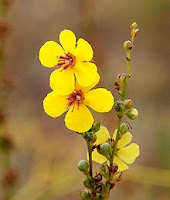
The plant has a long history of use as a medicine, and is an effective treatment for asthma and respiratory disorders. Extracts made from the plant's flowers are a very effective treatment for ear infections. Although this plant is a recent arrival to North America, Native Americans used the ground seeds of this plant as a paralytic fish poison due to their high levels of rotenone. One species, Verbascum thapsus (Great mullein), is used as an herbal remedy for sore throat, cough, and lung diseases. The leaves and flowers are the parts used medicinally. Fresh Mullein leaves are also used for the purpose of making a homoeopathic tincture.

Mullein is also the active ingredient in many alternative smoking blends.  It’s most unique use is as rod for use in the hand drill method of friction fire lighting.


Disclaimers – although these weeds have many medicinal properties, I do not recommend self medicating with them without experience or proper advice.  If you are interested in these plants, may I recommend some additional reading in:
  • Homegrown Herbs by Tammi Hartung  (2011)
  • The Natural Remedy Bible by Michael Tierra (2003)
  • The Encyclopedia of Medicinal Plants by Andrew Chavallier
Related Posts Plugin for WordPress, Blogger...