Showing posts with label bee balm. Show all posts

Sunday, March 15, 2026

Rose and Anise Tea - Tea Blend of the Month

This month we have a couple of uncommon herbs to use in our tea. Yarrow and Anise hyssop.  The both make a sweeter, yet earthy tea flavor and are great compainons to the added citurs flavors of this blend.

Yarrow has a number of surprising benefits, including helping wounds heal faster, reducing inflammation and lowering blood pressure.  It assists with blood clotting and regulating asthma symptoms. It also helps maintain a regular period. It has also been know to reduce anxiety.

Anise Hyssop - Used as an infusion in tea and cold remedies will relieve congestion. It is also used to strengthen a weak heart. A hot infusion will induce perspiration and is therefore useful in treating fevers. A cold infusion of Agastache foeniculum leaves is used to relieve pains in the chest from excessive coughing.


Rosehips- Rosehips are the seed-filled bulbs that grow at the base of the blossom of a rose. They have been used in traditional medicine to treat a variety of ailments. Native Americans have used rosehip tea to soothe sore throats and indigestion.  Rosehips contain vitamins C, E, and B as well as other minerals and antioxidants.  They also contain a substance that may ease inflammation.

Bee Balm – a native of North America the possess vibrant, tube-shaped flowers, in shades of red, pink, purple which attract a variety of pollinators, including bees, butterflies, and hummingbirds. In tea it is great for digestive problems and boosting immunity. An antioxidant it is also supportive to the respiratory and urinary systems.


Rosehip and Anise Hyssop Tea

  • 2 parts Rose Hips
  • 3 parts Anise Hyssop
  • 3 parts Yarrow
  • 1 part Bergamot
Combine ingredients and use 1 to 2 teaspoons per cup of hot water. Allow to steep 5 to 7 minutes.

Monday, September 26, 2022

Perennials Herbs to add to your landscape this Fall

Here are three Perennial herbs that you can plant in your fall garden so you can enjoy the flowers and eating them next year.

Edible flowers are a great addition to the landscape.  They have long-lasting flowers that not only add to the look of the garden space, but also add great flavors colors, and scents to your food dishes.  These three are easy to grow and simple to use. 

Perennials are a great plant to add to the garden at the end of the season so they can establish over winter and emerge for your enjoyment in Spring.


Chives (Allium schoenoprasum)

I recommend Common Chives, rather than Garlic chives.  Common Chives flower first thing in the spring when few other things are flowering and the flowers can be used a number of ways.  I love to make herbal vinegar with my chive blossoms.  It is a lovely pink color with the gentlest flavor of onion,  You can also crumble the flowers into a salad or to flavor oil dipping sauces. Later when the flowers are finished you can sprinkle the chopped leaves sprinkled over baked potatoes, salads or pizza.

Add them to your landscape where you want a change in texture as the thin blade-like leaves will fountain out as the plant gets older.

Chives are great in vinegar and salads as an edible flower and you can find several recipes on this blog.

Bee Balm (Monarda didyma)

Bee balm is a wonderful perennial for drawing pollinators into your garden, but did you know it is an edible ornamental? Both the leaves and flowers are edible and have a strong, oregano-like flavor. You might also detect notes of mint, as this perennial is in the mint family. Don’t let the fact that they are in the mint family fool you—these are non-running, clump-forming, petite perennials for the front of the border or herb garden.

Another common name for bee balm is bergamot, as an herbal tea is is a great substitute for the bergamot oil in black tea that flavors Earl Grey.   The leaves or flowers of Monarda didyma can also be used fresh, chopped finely like you would use fresh oregano to flavor pasta dishes, in salad dressings or on your homemade pizza.

To use Bee Balm in recipes, check out these posts.


English Lavender (Lavandula angustifolia)

Like bee balm, lavender is another plant we tend to think of mostly as an ornamental flowering perennial rather than an edible herb. You’ll find a number of different species at the garden center, but English lavender, Lavandula angustifolia, is the one often used in recipes and garden. It tastes much like it smells—sweet and floral-like. Its fresh or dried flowers can be used in marinades and cooking blends, sprinkled over ice cream, steeped in lemonade or cocktails, or used to flavor shortbread cookies and other baked goods.

The plant must be well mulched in winter to come back the following year, but the tall flower spikes with purple buds and flowers can bloom from June to September. When not blocking it has a needle-shape leaf in a silver-gray color that adds a bit of scent and texture to your garden landscape.

So try out these perennials and plant them now in the fall and enjoy them next year to their fullest and most tasty.

Check out recipes with this herb here on the blog.

Monday, August 15, 2016

Plants to Honor Mary

In the Spring I presented a garden theme idea of a Garden of Mary.  Now on the Feast of the Assumption of Mary, which was first celebrated in 529 AD, I thought we could learn a few more plants whose names were changed to Honor Mary.

Our Lady's Herbs


          Spearmint was known as Our Lady's Mint. 

Marjoram was Mother of God's Flower. 


          Bee balm and lemon balm were both called Sweet Mary. 
 
Lemon Balm
Catnip was Mary's Nettle.  

Sage was Mary's shawl. 

Dandelion was known as Mary's Bitter Sorrow.


A group of herbs became known as Manger Herbs because they made a bed for the Infant Jesus when he was born. 
Sweet Woodruff

·        Sweet woodruff and yellow bedstraw were called Our Lady's Bedstraw 
·        creeping thyme was Mary's Bedstraw. 
·        Mints and pennyroyal were also said to have been used in the manger. 


This information came from a hard to locate book entitled Mary’s Flowers: Gardens, Legends & Meditations, by Vincenzina Krymow.

I have never been able to locate this book, but I have read excepts and paraphrases of it from other blogs and articles.  If anyone knows where I can get a copy, please let me know.  My library, normally the best at locating the obscure and rare, has been unable to obtain a copy real or digital.

Saturday, January 17, 2015

10 Top Recipes from 2014 - Weekend Recipes

I was more diligent about posting my recipes in 2014.  I shared them on Facebook and here in the Blog and linked a few back to my Twitter account as well.

These are the top 10 recipes from my posts last year.  I thought I would gather them together so if you missed them, you can see what others are enjoying as well.

This year we will continue to dig into our stash of recipes and post one at least every weekend with more shared in the Herb of the Week posts too!


#10 most popular - Cinnamon Roasted Pumpkin - Our Cinnful Dessert blend was another big hit with surplus pumpkin seeds.

#9  Iced Green Tea Chai - Chai is even better in the summer with a bit of ice than you would expect after drinking it rich and hot all winter!

#8 Ratatouille on the Grill this a great vegetarian meal!

#7 Flavored Mustard - we will take another pilgrimage to the Mustard Museum in 2015 and I am sure we will have more of these for you.  I love a flavored mustard on my sandwiches and in my cooking.

#6 Saffron Risotto - This rare and expensive herb is just worth trying at least once a year and this creamy recipes is a perfect partner.

#5 Mid Winter Minestrone - When it is cold a hearty partner like this will keep you warm.

#4 Bee Balm Recipes - This was an extension of an Herb of the Week where I shared more than one recipes using this prolific and citrusy herb.  I know you will love the flavors as much as I do!

#3 Soothing Bath Sachet - my bath recipes were among the most popular and this simple sachet with soothing milk was one of my favorites.


#2 Chicken Pot Roast in a Crock Pot - This one has my chef husbands seal of approval.  The Chicken is tender, the vegetables tasty and the fragrance is wonderful as it fills the house.  Great way to try out lima beans if you have been leery...


#1 The most popular recipes in 2014 - Sporty Bath Blend - great smelling when you are not, this blend is good as a bath or a foot soak.

Tuesday, November 4, 2014

Bath Blend of the Month - Relax and Comfort Bath Combination


This blend of salts and essential oils with some dried herbs give comfort and relaxation as well as making a great gift item. To make them get a decorative canning jar.  Those colored ones Ball has out now are nice.  Then mix the herbs and salts right in the jar. If you want to give it as a gift, you can label the jar lids.  I found these great jar lid templates at Garden Therapy you might want to try: Jar lid Templates.


Relax and Comfort Bath Combination
§  2 cups Epsom salts
§  8 drop pure lavender essential oil
§  6 drops mint essential oil
§  2 drops eucalyptus essential oil
§  2 drops rosemary essential oil
§  1 tsp dried comfrey root powder
§  1 tsp dried lavender flowers
§  1 tsp dried mint leaves
§  ¼ tsp dried bergamot (bee balm) petals


Directions: 
Fill a pretty jar about halfway full of the Epsom salts. Add essential oils, replace lid, and shake. Remove the lid again, add comfrey and dried herbs, replace lid and shake (again.)  Add more Epsom salts to fill the jar, replace the lid and shake again.

To use: Add 2 to 3 Tbls. of salt mixture to bath as you fill the tub.  Swish to dissolve.  Grab a cup of herbal tea and relax your cares away.

Wednesday, August 13, 2014

Bee Balm (New Recipes) - Herb of the Week

Although I did an herb of the week on Bee Balm back in 2012, I find that this year, It has been so very attractive I cannot resist giving more information about this attractive perennial.

So Herb of the Week is Bee Balm  genus Monarda 

Bee Balm is a true Native American herb named Monarda by the Spanish explorer who discovered it in the new world in 1571. Its meaning in the Language of Flowers is Compassion. sympathy, consolation.

Known as Oswego Tea to some, this is the plant that Native Americans used to treat colds and to relax. This tea was used by the rebellious Boston patriots during the tea boycott. It is also known as Bergamot. This is a reference to its citrus-like scent which resembles the small, bitter Italian bergamot citrus orange called Orange Bergamot.  When you buy essential oil of Bergamot you are purchasing the oil of bergamot orange. This is the flavor used to give Earl Grey tea its distinctive flavor. This fragrance is very similar to the Bee Balm, but comes from a different plant.

To Grow

Bee Balm is naturalized throughout the United States. It is a hardy perennial in the mint family and grows to two to three feet tall. Its leaves grow in pairs that are oval and pointed on a four sided stem. Flowers appear in zone 5 in late June through August- September. lts tubular flowers bloom from a large round head. Both leaves and flowers have a strong citrus mint scent.
A rich purple Bee balm from the Rotary Garden in Janesville, WI

Bee Balm flowers come in colors from red to pink to purple to while. It’s roots are dense and shallow. It can easily be propagated from runners. Bee Balm which is in the mint family (you know by the square stem) can be invasive, but growth is usually checked by our cold winters.  This winter was snowy so I think the extra moisture resulted in the vivid colors and proliferation of flowers we see this year.

Bright Pink Bee Balm at the Morton Arboretum
Bee Blam flowers come in colors from red to pink to purple to white. The roots are dense and shallow. It can easily be propagated from runners. Bees and hummingbirds love the colorful tubular flowers.
The plant tolerates shade, but prefers full sun. Dry soil stunts plant growth since the roots are so near the surface. You want to plant Bee Balm somewhere where it is not disturbed by foot traffic or cultivation as the shallow roots can be damaged.  It responds well to being mulched especially in warmer climates.  Weeding must only be done by hand. Bee Balm often gets powdery mildew towards late August. The best treatment is to cut the stems to the ground and discard the diseased foliage. Do not put these diseased clippings in your compost pile.

To Use

Bee Balm flower petals are a good addition to tea, desserts and potpourri. Petals can be harvested often by picking only the flower petals and leaving the round heads attached. Picking just the petals in this way will encourage re-blooming for weeks. Dry the petals on a tray for about a week. When thoroughly dry, store them in an airtight jar until needed.


Bee Balm flower petals are edible flowers and add a citrus flavor to any dish including salad, jelly, bread, tea and honey. The fresh petals are delicious in lemonade or iced tea. Bee Balm petals are attractive and delicious with all fruits. Dried petals retain their flavor and can be used throughout the year.

Wild bee balm of light purple

Dragonfly Cheese
1  8-ounce package of cream cheese, softened
1/2 cup (4 tablespoons) margarine or butter, softened
1 Tablespoons fresh monarda petals, chopped
1 Tablespoon dried dill

Directions:
Mix cheese and butter together with edible flowers and dill. Mix well. Add one tablespoon of mayonnaise if you would like the mix more spreadable. Chill overnight and serve with cocktail rye, crackers or vegetable sticks.


Bumble Bee Punch
1 quart of brewed Backyard Patch Earl Grey Tea with Lavender or Lemon Bergamot Tea
1/2 cup sugar
1 quart lemonade

Directions:
Sweeten tea with sugar and stir until dissolved. Add lemonade to sweetened tea and mix in a large punch bowl. Add ice ring made with juice or tea and decorated with mint and edible flowers. Float lemon slices in punch bowl. Sprinkle with fresh monarda petals.

Herbal Headache Soother Tea
equal parts: 
     Lavender
     Chamomile
     Rosemary
     Mint
     Bee balm  (leaves and flowers)


Directions:
Blend ingredients together and store in a jar with tight fitting lid.  Use 1 to 2 teaspoons per cup of hot water (more if you make it iced).  Allow to steep 7 to 10 minutes before drinking.

Wednesday, July 31, 2013

Fragrance Garden at the Morton Arboretum - Herb(s) of the Week

This week I stopped by the Morton Arboretum in Lisle, Illinois.  I drive past it everyday and stop in on my way home several times a week if my own garden permits.

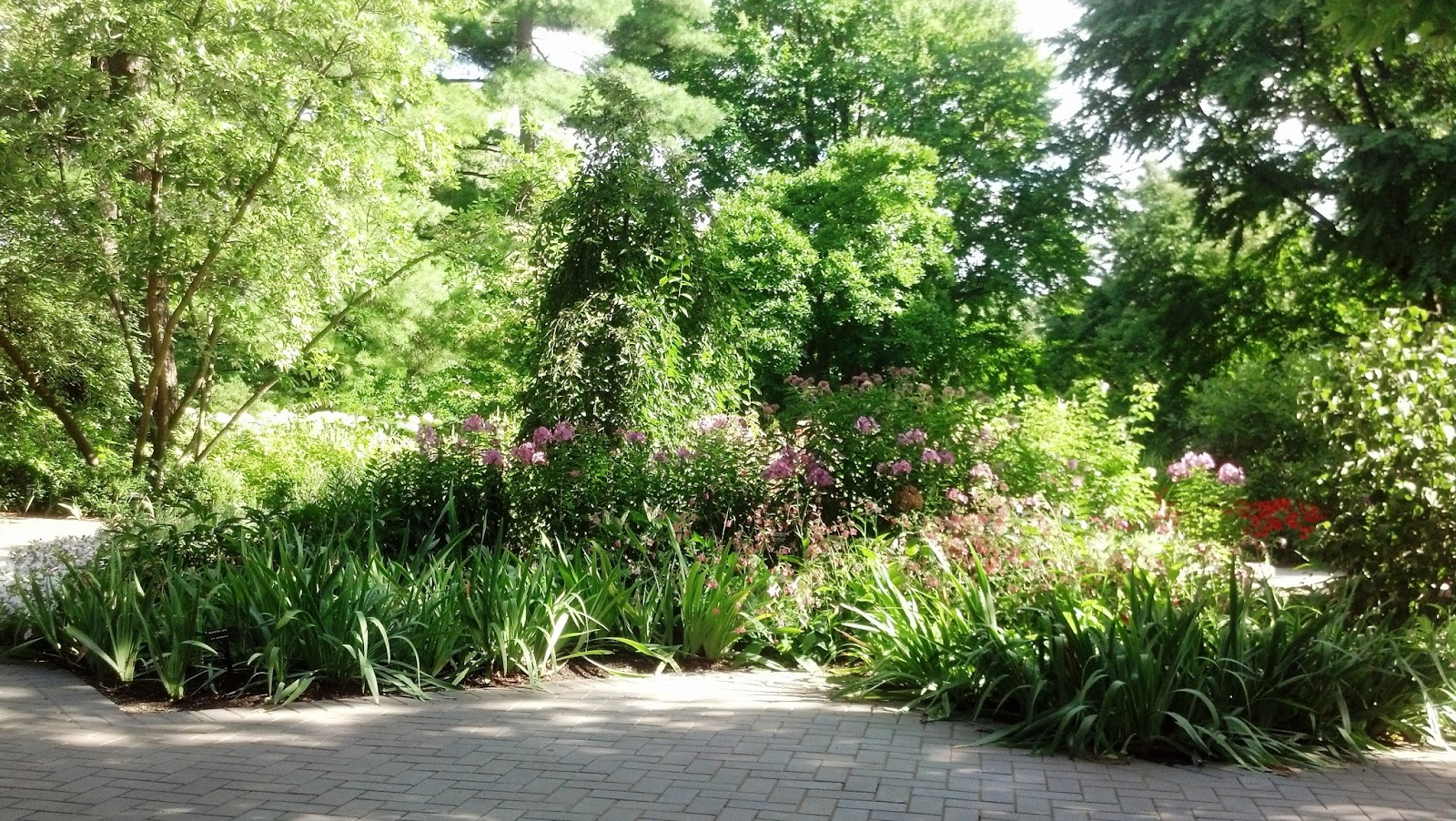
The weather Monday was spectacular.  The sun was out there was a gentle breeze and the temperature was only in the high 70s.  For Illinois at the end of July this is heaven!  As a result I grabbed my dinner and when the the arboretum to enjoy the outdoors.  After eating I strolled the area and stumbled across the Fragrance Garden.  Located a the north end of Joy Path, this quiet little oasis was just the perfect spot to stop. I did not have my camera with me, so these images were taken with my camera on my phone.

There are several benches and resting areas and frog pond mixed in among the plantings.


This was the view from one of the shaded benches.  I liked the fact that this garden had a number of herbal plantings.  The flowers were mostly spent so I did not find much fragrance in a overcome your senses sort of way, but the bees and the butterflies were everywhere!

I loved the overall look of the bee balm plantings.  There were two clusters a traditional scarlet and a pink.
Pink Supreme Dwarf Bee Balm

traditional red

If the pink was a dwarf, I wonder what the regular size of this hybrid is, because it was waist high. There were catmints, and creeping thyme and this chive-like plant that I have noticed is all the rage in landscape plantings this year.  I had been wondering about the name and I now know it is: Summer Beauty German Garlic. A Allium variety with a large purple flower head and all the scent of traditional chives.


I wandered the garden slowly on the brick path and took in the view from several different benches.


The most spectacular find for me was this hybrid of Purple cone flower called Salsa Red Sombrero.  It has a flatter shape and an amazing red color I was surprised my camera phone could capture.


This was by far my favorite item and I came back to it several times.  However, I also enjoy a leaf variation too!  And this garden did not disappoint in that aspect either.  They had a dark leafed bugbane and a golden leafed anise hyssop.
Black Negligee Komchatka Bugbane

Golden Jubilee Anise Hyssop

It was an enjoyable hour I spend resting and exploring in the Fragrance Garden at the Morton Arboretum and I suggest if you live nearby you invest in a membership so you can just pop in after a long day and enjoy the nature and the beauty.  
          
                                You never know what you might find...

Like this perfect tiny leaf catmint that I will be adding to my fairy garden next year.
Kit Kat Catmint  (normal leaves left for scale)

Friday, March 9, 2012

Bergamot / Bee Balm - Herb of the Week

A truly American herb, also known as Oswego tea or bee balm, bergamot 
            (Monarda Didyma) is this week's Herb of the Week
Grown and used by Native Americans as a popular tea for both its taste and medicinal properties, Bergamot originally grew in parts of Western New York but now the plant is cultivated in Europe after seeds were sent over in the 1700s by John Bartam. In Europe and England the common name is Golden Melissa or Indian nettle. Although these perennials are used to adorn gardens, because hummingbirds, butterflies and bees are attracted to the fragrance and nectar, the leaves are popularly dried to prepare bergamot tea. In fact, Native American bergamot tea drinkers shared this delectable tea with colonial settlers, who then used it as a substitute when imported tea became scarce after the Boston tea party.

It is known by so many names that it is best to search for it by scientific name Monarda Didyma or just Monarda, but when asking for the plant remember if they do not know Bergamot, ask for Bee Balm the most common name used.
To Grow
Bergamot is identified by its sturdy, square stems shooting to a height of four feet with simple leaves. The leaves are crowned with glorious pink, purple, white or bright red colored flowers. The flowers have petals shaped as spikes, which is what makes them uniquely beautiful. Known as herbaceous perennial, Bergamot has a non-woody stem and will survive the winter, even thought its growth above the ground dies.
The Bergamot plant is indigenous to eastern North America. It grows in early to late summer and attains a height of 2-4 feet. This plant requires good sunshine and grows well under a full sun. It requires moist and well-drained soil for growth. The leaves and even flowers of the Bergamot are used to make tea. This plant belongs to the mint family and its blooms and leaves have a minty fragrance. The plant grows and spreads fast, so it requires lots of space to grow.
For proper Bergamot planting, place in an area where there is partial to full sunshine and good air circulation. The Bergamot should be planted in spring or fall and space of at least 1 to 2 feet should be maintained between each plant, because it spreads very fast. A 12 to 15 inch deep hole should be dug for planting. Mix some compost with the soil removed, then place the plant in the hole, cover lightly with soil and water enough to moisten the soil. Do not over water. Use the 10-10-10 garden fertilizers in small amounts to nourish the plant, if needed.
It is important to provide the Bergamot with plenty of space to grow and spread. It can self-seed and spread by underground stems, like any good Mint.  Being from the mint family it is invasive and will spread to occupy every little space nearby. Many people plant it in the landscape in areas where other plants do not grow well so it will fill in a sparse landscape.  It is therefore important that the plants be divided every few years, in the spring, in order to prevent them from forming an entangled mess. Apply a layer of compost each spring along with a 2-inch layer of mulch to retain moisture. In the fall, prune the plant down to an inch or two above the ground. While growing Bee Balm, remember that it needs to be protected from powdery mildew. In case it succumbs to powdery mildew, then trim the plant down to the ground surface.
Deadheading can also be done to cause the plant to re-bloom. Deadheading means removing the spent flowers so as to promote fresh flowering. Bergamot starts flowering from July and continues until late fall. In this period, pruning and trimming is very important to facilitate healthy flowering. Clean off the dead flowers and dried leaves regularly. Once the growth of the plant starts to slow down, cut the plants back to ground almost to 6 inches.
Bergamot can be grown in ordinary garden soil or clay soils. But it has been observed that they thrive better in dry alkaline soil. Sunlight is a must to facilitate healthy growth of the plant. Using mulch is recommended as it helps in retaining moisture in the soil thereby preventing soil and reduces the need for watering.
If you want to grow Bergamot in a container, you can prepare a well-drained soil mixture for them to grow in. A mixture of perlite, peat moss, dry compost, vermiculite and some manure for nutrition will be perfect.  Select a place in your garden for the container where there is full sun or partial shade.
Bergamot is very susceptible to powdery mildew, especially the original purple varieties which I believe are the wild versions (M. fistulosa) closest to the Oswego Tea of the Native Americans.  It does have geranoil which helps prevent tooth decay.   But with 30 different Bergamot cultivars available now, you can find those that are resistant to powdery mildew.  ‘Marshall’s Delight’ which is deep pink, and ‘Gardenview Scarlet’ are disease resistant.  If you have a dry, warm climate choose ‘Adam’ which is white or ‘Blue Stocking’ which is violet.  If you, like me, enjoy a lemon flavor, look for Monarda citrodora, lemon bergamot.  If you like something out of the ordinary try Monarda punctata sometimes called spotted bee balm or horsebalm.  It is high in antiseptic compounds and has whorls of cream-colored flowers spotted with purple.

To Use
Apart from their aesthetic value, the Bergamot leaves and flowers are used to make tea. The fragrant oil of the Bergamot is used to treat skin eruptions, rashes and infections. It can also be used for relief from fever, nausea, headaches and sore throat. Also, the pulverized leaves of the plant are used to treat bee stings. That is where the common name Bee balm comes from. Tea can be made from fresh as well as dried leaves. Bergamot tea has even been used to preserve meats and as perfume.

The leaves of bergamot have been used to brew tea for the past 1000 years.  the essential oil is use to flavor Earl Grey tea, so when you drink a bergamot tea you will recognize the flavor as being a kin.  Oswego tea, as the natural brew is known, 
aids in calming down jittery nerves. Herbs like valerian and chamomile are also added to this tea to increase the relaxation effect. Oswego tea is believed to be an appetizing agent that aids in curing digestion disorders. It can also palliate cramps during menstruation and reduce nausea.  Bergamot tea is also great for combating fevers and chills and also increasing urine output. Since this herbal tea contains the aromatic antiseptic thymol (the oil in thyme that kills germs), it is commonly used by dentists and modern medical practitioners.Therapeutic baths also use bergamot leaves as it is an aromatic herbaceous plant. Just pluck a handful of leaves and tie them in a cloth. Place it in your hot water bath and enjoy the scented water! At times, breathing in the aromatic steam of bergamot leaves aids in relieving throat afflictions like cough and sore throat. Ointments made of bergamot are also used for healing minor insect stings, cold sores and acne.
In cooking, bergamot is used as a pot herb for seasoning and flavoring food items.  it is especially good with sweet dishes like fruits and salads, but is also good in sauces and rubs for meats and poultry. The flowers are edible and used for garnishing yummy vegetable salads!

Recipes

Bergamot Tea
Preparing bergamot tea is quite simple. Just take a cup of boiling water and pour it onto the bergamot herb. The tea can be prepared from the fresh form, dried form or even the seeds of the herb. Depending on the form used, the recipe will vary slightly. If you are using the fresh plant material, one needs to add ¼ cup of the fresh material to a cup of boiling water and allow it to stand for 5 minutes before straining and drinking it. For all the forms the procedure is the same, with the only difference lying in the quantity of herb form added. If you are using the dried leaves or seeds, add only 2 teaspoons of the herb. For leaves steeep 5 minutes for seeds, steep 10 minutes. To enhance the flavor of bergamot tea add honey or fresh lemon juice to the tea.
Cautions: People with menstrual disorders should not drink this tea. Even pregnant women should keep away from this tea. Bergamot tea should not be consumed continuously. always give your body a break from this tea.  Have it for 8-10 days, then stop having it for one week, then resume. However, if you are drinking it to treat cold, flu, sinusitis, etc. you can have it three times a day, but not beyond four days. Having it in moderate amounts will help your body.

Bee Balm Fruit Salad
 
6 Tbls. of sugar (superfine if you have it)
¾ cup water
juice of 2 oranges
bee balm leaves
1 cup black currents (or blackberries)
2 cups strawberries, hulled
2 cups raspberries, hulled
bee balm flowers (to decorate)
scented geranium leaves (to decorate)

Put the sugar, water, orange juice and bee balm leaves in a pan over low heat.  Stir occasionally until the sugar is dissolved, then bring to a boil for five minutes to reduce to a syrup. 

Discard the bee balm leaves, and then add the black currents and return to a boil.  Simmer for 5 minutes.  Remove from heat and set aside to cool

Add strawberries and raspberries to a bowl and pour cooled mixture over them and gently toss to coat.  Decorate with bee balm flowers and scented geranium leaves.

Pork Fillets with Bergamot Sauce
(serves 2)

2 large pork filets
5 Tbls. butter
2 shallots, finely chopped
2 ½ Tbls. flour
½ cup chicken or pork stock
4 Tbls. dry white wine
3 ½ Tbls. chopped bergamot leaves
salt & pepper to taste
1 Tbls. double cream

Preheat over to 400 degrees.  Wash the pork filets.  Pat dry and season with salt and pepper and smear with half the butter.  Roast in a shallow greased baking pan for 25 minutes.  Allow to rest 5 minutes before slicing.  Arrange slices on a warmed serving dish.  Prepare the sauce while the fillets are in the oven.  Sweat the shallots in half the butter until soft.  Stir in the flour and cook for about 1 minutes stirring all the time.  Whisk in the stock.  Simmer until it thickens, stirring occasionally.  Then slowly add the wine and 3 Tbls. of chopped bergamot.  Simmer for several minutes then season to taste.  Remove from heat and stir in cream, pour over pork slices and garnish with remaining chopped bergamot.  Great served with mashed potatoes and broccoli.
Related Posts Plugin for WordPress, Blogger...