I'm Marcy Lautanen-Raleigh growing herbs is a passion I've had for more than 20 years now. Backyard Patch Herbs is my own herb business started in 1995. I specialize in fresh, amazing, organic blended herbs. Those for cooking, tea and bath -- and they are all home-grown and hand-blended. In the last 20 years I have gained a knowledge of herbs and their flavors that I share here.
A friend sent me an email
with a simple calendula salve recipe .
Her instructions were:
“Macerate your whole
flower tops in good quality EVOO. Just stuff a jar with flowers and then fill
will oil to cover you plant material. Place for 6-8 weeks in a sunny window.
Strain out your plant material and add some beeswax about 1-4 Tbls. to your
strained oil. Gently heat to melt the beeswax and pour into containers. Easy
simple calendula salve. Good for wrinkles too! Linda Thistledown Farm”
Now I know this is not the
kind of detail I give on the blog so I worked out the details for you.
I made my calendula oil by
harvesting the flower heads of my plants a few at a time. I started with about
5 of 6 flowers and poured 8 ounces of almond oil over top in a mason jar. In future I would use grapeseed oil or coconut oil as almond can go rancid.
As weeks passed I added
more flowers. I chose those of the best
quality that were at the peak of pretty. I harvested them in the morning before the
oils were evaporated from the petals.
Some were yellow and some
were orange as you can see it gives the oil a rusty color.
Once I was happy with the
quality of the oil (about 8 to 10 weeks, I think.)
I strained it and placed it
in the top of my double boiler.
I then grated about 6
ounces of bees wax. Well I should be
honest I cut up about 3 ounces and grated about 3 ounces, because I knew I
would need at least 3 ounces to make the salve. I could start with the large chunks and add the grated to get the thickening I desired.
I added the
grated wax a bit at a time to get the perfect consistency. Once the beeswax was
melted I let the mixture cool to see if it would create the solid that I
wanted. I ladled out a small amount into a cup and let it set up.
I found it to be the hardness I wanted, yet still soft and easy to spread om the skin. I then added this to the double boiler and remelted it, added just a bit more wax and poured it into containers.
I use this salve for
myself. It is great for my rosacea. Calendula is a perfect herb for the Zodiac sign of Leo so I also include the salve in the Zodiac Box for Leo.
Here is the final recipe:
Dozens of fresh calendula
flowers free of bugs and blemishes
8 oz. almond or olive oil
4 ounces beeswax
Steep the flowers (all at once or over time) in the oil for 4 to 8 weeks. Once the oil is well infused with the flowers, strain it to remove the flower particulates. Grate the beeswax. Place the oil in the top of a double boiler and simmer (do not boil) of the heated water adding the grated beeswax and stirring until it is melted. Use about 4 to 6 ounces of beeswax per 8 ounces of oil. Once the wax is all melted remove the boiler top form the water and allow to cool for 5 to 10 minutes. check the mixture for consistency and texture. Be aware salves are subject to humidity and other environmental conditions so you will need to adjust the amount of beeswax accordingly. If you are satisfied with the texture return the double boiler to the water and allow it to remelt, then while warm pour into containers. All to cool completely before putting a cover on the containers.
Working in the dirt is very drying.I wear gloves when I garden, but that does not keep the dry effects away.I always wash carefully when I come in the house and then put on a moisturizing salve or lotion.
I like to make one with herbs for use in the summer.The first step is to make an infused oil to prepare the salve from. I gave instructions for that in a previous blog post in September 2012 (Making Infused Herbal Oils.)For this salve I recommend making the infused oil with a savory herb like thyme, lemon grass or oregano for the earthy scent and the germ fighting abilities.(Never forget that many germs exist in the soil.)
To make a simple salve, grate up some beeswax and add it to hot infused oil, stirring continuously until it melts. (About 1ounce beeswax to 8 fluid ounces of oil)
Test on the back of a wooden spoon to see whether it is of a suitable consistency.That means stir the spoon down into the melted wax and oil, then draw it up and turn it over.As the mixture cools it will harden.See if this is the texture you want.If it is rough and hard add more oil, if it is runny and slick add a bit more beeswax.Sometimes the humidity of the day will affect the consistence so do not be afraid to make adjustments. If you are not confident to do the spoon test, an easier way of checking is to drop a very small amount of oil plus melted wax into cold water in a small bowl or mug. The salve will immediately cool and you can rub it between your fingers to check the desired thickness.
Once you are happy, pour the mixture into small jars and seal. The salve will thicken on cooling, usually from the bottom upwards if you pour into cold jars. It will usually be a paler color than the original oil.
To make a moisturizing salve use oils which have an affinity with the skin such as calendula and add violet leaf or marshmallow oil to add moisture. If you want the salve to have a strong scent, add 1-4 drops of your favorite essential oil per fluid oz of oil, but do not do this if the salve may be used by a young child.
You can experiment with adding honey or lanolin to your salve to give it extra softness.
Tomorrow is National Weed Day, so in celebration, I decided to make the
Herb of the Week Chickweed (Stellaria media)
common chickweed to be exact.
This cool-season annual herb started out as a weed in Europe and has been naturalized worldwide. It is so named because it is a favorite food of chickens. Chickweed is an annual, meaning that the plant's life span is over in one year, and the plants for the next year come from seeds, either self-seeded by the plant or sewn in by the gardener.
Chickweeds are an annual herb, widespread in temperate zones, arctic zones, and throughout their place of origin – Europe. Chickweeds have established themselves all over the world, possibly carried on the clothes and shoes of explorers. They are as numerous in species as they are in region. Most are succulent and have white flowers, and all with practically the same edible and medicinal values. They all exhibit a very interesting trait, (they sleep) termed the 'Sleep of Plants,' every night the leaves fold over the tender buds and the new shoots.
To Grow
Chickweed grows from 3 to 8 inches high, and the plants will mat together and grow to about 16 inches long. The leaves, which have smooth edges, are no more than 1 inch long and can be as short as ½ inch and always grow in pairs, directly opposite each other on the stem. The stem itself is not smooth, having fine hairs covering the entire length. The flowers themselves are petite, measuring just 1/8 inch across. They are white with five petals, giving them a star shape. Directly under the flower petals are five sepals, which look like leaves, and grow as long as the petals.
There are a few different types of chickweed, each one with its own modification on the general features, and all of them are edible. Common chickweed has leaves with stalks, star chickweed has leaves without stalks, and mouse-ear chickweed has coarse hairs.
To Use
The cultivation of this her (weed) is not really necessary as it can be found abundantly in the wild.One can gather fresh edible plant between May and July, as soon as flowers appear, it can be used fresh or be dried for later herb use.
Common chickweed as well as star chickweed can be eaten raw in salads or cooked just like spinach, for about five minutes. Mouse hair chickweed is a bit tough to eat raw. It has to be cooked. Chickweed is an excellent source of vitamins and minerals including A, D, B complex, C, rutin. iron, calcium, potassium, phosphorus, zinc, manganese, sodium, copper, and silica.
Chickweeds are Medicinal and edible, they are very nutritious, high in vitamins and minerals, can be added to salads or cooked as a pot herb, tasting somewhat like spinach. The major plant constituents in Chickweed are Ascorbic-acid, Beta-carotene, Calcium, Coumarins (blood thinners), Flavonoids, Magnesium, Niacin, Oleic-acid, Potassium, Riboflavin, Selenium, Thiamin, and Zinc.
The whole plant is used in alternative medicine as an astringent, carminative, demulcent, diuretic, expectorant, and laxative. A decoction of the whole plant is taken internally as a post-partum tonic. It is also used to relieve constipation; an infusion of the dried herb is used in coughs and hoarseness, and is beneficial in the treatment of kidney complaints.New research indicates its use as an effective antihistamine. The decoction is also used externally to treat rheumatic pains, wounds and ulcers. It can be applied as a medicinal poultice and will relieve any kind of roseola and is effective wherever there are fragile superficial veins or itching skin conditions.I plan to make a salve with it this spring to see if it is effective on my rosacea.
Historically, Chickweed water is an old wives' remedy for obesity. The plant has medicinal purposes and is used in folk medicine. It has been used as a remedy to treat itchy skin conditions and pulmonary diseases. 17th century herbalist John Gerard recommended it as a remedy for mange. Modern herbalists mainly prescribe it for skin diseases, and also for bronchitis, rheumatic pains, arthritis and period pain. A poultice of chickweed can be applied to cuts, burns and bruises. Not all of these uses are supported by scientific evidence.
Problems
Be careful when picking chickweed. There are poisonous plants that grow the same way, but have different features. Spotted Spurge trails along the ground and has the same leaf characteristics, but has different flowers, and if you break the stem, you will get a milky sap. Matted doorweed, also known as oval-leaf knotweed, also trails along the ground, but the leaves are not opposite one another--they alternate up the stem one by one.
Put chickweed and comfrey powder into sweet olive oil and simmer 3 hours. Strain and add beeswax to warm oil. Stir until wax dissolves. Pour into salve jars or tins. If you want a thin consistency (such as a cream or Vaseline ) add only a little bit of Beeswax. Want it thicker like wax? Just add more Beeswax.
Allow the base to cool down to see what the consistency is like. If it's too thick, add more oil and reheat, too thin, add more Beeswax.
Mix together chickweed, wormwood powder, add the mixed herbs to sweet olive oil and simmer 3 hours. Strain and add beeswax to warm oil. Stir until wax dissolves, then add Tea Tree Oil. Pour into salve jars or tins.
TRAVELER'S JOY SALAD
If you are out in the wild or have a large yard, it is possible to gather many of these salad ingredients from the landscape. (I think I originally found this recipe at Learning Herbs.com – but the citation is lost)
3 cups purslane, chopped
1 hard-boiled egg, sliced
1/2 cup amaranth leaves
1/4 cup cheddar cheese (or other cheese), diced into small bits
1/2 onion
1 cup chickweed
1 ripe avocado
1 teaspoon garlic salt
Juice of 1/2 lemon
Chop the purslane, chickweed, amaranth, and onion into bite sized bits. Add the avocado, peeled and diced. Add one hard-boiled egg, sliced. Mix in approximately 1/4 cup of cheddar cheese which has been cut into small bits. Squeeze the lemon over the salad, add the garlic salt, and mix well. If you have them, you can add chia seeds and one tablespoon of mayonnaise.
Flashes Blend Tea
I got this recipe from a friend who swore by Chickweed’s menopausal and post partum treatment qualities.
1 part sage 1 part motherwort 1 part dandelion 1 part chickweed & violet leaves 1 part each elder flowers & oatstraw
Brew with 1 to 2 tsp. per cup of hot water. Brew up a pot and sip when needed.
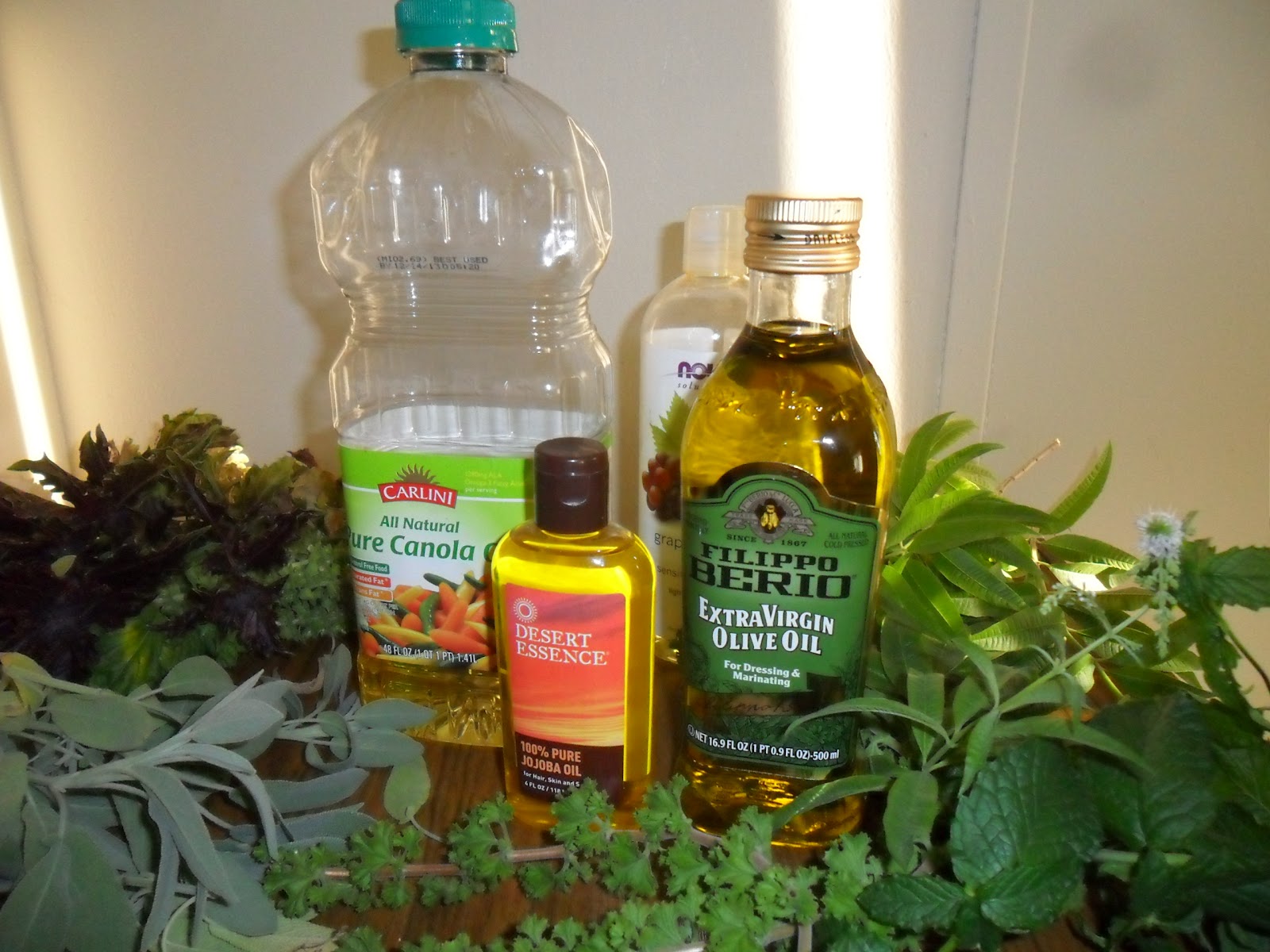
Herb infused oils are used to make scented salves and beauty products and sometimes to cook with. I have shared making Lemon Cooking oil on the blog previously. This time I want to explain how to make an herb infused oil for making a salve. I share this now because we are entering the gift making season and I will be sharing a few recipes for salves and toners and creams and other beauty gifts in the coming months. I wanted you to have this base of information to work with.
Oils, unlike vinegar will not keep indefinitely, so you must use a preservative, like alcohol or another stabilizer to keep the oil from going rancid.
To Make Herb-infused oil for a salve
Infused-Herb Oil
What you’ll need: oil of your choice (almond, jojoba, grape seed, olive oil can all be used), wide-mouth jar, herbs of your choice, 190-proof alcohol
Use a ½ pint wide-mouth jar for this size recipe.Add about ¾ cup herb of your choice (washed, chopped and air dried until they are wilty), to that add about ¾ cup oil, ore more as needed to cover the herbs entirely, but leave about 1 to 2 inches of headroom at the top of the jar.Insert a butter knife into the jar and run it around the edge to dislodge any air bubbles.Make sure the oil covers the herbs completely.Then to prevent mold float about a ½ inch of 190-proof alcohol on top.Put a tight fitting lid on top and shake the alcohol into the oil.Remove the lid and replace with four layers of cheese cloth, help in place with a rubber band or jar lid rim.Place in a warm dry spot for about 2 weeks or until oil has taken the color of the herbs and the oil has evaporated.Then strain the oil from the jar pressing as much of it out of the herbs as possible.Let the oil sit overnight.Decant it to separate it from any sediment or water that will settle to the bottom.A turkey baster can be helpful in doing this.
Salve from herb-infused oil
What you’ll need: a double boiler, beeswax, 8 liquid ounces of herb oil, enrichers of your choice can also be added like vitamin E, lanolin, cocoa butter, coconut oil, etc. depending on your skin type.
Gently warm 8 ounces of herb oil ion a glass or stainless double boiler.Add 1 Tablespoon of beeswax; add small amounts of other enriching ingredients about ½ teaspoon at a time.When the ingredients are all melt together, you check the consistency by dropping a few drops in ice water.If the salve is thick in will form a little ball, if thin it will spread out over the top of the water.Simply add ¼ teaspoon of beeswax at a time to firm it up or a bit more herb oil to thin it down.While liquid pour it into a container.Let it sit to cool.If when it sets it is not the firmness you like, you can reheat it and add materials until you adjust it to your desires.
Sweet Dream Balm (adapted from Rosemary Gladstar's recipes) Rub on temples at night for sweet dreams. Great for children!
1/2 cup Borage Flowers 1/4 cup Chamomile Flowers 1/4 cup Rose buds 1/4 cup Hops 1/4 cup Mugwort 4 cups Olive Oil 4 oz. Beeswax 50 drops Lavender Essential oil
20 drops Chamomile Essential oil.
To begin your salve, measure the herbs into an enamel, glass or stainless steel pan (never use aluminum), or into a crock-pot. Cover the herbs with oil. Heat the herbs and oil over a low heat for several hours (about 3 hours). If you are using roots you should heat the oil longer (about 5 hours). Do not fry the herbs, and keep the vessel covered to retain all the wonderful medicinal qualities of the herbs. After the oil is infused, strain the herbs through a cloth. When most of the oil has filtered through the cloth, squeeze as much oil as possible from the herbs and cloth. Be careful not to burn yourself in this process! Measure the infused oil to ascertain the amount of beeswax needed to make the balm. You need about 1 oz. beeswax for each cup of oil.
Pour the oil into a clean pot, add beeswax to the oil and heat it until all the wax is melted. To test to see if your salve is firm enough, put some on a spoon and set it in the freezer for a few minutes. If your salve is too soft, add more beeswax. If the salve is too thick, you can add a bit more oil to soften it. If you are using essential oils or Vitamin E you can blend them in now. Finally, pour your salve into containers and label.
Let's face it. The turn in the weather here this week from mild to very cold has certainly chapped my skin.And the over heated office I work in has taken its toll as well. But herbs can help to heal both body and spirit. And there's something especially healing in a soothing product you've made yourself, with all-natural ingredients.
So today’s Herb of the Week is Calendula (Calendula officinalis), one of the top skin healing herbs.
Tonight I am presenting a program on Bath and Beauty which focuses on aromatherapy to lift your spirits and soothing treatments for winter harried skin.I thought I would share a couple of the calendula-centered recipes I put together for this program as well as help you in a decision to include this great herb in your garden this year.
History
The name Calendula came from the ancient Romans for the fact that it bloomed on or around the first day of the month or calends.Although more popular for its color and attractive flowers rather than its medicinal properties it was featured in the Doctrine of Signatures (the principal that an herb's physical characteristics are a clue to its usefulness) as a treatment of jaundice.Nicolas Culpepper stated it was a good herb to strengthen the heart.
Calendula came to the Americas with European settlers.It was prominently used during the Civil War as a treatment for healing wounds and halting bleeding.
To Grow
Calendula is a cheery, dependable blooming flower in the marigold family (not to be confused with scented marigolds in the family Tagetes.) They have semi strong upright branching stems with medium green leaves covered with tiny hairs.The flowers are round many petal daisy-like poms that come in shades from yellow to deep orange.They will bloom from midsummer until after frost.The flowers close at dusk.It is said if the flowers open fully in the morning the weather will be pleasant, if they do not, weather will be less seasonal.
This is a plant easily grown from seed and can be grown in all zones.Fresh seed is essential however, because the seed viability is only one year.The seeds are curvy crescent shapes covered with ridges.Harvesting seed yourself is great but you must use them in the next growing season.You can sow the seed directly into the garden once the soil has reached about 60 degrees.On a nice sunny day in April or May this is a great early garden activity.You can also start them indoors planting them out after the chance of frost has passed. Thin the plants to inches and keep them weed free, but beyond this no special treatment is needed to grow them.They are a hardy annual plant and will survive frosts and even early snow.They prefer a cooler climate and bloom best in fall weather.Once the temperature reaches 25 degrees their season will end.If you put seeds in pots in July you can enjoy them along with your mums for fall color.
The plants will grow 12 to 18 inches tall depending on conditions.They are also a great container plant and keep to inches in window boxes and patio planters.They will grow in just about any soil that is well drained.They react badly to dampness.They do prefer a sunny location. Calendula is considered a companion plant as it can draw aphids away from other plants, but you will need to watch for an infestation.
Susceptible to all the normal pests of the garden, they will develop powdery mildew if not properly thinned.To keep them blooming, make sure they are well watered and clip of the spent flower heads.Since I harvest the flower heads, just as they reach full bloom, I know I will always have a new crop of buds to take their place.
To Use
Pinch off the flower heads from the stem and lay them flat to dry.Once they are dry you must place them in a dark jar with a tight fitting lid to preserve the color of the petals.The flowers are hygroscopic meaning they are easily affected by humidity.Some suggest pulling each petal off the flower, but I have never had the patience to do that before drying and am still satisfied with the color and quality of my dried calendula.
Historically a woman who could not choose between two suitors was advised to make a fine powder of dried calendula flowers, marjoram, thyme and wormwood simmer them in honey and white wine then rub the mixture over her body. Then she must lie down and repeat “St. Luke, St. Luke be kind to me: In my dreams let me my true love see!”I just had to share that because it is February!
As an edible flower, the most common early uses for Calendula were in cooking.In England it was tossed into dishes so often you might think it was a vegetable.It was especially popular for flavor when stewing lark or sparrow according to the Elizabethan cookbook of John Gerard. Other dishes including Calendula pudding, Calendula oatmeal, and calendula dumplings were also created.There were even recipes for calendula wine (see below).It is great as a coloring in rice dishes, and the leaves can be used in salads.Add the petals to soups, stews and fish dishes.
Tinctures of the flowers have been recommended for the treatment of a wide variety of ailments including amenorrhea, cramps, toothaches, fever, flu, and stomach aches.As a general tonic it has been known to induce sweating in a fever and increase urination and aid digestion. Calendula has also been extensively used as an external remedy for sores, cuts, bruises, burns and rashes.You can make a quick and easy ointment by crushing fresh flower petals and mixing them with olive oil.A personal powder can be made by grinding dried flowers and blending them with arrowroot powder, cornstarch or talc.I will often pluck a flower and rub it on a bee sting to relieve the pain and itching with good results.
Calendula has a strong yellow / orange color and the petals can often be substituted for saffron in a recipe.I grid them, then stir them in when I want a rich yellow color in my lemon herbal butter.
More recently with the advent of home making of remedies and cosmetics, Calendula has found a new niche.In addition to the yellow color it can impart to lotions and salves it is also great for skin.An antiseptic with anti-fungal and anti-bacterial properties it can promote healing.The essential oils in the petals are an excellent skin healer, especially for cracked skin and chapped lips.A poultice on burns or stings is very use useful.Salves with calendula can be used for the treatment of varicose veins, chilblains and impetigo.A cold infusion (tea) can be used as eyewash for Pink Eye (Conjunctivitis.)The sap in the stem has a reputation for removing warts, corns and calluses, which is why an infusion of the leaves, stems and flowers is used to make soothing lotions and creams for dry rough skin.
Put the butter sugar, eggs and sifted flour and baking powder into a bowl and mix until smooth and glossy.Fold in 1 ½ Tbls. calendula petals.Turn the mixture into greased or paper lined muffin tins and sprinkle with remaining petals.Bake in a warm over 325 degrees for 25 to 30 minutes.
Calendula Wine
2 quarts of Calendula officinalis flowers
1 gallon boiling water
1 Campden tablet, crushed (sterilizer available from a wine making store)
3 tangerines, juice and thinly pared peel from each
1 lemon, juice and thinly pared peel
5 ¾ cups sugar
1 ¼ cups white raisins, finely chopped
wine yeast
yeast nutrient
Directions:
1.Wash the flowers and put into a large container with a lid.Pour over the boiling water and stir in the Campden tablet and leave for 24 hours.
2.Place the sugar in a large bowl.Draw off 1 cup of the liquid and heat it to just before boiling with the citrus peel, then pour over the sugar.Leave to cool to body temperature (rather than room temperature.)Then pour back into the bulk of the liquid adding the raisins citrus juice, yeast and nutrient.Cover and leave in a warm place for 5 days to ferment, stirring twice a day.
3.Strain the liquid through a double thickness of muslin.Pour into a fermenting jar, fitted with a fermentation lock and leave to continue fermenting.
4.Rack the wine as it begins to clear.
5.When the wine is completely clear, bottle and store in a cool dark place for at least 6 months to mature.
Calendula Cleanser
4 Tbls. olive or almond oil
2 Tbls. dried calendula flowers
few drops of violet, orange blossom or rose water
Directions:
Warm the oil in a bowl placed over a saucepan of hot water.Stir in the dried flowers and continue to heat gently for 30 minutes.Remove the bowl from the heat and allow to cool.Stir in the flower water.Bottle
Directions for use: swear a small amount onto face and rinse with warm water.Keep refrigerated and use within 10 days.
Facial Mask Calendula and chamomile have long been used as skin softeners, and aloe is a proven healer. Use the gel from your own aloe or purchase from the drugstore. Here's a soothing treatment for winter-worn faces, suitable for all skin types. The essential oils—you can choose from several, with different effects—provide a subtle aromatherapy, lifting and soothing your spirits, while the herbs and almond meal do their work.
2 tablespoons almond meal (almonds ground very fine)* 1 tablespoon powdered calendula 1 tablespoon powdered chamomile about half of a raw egg, yolk and white beaten together aloe gel, enough to make a paste 2 drops chamomile essential oil, or oil of your choice
Mix the almond meal and herbs together. Add enough aloe gel and egg to make a paste. Add essential oil. If the paste is too thin, add more almond meal; if it’s too thick, add a bit of aloe gel or egg. To use, wash your face. Pat dry, and apply the mask. Leave on for 10 minutes or so, while you’re lying down, then wash off gently. Refrigerate for up to a week. (This will make 3-4 masks.) Follow the mask with a gentle moisturizer.
*Almond meal and almond oil are recommended for cosmetics because both are superior moisturizing and softening agents. If you are allergic to nuts, or intend to make the cosmetic as a gift for a friend, you may substitute oatmeal (oat flakes ground fine) and a non-nut oil of your choice.