Showing posts with label Edible Herbs. Show all posts

Thursday, April 18, 2019

Visiting the Klehm Botanic Garden - National Garden Month Series

Just so you don't think I have only visited gardens in Indiana I thought today I would explain a garden I visited back in 2013 right here in my home state of Illinois.

I was using my first digital camera that had useful pixels that actually took photos that look good posted anywhere.  Before that the images are so grainy from my 3 or 5 pixel cameras, that I am embarrassed to share most of them.


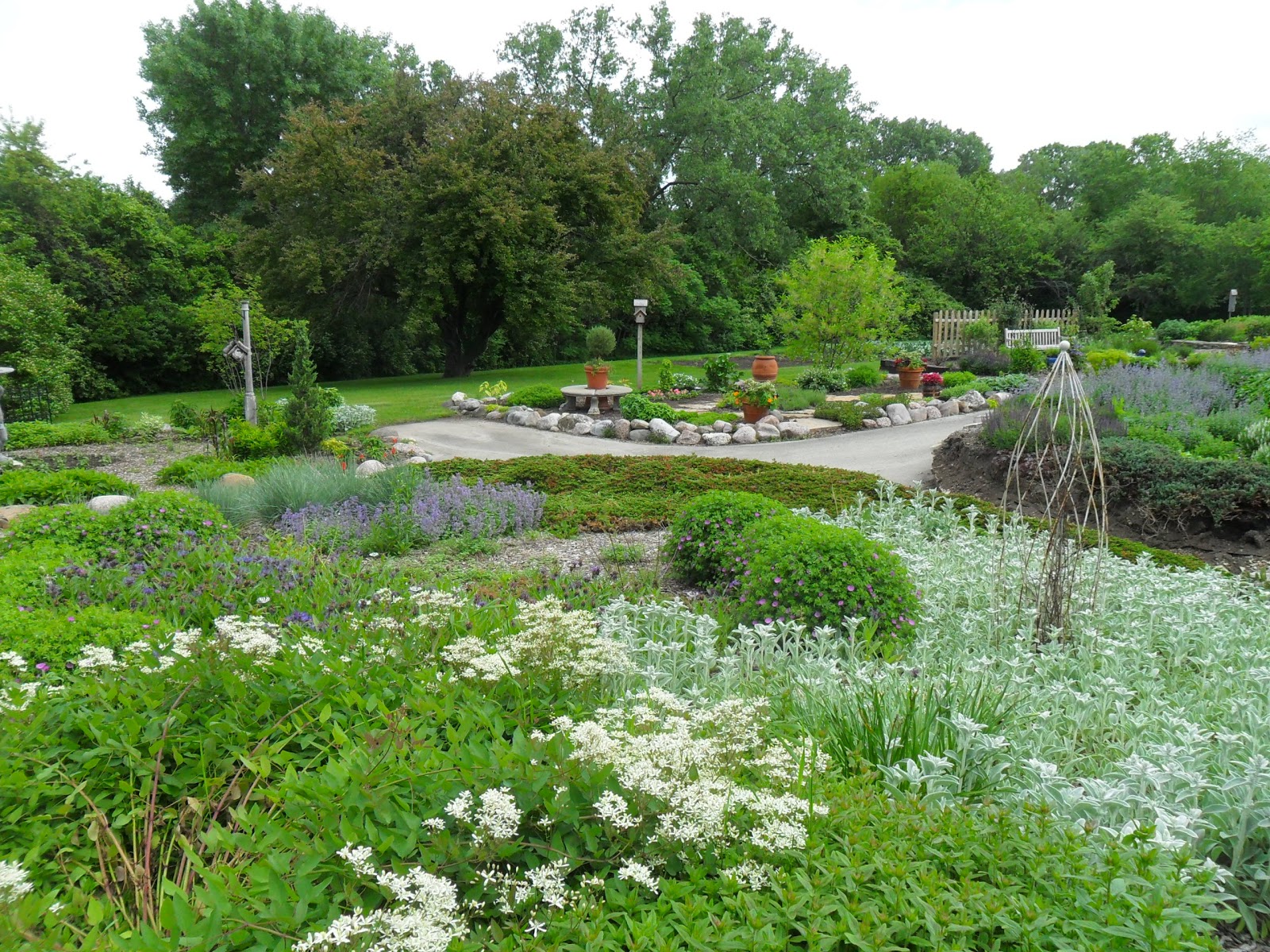
This is the Klehm Arboretum and Botanic Garden located in Rockford, Illinois.  We stopped by on an early June day back in 2013 when the weather was balmy and sunny and the plants were just hitting their late spring flush. We were out on a road trip to enjoy the lovely day and stopped by when we saw the sign.

I was fascinated with the Children's garden that is dotted with fun interactive ideas and bright colors. I think A to Z gardens are such fun, you often find them in Children's gardens, but as an adult I love the organization of them and the choices the gardeners use for each letter often takes me on fun adventures.

I took way too many photos of the A to Z garden, so I will just share the end of the alphabet with my favorite flower - Zinnia!  If you want to see the details, check out my post from 2013.


A tower in the Children's garden area allowed us to get a bird's eye view of all the fun. They also had a human sized sundial which worked perfectly on that sunny day to tell the correct time of 10:00 AM.


We also enjoyed strolling the Rhododendron and Azalea Dell


and visiting the Demonstration Gardens gave me lovely landscaping ideas.


There was a maze -- love a good maze.


A number of flowering and ornamental trees were also part of the experiences in the arboretum.  Here is hubby pointing at -- I have no idea.


We were there on bring your dog to the arboretum day and we got a lot of comments from visitors asking where our dog was and joked with a couple about being the only folks there without one on that day.
The entrance to the Arboretum with the fountains is really striking and a great wedding venue.  The admission is reasonable and they do have a reciprocal program if you are a member of another arboretum.


fountain 03garden
This photo courtesy of the Klehm Arboretum and Garden

We just had a wonderful experience walking through the place and catching all the lovely touches they have included in the landscape. Like these edible flowers!


So if you are traveling though northern Illinois, visit the Klehm Arboretum and Garden located at 2715 S. Main Street in Rockford, Illinois.

The next garden in the National Garden Month post is here.

Tuesday, May 2, 2017

Edibles in your Garden Landscape


Most gardens today are solely ornamental and many of the ones that are edible are tucked into hidden corners of back yards, valued solely for their contribution to the pantry. Before herb gardens and vegetable gardens were relegated to their own spaces, kitchen gardens, cottage gardens, and landscapes around homes were filled plants that were as beautiful as they were useful.

Fortunately, edible landscaping is making a comeback, with more home gardeners choosing to plant attractive edibles that are easy on the eye as well as the dinner plate. A productive, functional and beautiful landscape can be grown on any scale and is especially useful when gardening in a limited space. 

Consider adding a few edibles to your garden from the Garden Club of Villa Park Plant Sale (May 12 & 13, 2017 -  320 E Wildwood, Villa Park, IL)  You can get details and pre-order forms on their website: www.homegardening.org. 

Here are a few basic ideas to get your edibles mixed into your garden landscape:

Height and Depth: pairing together edibles of varying heights in one bed or area creates an interesting look similar to wilder-inclined flower beds. Most vegetables prefer a full day of sun, but some can tolerate 4 to 6 hours of sun.  Any greens and cool-weather loving edibles enjoy the relief of some shade in the hottest parts of the year, so consider interplanting them with taller sun-loving vegetables and edible flowers or herbs. For example, the handsome Spotted Trout Lettuce can be planted under Ping Pong Tomatoes for contrasting colors, depth, height, and a one-stop salad harvest. African Crackerjack Marigolds (a very tall variety) can serve as a backdrop for a row of alternating Red Russian Kale and Purple Vienna Kolhrabi, with Arugula or Spinach interplanted between the brassicas – for a rich landscape of orange, red, purple, and deep green.

In extra cramped quarters, the same effects can be achieved within one pot. For example, Nasturtiums (edible flowers with a peppery kick) can serve as a “groundcover,” draping over the side of a tall container, with one Rainbow Chard and Tom Thumb Pea plant growing up from the center of the pot.


Succession sowing is also a useful tool both for food production and for growing an edible landscape. For example, radishes – a quickly maturing crop -- can be interplanted with Red Express Cabbage – a pretty, petite cabbage that matures quickly, for a cabbage. Sunflowers can be added to complete the trio, which will eventually grow tall enough to shade out the entire area, but not before the radishes and cabbages are ready to be harvested.  You can also use succession planting to give a continuous crop for herbs like dill or cilantro which can form seed rather quickly eliminating the ability to harvest the tasty leaves.

Colorful Contrast: Simply planting your go-to vegetables in a new formation creates a beautiful, new landscape. Planting Purple Peacock Broccoli and Cauliflower in one block will make for a snow white and rich purple/green checkerboard. Grouping a variety of colorful flowers and vegetables in a cluster instead of a row will automatically bring aesthetic interest to a corner of your garden.


The easiest way to create colorful contrast is to let some of your edible plantings go to seed! Not only will you end season with your very own seed bank, but ordinary plants will assume beautiful, new forms: lettuces, for example, will grow tall and bloom like clusters of tiny dandelions; leeks will shoot out one long stalk with a giant, lavender-hued, globe-shaped blossom.

Choose unusual varieties of usual vegetables in the interest of color, nutrition, and flavor. Merlot Lettuce is merlot colored, Lemon Cucumbers are lemon colored, and Rainbow Chard, yes – also true to its name – comes with stalks in varying colors.
 
purple basil in the center pot,
 edible and color coordinated

Substitute: Another helpful way to think about edible landscapes is to substitute edible varieties for each role you want a plant to serve in the garden. Want a vine to climb up the back fence? How about peas, followed by pole beans: they have beautiful flowers and foliage and also produce delicious pods. Looking for a petite tuft of grass to edge your pathway? How about chives instead – a hardy, perennial with great flavor and attractive magenta blooms. Thyme works great not only as an indispensable seasoning, but as a groundcover too, especially in between a stone pathway. Purple Basil can substitute for a coleus and has the same burgundy foliage.  Adding edible flowers to the flower garden can give you double duty. Chamomile and feverfew look like small daisies; Borage, bachelor Buttons, Love-in-a-Mist can all be eaten; Nasturtiums are well known for the peppery flavor of the leaves and the flowers. And pansies and calendula are also edible.

Tuesday, April 18, 2017

Growing Herbs in Containers - Tips for success

For the past several posts I have shared how to choose, design and plant containers.  This is a wrap up of tips to successful container gardening.

Tricks for a Successful Container Garden
ü  Don't fill a large container in the wrong place: Ever tried to lift a large container garden filled with dirt and plants? It can be overwhelmingly heavy. When using a large or unwieldy container make sure to place your pot where it will live and then fill it – you’ll save your back! 

ü  Make a large container lighter: If you know you are planting shallow rooted plants in a very large container (for example, herbs, annuals, succulents), you can fill the bottom third with empty plastic bottles and cover them with plastic screening, or create drainage with Styrofoam peanuts. Not only does this make the container lighter, but also less expensive because you won't need as much potting soil.
 ü  Don't Drown Your Plants: To avoid over-watering your container gardens, use containers that have drainage holes – lots of them.  Also, make sure to read the moisture requirements for your plants and then follow them. Before you water, check if your soil is moist. To do this put your finger into the soil up to your second knuckle. If the soil at your fingertip feels dry, water your plant.

If you do over-water, leaves may turn yellow and fall off, or your plants may get limp. If your soil is too wet, move the container to a dry, breezy spot until it dries out. If you have the room, you can also move your container garden into a garage or sheltered spot to dry it out, particularly if the weather is continuing to be wet.

ü  Don't Under-water: Most container gardens need watering at least once a day in the heat of the summer. Many, especially hanging planters or small containers, need watering even more often because there is less soil to hold moisture. When you water, make sure to really soak your plants – if you just give them a sip, the water will only wet the top layer of soil. Water until you see it coming out of the bottom of your pot.  Lots of people use water crystals but they are expensive and some tests have shown that they aren't particularly effective.

If your plants do dry out, don’t despair; even the most pathetic, limp, plant might revive with a good drink. If the container is small enough, submerge the whole thing in a bucket of water until the air bubbles subside. For a large container take a skewer or stick and gently poke holes deep into the soil to allow water to reach the roots. Then water generously.

ü  Awkward plant to pot ratio: Make sure to consider the proportions of your plants to your container. A large container stuffed with short plants can look stunted. If you need a rule of thumb (and remember that rules are meant to be broken) try to have at least one plant that is as tall as the container. Also try plants that will spill over the sides.

 ü  Don't buy weak or sickly plants: Buying plants at a reputable local nursery is a good place to start in your quest for healthy plants. You have a greater chance of getting plants that are disease and pest free and well cared for than at a big box store. At a nursery, you can often get a wealth of information and advice from knowledgeable staff. Don't be afraid to ask someone to help you pick out a good plant.

ü  Fear of pruning / Trim your herbs: To keep your basil bushy, use it often or clip it back - the more you use the more you'll have (of course within reason). Cut back parsley and dill before it flowers. When your container gardens start looking leggy or ragged, don’t be afraid to cut them back. You may want to put them in an out-of-the-way spot until they re-bound, but chances are they’ll come back healthier and happier with a good haircut.

ü  Keep Like with Like: Make sure that all the plants in your container garden share the same sun, soil and water requirements. You can find out this information from your seed packets or plant labels. Or get a book on annuals, perennials and herbs from the library.

ü  Feed your Containers: Most potting mix has very few of the nutrients that plants require to grow and be healthy so you will need to add those nutrients to the soil. There are many fertilizers to choose from and flowering plants have different needs than vegetables and herbs. In container gardening what nutrients there are in your potting soil are either quickly used by the plants or are washed out with repeated watering. Fertilizing container gardens with flowers regularly is a key to their success. Add a diluted, liquid fertilizer, such as fish emulsion, every couple of weeks. Don't use too much fertilizer with herbs, it can effect the taste of the herbs.

ü  Know when it its okay to say goodbye: After you’ve tried everything, short of mouth-to-mouth resuscitation and your plant still looks dreadful, cut your losses and toss it on the compost pile or in the trash. If only one plant in your container garden is icky, just pull out that plant and replace it.

ü  Don't have unrealistic expectations: Before you make your container gardens, evaluate how you live. Do you travel a lot during the summer? If so, either get self-watering containers, an automatic drip irrigation system, enlist some help to keep your plants healthy and alive while you’re gone or get plants that don't need a lot of water.

ü  Garden how you live. Are you casual or formal? I take a relaxed approach to gardening because it fits well with my personality. I like big overflowing containers with riotous colors and luxuriant blossoms. Some people like neat, well-planned, formal containers.

ü  Give plants protection and environment they need.  Many plants don’t like being whipped by the wind. Big, broad leaves can easily get battered or act like a sail and pull even a big pot right over. Some plants with heavy flowers or fruit, can bend or break delicate stems in a stiff breeze. Conversely, a protected area can act like an oven, retaining heat and cooking plants that don’t like the heat. So choose the location and the plant combination to fit the location your plants will occupy.

Just a few last herb container tips:
1.   Chose containers with trays or get trays and fill them with pebbles.  Herbs do not like to have wet feet, but they also like to have a bit of water to draw on in the heat of the day.  Placing the pot in a tray will keep you from watering twice during the hot days of summer.
2.   Don't let your herbs flower, unless you want to look at rather than eat them.  Herb flavors change when they create flowers, so cut those flower heads off to preserve the best flavors for cooking and tea.
3.   Throughout the growing season pinch back the ends of the branches to promote more branching and the production of more leaves to harvest. 

4.   Check daily for dryness and water when the soil is dry about 1" depth.  Do not overwater and provide good drainage.  To test soil for dryness, poke your finger into the soil: If it feels dry to a depth of one-inch in a 12 inch pot and two inches in a 24” or larger pot, water it.


Friday, April 14, 2017

Growing Herbs in Containers - Planning a Container Garden

Planning a container garden


Where garden space is limited, or where your claim to the great outdoors begins and ends at the balcony or window box, you can create a visual and edible feast with herbs grown in pots and other containers.  Herbs such as bay laurel and rosemary are at their most effective when planted in their own in a container and since both can have a nice long life, placing them in a container lets you bring them indoors come winter.  Other herbs can be planted individually or in larger containers in groups.

rosemary being trained
on a copper frame into a
triangle topiary
This design is something you can do in its entirety or you can pick and choose those parts that will fit in the space you have available.

You can be as simple as a clipped bay or topiary rosemary in a large container flanking the door or a strawberry pot holding a wide variety of plants.


Containers can be the more traditional terra cotta or plastic pots to the more creative and textural stones sinks, barrels or half barrels, wheel barrows, olive oil cans, paint cans, steel tomato cans, wooden crates or hand-crafted hypertuffa containers you can make in any shape you want.


Keep these tips in mind when choosing containers:
1. Shallow containers such as stone sinks, and terracotta or hypertuffa troughs are suited for annual herbs such as sweet basil, dill, chervil, and calendula. 
2. Try to keep annuals and perennials in separate containers so you do not disturb the long-term herbs when you plant or discard the annuals.
3. All containers, regardless of style require adequate drainage holes in the base.  
4. If you are filling a large container, place it in the final position before you fill it, as it will be heavy and hard to move.

To Plan -- 

The easiest way to begin to fill a container is to combine three categories of plants: thriller, filler and spiller.

You want to have a bold, upright, architectural plant; that's the thriller.  It should get your attention.

The filler is the plant with medium height in the pot, or the next step down from the thriller.

The spiller tumbles out of the edge of the container and falls toward the ground.


When considering plants to use as your thrillers, fillers and spillers, think about their texture, fragrance and color combinations. Individually, each plant conveys color, texture, shape, and dazzle. Yet when combined in one container or a grouping of pots, examine how the plants interact with each other. Do certain colors in one plant bring out subtle complementary colors in another? How do the various leaf shapes, sizes and textures carry through the container plantings? Is there an underlying theme that connects all the plants together?

You can accomplish this with one container or a set of containers grouped together.

Thriller
So how do you combine form and function into a fabulous container? Start with your focal point, or thriller. This is the plant that provides architectural structure in the pot. "Thrillers are the big, bold element, so look for shapes that are strong and pronounced," says Steve. Good options for thrillers are elephant ears, cannas and ornamental grasses.  You can add a lemon grass, chives and a thick-leaved scented geranium like ‘Mabel Grey’ too.

Filler
Fillers are the plants in the middle that connect the thrillers to the spillers. Fillers are mounding, billowy plants that you put around the thriller. They disguise the base of the thriller and fill up the pot with neat shapes. Consider using plants of moderate size, such as basil, coleus, pentas and lantana. Small leaf filler would include thyme and variegated thyme.

Spiller
Spillers are the final element to consider when designing your pots. They cascade to the ground, softening the edges of the pot and anchoring it in place. They provide a colorful skirt around the combination of thrillers and fillers. Sweet potato vine, million bells (Calibrachoa) and nasturtiums are good examples of trailing plants.


Come back tomorrow for Design and Layout ideas for Containers

Wednesday, May 29, 2013

Herb of the Week - 10 herbs from the Herb Society of America

I admit I did not write this post, I copied it from the list provided on the Herb Society Website as it was perfect and comprehensive.  However, they have links in theirs to great fliers and posts giving even more info on these great herbs, so please go visit their website and get even more details.


Sweet Basil (Ocimum basilicum)
Basil is used in salads (tuna, green, potato or egg), use with fresh tomatoes, eggplant, peppers, zucchini, in marinades or pesto. Works well in combination with tomatoes and mozzarella cheese. Try basil on a sandwich of whole wheat bread with tomatoes and mayonnaise.
Common Thyme (Thymus vulgaris)Thyme is used in chicken broth and stuffing, marinades for meet or fish, lamb, veal, sauces, soups or egg dishes, often used in partnership with tomatoes, works well in oils and butters. Lemon thyme (T. x citriodorus) can be used with fish, in tea and in salad dressings.
Bay (Laurus nobilis)
Bay leaf is added at the beginning of cooking soups and stews and imparts a deep rich flavor. The leaf is left whole so it can be retrieved prior to searing. Fresh leaves are stronger than dried.
Common Sage (Salvia officinalis)
Sage is used in sausage, poultry, stuffing, pork, lamb, seafood, vegetables, breads and is used as a spice rub for pork shops or pork tenderloin. It is also frequently used in salads.
Greek Oregano (Origanum vulgare)
Oregano is used in soups, casseroles, sauces, stews, stuffing, eggs, tomato-based dishes, chili and pizza.
Chives (Alliums schoenoprasum)
Chives are used in vinegars, soft cheeses, salads, used as garnish, leaves work well in butter and oils.
Dill (Anethum graveolens)
Dill seeds are often combined with onions, cabbage, potatoes, cumin, chili powder, paprika. Seeds can be added to casseroles, lamb, fish, vegetable dishes and sauces. Chopped or whole dill weed can be added to soups, stews, casseroles, meat dishes, pasta, eggs and used to enhance sauces, dips, butters and cheeses.
Parsley (Petroselinum crispum)
Parsley is used in soups, stews, gravies, salads, meat and potatoes, used as a garnish and a breath freshener. Be generous with this herb in tomato dishes.
Rosemary (Rosmarinus officinalis)
Rosemary is used with lamb, venison, poultry, soups, stews, fish, tomatoes sauces, vegetables, marinades, and can be used as skewers for vegetables and meats on the grill, works well in a trio with sage and thyme or garlic and thyme, tastes great on steamed red potatoes or peas.
Lavender (Lavandula spp.)
Lavender is used in beverages, is an ingredient in Herbes de Provence blends and in a variety of sweet dishes.
Lavendula angustifolia is best for culinary use and the flowers should be harvested just prior to opening and dried before use.

And for blends using any and all of these wonderful suggestions, please check out my website too!

Tuesday, July 24, 2012

Herb Garden Event - Chicago Botanic Gardens

Coming up in a few days at the Chicago Botanic Garden is
   Herb Weekend - June 28 & 29!
The mission of the Chicago Botanic Garden is to promote the enjoyment, understanding, and conservation of plants and the natural world and herbs as scent and edible plants fits so nicely into that mission that it is not hard to understand why they have a nice focus on herbs in the vegetable garden island.  I recently enjoyed my membership to tour the grounds of the Regenstein Fruit and Vegetable Garden where the event will be held this weekend.  I wanted to see how the herbs were faring combared to mine. I must say they have been well cared for.

Calendula
Tarragon (and thyme)
dill

During the Herb Weekend Event they will have “Herb Discovery Carts” for extra inforamtion about growing as well as vendors and some extra special Herb-theme items in the Wheelbarrow Shop. 

chives
You will have to wander around to find the herbs, but they will have volunteers to help you find your way.  Be sure to explore the wall garden and the kitchen garden as well as the round shaped main vegetable and herb area.

They hid the chives behind this bench, but they don't look real happy there!  They did have purple basil in the kitchen garden (along with several other basils, including a lime basil I had never seen before.)

purple basil and purple sage


corner garden filled with lime thyme
I found this cute corner garden in a small square of bricks along the main pathway, but I missed it on the way in and found it on my way out.  Those are the wonderful sorts of experiences you will find while touring the Regenstien Garden.

During the event they will have take-home herb resource sheets with plant/seed sources and recommendations.  They also will have some focusing on Old-fashioned herbs, kitchen herbs and those you can grow in containers.


They have a number of  herbs and edible flowers and demonstrate ways of interplant them so you can add herbs to your home garden easily.

So looking sor something herby to do with your weekend, get outside and have some fun at the Chicago Botanic Garden.

raised beds of vegetables and herbs
The Final Details:
The Chicago Botanic Garden is easy to find and easy to reach, approximately 20 miles north of Chicago. 
The Garden is located at 1000 Lake Cook Road in Glencoe, Illinois. For maps and driving directions I  recommend http://www.mapquest.com/maps/map.adp?cat=chicago botanic garden&formtype=address&addtohistory=&address=1000 Lake Cook Rd&city=Glencoe&state=IL&zipcode=60022-1168&country=US&geodiff=1, which also has traffic updates.


The Schedule:
Herb Weekend will be in the Regenstein Fruit & Vegetable Garden
July 28 and 29, 11 a.m. – 4 p.m.

1:30 and 2:30 p.m.
Garden Chef Series, Kitchen Amphitheater


Nice shady seating!


11 a.m. – 4 p.m. Ongoing Activities 
  • 11:30 a.m.  Companion Planting with Herbs: Folklore or Fact?
  • Noon, 1 p.m. and 2 p.m. Growing Herbs in Containers
  • 3 p.m. Herbal Soap Making


Friday, June 29, 2012

Weekend Recipe - Herb Flower Salad


This weekend it is to be so hot and right before the grilling event of the summer, that I thought I would share a quick salad recipe with you.  You can make this as a meal by serving over a chicken breast, or as a side salad.  It is the perfect way to enjoy all the blooming flowers in your herb garden.

Herb Flower Salad with Lemon Vinaigrette

2 Nasturtium flowers and 8 leaves
6 red clover blossoms
6 to 8 young plantain leaves
2 stalks lambs quarter greens and seeds
12 pepper grass leaves
    you can use kale instead
2 purple mustard leaves
    you can use kale instead
6 catnip leaves
6 violet leaves
4 dandelion leaves

Dressing
½ cup good olive oil
¼ cup freshly squeezed lemon juice
      add about 1 to 2 tsp. lemon thyme or lemon basil, crumbled dry or minced fresh.
 
Gently toss the flowers and herbs in a bowl.  Prepare dressing by combining ingredients in a jar and shaking briskly.  Toss with greens just before serving.  To add texture to the salad, drop in some slivered almonds or plain roasted nuts.  To give it strength mince in some fresh garlic.  

Don't Forget your last days to comment and get into the drawing for some citrus bath salts is June 30th.  See this post for details.
Related Posts Plugin for WordPress, Blogger...