I'm Marcy Lautanen-Raleigh growing herbs is a passion I've had for more than 20 years now. Backyard Patch Herbs is my own herb business started in 1995. I specialize in fresh, amazing, organic blended herbs. Those for cooking, tea and bath -- and they are all home-grown and hand-blended. In the last 20 years I have gained a knowledge of herbs and their flavors that I share here.
An herbal wedding is wonderful at any time of the year, but with June wedding season just around the corner, now is the time to begin working on a unique and memorable experience for the bride and groom, the family, and all the guests using herbs. If there's a wedding in your future—or any other celebration, for that matter—it will be a special delight if it's rich in herbs.
Of course, if the wedding to occur sooner, everything is probably already settled, and the most you can do is to tuck rosemary into the bride's bouquet and add some sprigs of lavender and mint to the bridesmaids' flowers. But if you have some time for planning, think about the many ways that herbs can be used as a delightful wedding theme.
Romantic Herbs
We treasure herbs because of the special meanings they have acquired. Here are a dozen herbs that brides over the centuries have included in their weddings, with the loving messages they convey.
Apple blossom - We choose each other.
Burnet – a merry heart
Borage - We have courage for the road ahead.
Calendula - health and joy
Clover (four-leaf) - Good luck to us!
Dill - good spirits
Daisy - We are full of hope.
Ivy - We will be faithful, clinging only to each other.
Lamb’s ear - support
Lavender - We are devoted to each other.
Lemon balm - We will comfort each other, whatever comes.
Lemon verbena - unity
Marjoram - What a joyful day!
Mint - warmth of feeling, virtue
Mustard seed - We have faith in our future.
Oregano - joy and happiness
Rose (red) - Our desire is for each other.
Rose (pink) - beauty, grace
Rosemary - We will always remember this day.
Thyme – courage, strength
Yarrow - Our love will be everlasting.
An herbal friend of mine that runs a shop in Chagrin Falls, Ohio the Village Herb Shop, is considered one of the experts on the Language of Flowers.She has a great book available called Flora’s Dictionary which discusses the Victorian meanings for flowers and herbs in more detail than I can here.
Let's face it. The turn in the weather here this week from mild to very cold has certainly chapped my skin.And the over heated office I work in has taken its toll as well. But herbs can help to heal both body and spirit. And there's something especially healing in a soothing product you've made yourself, with all-natural ingredients.
So today’s Herb of the Week is Calendula (Calendula officinalis), one of the top skin healing herbs.
Tonight I am presenting a program on Bath and Beauty which focuses on aromatherapy to lift your spirits and soothing treatments for winter harried skin.I thought I would share a couple of the calendula-centered recipes I put together for this program as well as help you in a decision to include this great herb in your garden this year.
History
The name Calendula came from the ancient Romans for the fact that it bloomed on or around the first day of the month or calends.Although more popular for its color and attractive flowers rather than its medicinal properties it was featured in the Doctrine of Signatures (the principal that an herb's physical characteristics are a clue to its usefulness) as a treatment of jaundice.Nicolas Culpepper stated it was a good herb to strengthen the heart.
Calendula came to the Americas with European settlers.It was prominently used during the Civil War as a treatment for healing wounds and halting bleeding.
To Grow
Calendula is a cheery, dependable blooming flower in the marigold family (not to be confused with scented marigolds in the family Tagetes.) They have semi strong upright branching stems with medium green leaves covered with tiny hairs.The flowers are round many petal daisy-like poms that come in shades from yellow to deep orange.They will bloom from midsummer until after frost.The flowers close at dusk.It is said if the flowers open fully in the morning the weather will be pleasant, if they do not, weather will be less seasonal.
This is a plant easily grown from seed and can be grown in all zones.Fresh seed is essential however, because the seed viability is only one year.The seeds are curvy crescent shapes covered with ridges.Harvesting seed yourself is great but you must use them in the next growing season.You can sow the seed directly into the garden once the soil has reached about 60 degrees.On a nice sunny day in April or May this is a great early garden activity.You can also start them indoors planting them out after the chance of frost has passed. Thin the plants to inches and keep them weed free, but beyond this no special treatment is needed to grow them.They are a hardy annual plant and will survive frosts and even early snow.They prefer a cooler climate and bloom best in fall weather.Once the temperature reaches 25 degrees their season will end.If you put seeds in pots in July you can enjoy them along with your mums for fall color.
The plants will grow 12 to 18 inches tall depending on conditions.They are also a great container plant and keep to inches in window boxes and patio planters.They will grow in just about any soil that is well drained.They react badly to dampness.They do prefer a sunny location. Calendula is considered a companion plant as it can draw aphids away from other plants, but you will need to watch for an infestation.
Susceptible to all the normal pests of the garden, they will develop powdery mildew if not properly thinned.To keep them blooming, make sure they are well watered and clip of the spent flower heads.Since I harvest the flower heads, just as they reach full bloom, I know I will always have a new crop of buds to take their place.
To Use
Pinch off the flower heads from the stem and lay them flat to dry.Once they are dry you must place them in a dark jar with a tight fitting lid to preserve the color of the petals.The flowers are hygroscopic meaning they are easily affected by humidity.Some suggest pulling each petal off the flower, but I have never had the patience to do that before drying and am still satisfied with the color and quality of my dried calendula.
Historically a woman who could not choose between two suitors was advised to make a fine powder of dried calendula flowers, marjoram, thyme and wormwood simmer them in honey and white wine then rub the mixture over her body. Then she must lie down and repeat “St. Luke, St. Luke be kind to me: In my dreams let me my true love see!”I just had to share that because it is February!
As an edible flower, the most common early uses for Calendula were in cooking.In England it was tossed into dishes so often you might think it was a vegetable.It was especially popular for flavor when stewing lark or sparrow according to the Elizabethan cookbook of John Gerard. Other dishes including Calendula pudding, Calendula oatmeal, and calendula dumplings were also created.There were even recipes for calendula wine (see below).It is great as a coloring in rice dishes, and the leaves can be used in salads.Add the petals to soups, stews and fish dishes.
Tinctures of the flowers have been recommended for the treatment of a wide variety of ailments including amenorrhea, cramps, toothaches, fever, flu, and stomach aches.As a general tonic it has been known to induce sweating in a fever and increase urination and aid digestion. Calendula has also been extensively used as an external remedy for sores, cuts, bruises, burns and rashes.You can make a quick and easy ointment by crushing fresh flower petals and mixing them with olive oil.A personal powder can be made by grinding dried flowers and blending them with arrowroot powder, cornstarch or talc.I will often pluck a flower and rub it on a bee sting to relieve the pain and itching with good results.
Calendula has a strong yellow / orange color and the petals can often be substituted for saffron in a recipe.I grid them, then stir them in when I want a rich yellow color in my lemon herbal butter.
More recently with the advent of home making of remedies and cosmetics, Calendula has found a new niche.In addition to the yellow color it can impart to lotions and salves it is also great for skin.An antiseptic with anti-fungal and anti-bacterial properties it can promote healing.The essential oils in the petals are an excellent skin healer, especially for cracked skin and chapped lips.A poultice on burns or stings is very use useful.Salves with calendula can be used for the treatment of varicose veins, chilblains and impetigo.A cold infusion (tea) can be used as eyewash for Pink Eye (Conjunctivitis.)The sap in the stem has a reputation for removing warts, corns and calluses, which is why an infusion of the leaves, stems and flowers is used to make soothing lotions and creams for dry rough skin.
Put the butter sugar, eggs and sifted flour and baking powder into a bowl and mix until smooth and glossy.Fold in 1 ½ Tbls. calendula petals.Turn the mixture into greased or paper lined muffin tins and sprinkle with remaining petals.Bake in a warm over 325 degrees for 25 to 30 minutes.
Calendula Wine
2 quarts of Calendula officinalis flowers
1 gallon boiling water
1 Campden tablet, crushed (sterilizer available from a wine making store)
3 tangerines, juice and thinly pared peel from each
1 lemon, juice and thinly pared peel
5 ¾ cups sugar
1 ¼ cups white raisins, finely chopped
wine yeast
yeast nutrient
Directions:
1.Wash the flowers and put into a large container with a lid.Pour over the boiling water and stir in the Campden tablet and leave for 24 hours.
2.Place the sugar in a large bowl.Draw off 1 cup of the liquid and heat it to just before boiling with the citrus peel, then pour over the sugar.Leave to cool to body temperature (rather than room temperature.)Then pour back into the bulk of the liquid adding the raisins citrus juice, yeast and nutrient.Cover and leave in a warm place for 5 days to ferment, stirring twice a day.
3.Strain the liquid through a double thickness of muslin.Pour into a fermenting jar, fitted with a fermentation lock and leave to continue fermenting.
4.Rack the wine as it begins to clear.
5.When the wine is completely clear, bottle and store in a cool dark place for at least 6 months to mature.
Calendula Cleanser
4 Tbls. olive or almond oil
2 Tbls. dried calendula flowers
few drops of violet, orange blossom or rose water
Directions:
Warm the oil in a bowl placed over a saucepan of hot water.Stir in the dried flowers and continue to heat gently for 30 minutes.Remove the bowl from the heat and allow to cool.Stir in the flower water.Bottle
Directions for use: swear a small amount onto face and rinse with warm water.Keep refrigerated and use within 10 days.
Facial Mask Calendula and chamomile have long been used as skin softeners, and aloe is a proven healer. Use the gel from your own aloe or purchase from the drugstore. Here's a soothing treatment for winter-worn faces, suitable for all skin types. The essential oils—you can choose from several, with different effects—provide a subtle aromatherapy, lifting and soothing your spirits, while the herbs and almond meal do their work.
2 tablespoons almond meal (almonds ground very fine)* 1 tablespoon powdered calendula 1 tablespoon powdered chamomile about half of a raw egg, yolk and white beaten together aloe gel, enough to make a paste 2 drops chamomile essential oil, or oil of your choice
Mix the almond meal and herbs together. Add enough aloe gel and egg to make a paste. Add essential oil. If the paste is too thin, add more almond meal; if it’s too thick, add a bit of aloe gel or egg. To use, wash your face. Pat dry, and apply the mask. Leave on for 10 minutes or so, while you’re lying down, then wash off gently. Refrigerate for up to a week. (This will make 3-4 masks.) Follow the mask with a gentle moisturizer.
*Almond meal and almond oil are recommended for cosmetics because both are superior moisturizing and softening agents. If you are allergic to nuts, or intend to make the cosmetic as a gift for a friend, you may substitute oatmeal (oat flakes ground fine) and a non-nut oil of your choice.
I hope your Holiday is filled with all that you desire, from family to food to peace and quiet!
This year with the herb business expanding and my role with organizing an office move time slipped through my fingers and I ended up not getting my decoration out.We are also traveling to Wisconsin for the holiday so in the end since I would not be home to enjoy it, I decided against putting up the tree.
So in celebration of Christmas Day I created this virtual selection of herb related ornaments that I could have put on my tree, if I’d actually gotten it out of storage!
I start with scent.Here are the spice and applesauce balls I made at the Palos Park Library for my November program.These smell heavenly and are so easy to make.
Not sure if I shared the recipe to make these here before but here it is:
Apple Spice Balls
1 cup unsweetened applesauce
1 ½ cups ground spices
(1/2 cup each cinnamon, nutmeg, cloves)
2 tsp. orris root powder
Gradually stir the spices into cold applesauce until thick enough to roll into balls without being sticky.If crumbly, add a bit of water.Roll dough into small balls and lay on wax paper to air dry.Allow to dry for 1 to 2 weeks.Wrap in netting and tie with ribbon.To create ornaments, push a skewer through the center, and when partly dry, remove skewer and thread with ribbon, then continue to dry.
I also crafted a scented ornament using mulling spices. The warmth of the bulbs on the tree lifts the scent out of the ornament and it is pretty to look at too filled with cinnamon, star anise, orange and lemon peel, lemon balm and cloves.
A friend said she dries Queen Anne’s Lace during the summer, spray paints it gold, sometimes add a bit of glitter, then sets them on the tree branches.
In the past I have made popcorn and cranberry garlands, especially when I worked at Kline Creek Farm with the hubby.I remember coming home with red fingers and it wasn’t only from the cranberries.
A pomander ball, made by pressing cloves into the skin of a fresh orange is always a seasonal scented delight.They were very popular in the Victorian era and were something I remember my grandmother teaching me to make back when I was in first grade.
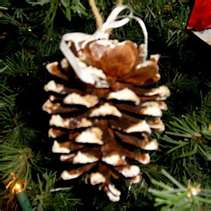
Pine cones are my favorite thing to use in decorations. This year I started working on a ball ornament that incorporated many pine cones of various shapes and sizes. I don't think it has the final look I want yet though??
I love the attractive natural look of them.I have decorated them with just ribbon.
Dusted them with powdered sugar or glitter to give a snow effect and painted them gold and silver too.
I like pine cones so much that 40% of the glass ornaments I have for my Christmas tree are shaped or colored like pine cones.
Hope you have enjoyed the vitual tree and however you decorate, I hope you have a blessed and peaceful holiday season. Please enjoy your holiday and if you are traveling, be safe!