Showing posts with label National Garden Month. Show all posts

Monday, April 29, 2019

Hidden Hill Nursery - National Garden Month Series

If you like eclectic and unusual garden art and large scale garden presentation, then you will love Hidden Hill Nursery in Utica, Indiana.


I found this nursery when we were travelling to Evansville, Indiana and needed a stop over on the way home. This was a commercial business with display gardens overflowing with art.  In fall 2018 they closed down nursery operations and simply have the 8 acre forested garden area available.  I do not know the hours of operation, but you may find what you need on their Facebook page.

When we went to visit in 2014 after our quest to Evansville, Indiana to see an LST (Landing Ship Tank - a troop and equipment transport from WWII) we stopped by because it was open on a Sunday when many other things were not.  The garden art is worth trekking the back roads of Utica Indiana to find it.

The promotional shot for the place has this man made out of salvaged metal parts, but the one made out of milk crates I found while wondering was much more to my liking.


My husband liked the walk under the string arbor covered with vines that was tall enough for his six foot 8 frame to fit under.


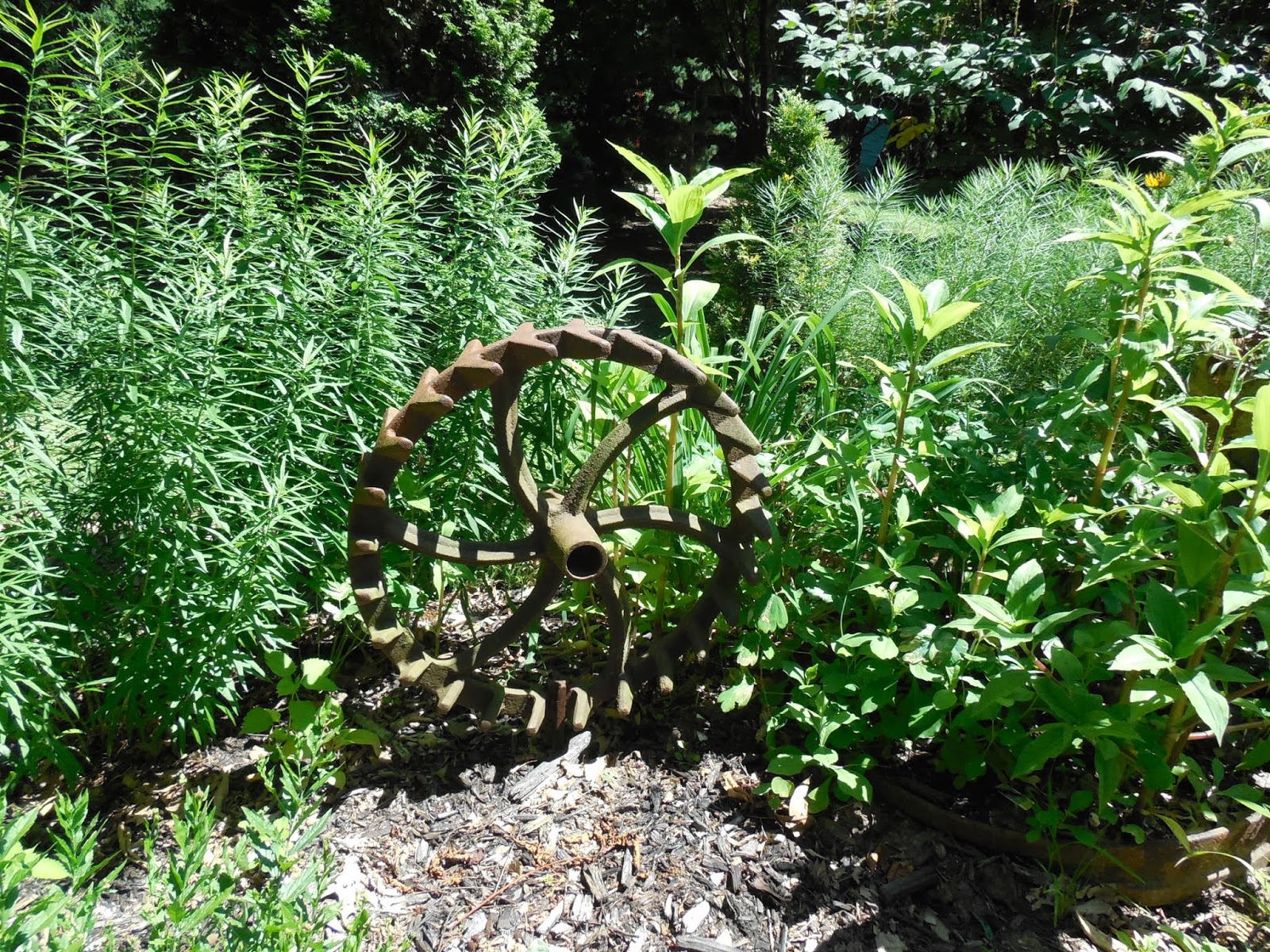
and he identified all the implements where the parts were used to decorate this flower border filled with metal flowers made from old farm implements.


There was a stream populated by gnomes.


A giant Squash made out of old tires.


A bathtub in the middle of a woodland.


A stone stacking area where you could stack stones and meditate.


The butterfly garden sported a butterfly bench.


And the largest succulents I have ever seen grew in a vertical pallet garden with a smaller one filled with herbs nearby.


A prairie space covered with black-eyed Susan had a wonderful wind sculpture,


and in the same area was a dragon made out of an oat conveyor.


The fountain garden had some of the most interesting tile.


And the gate / door into the prairie was just cool.


I took one of my best art photos here too:


Hidden Hill Nursery was a wonderful little hidden Gem.


Thursday, April 25, 2019

LaSalle County Historical Society and Illinois Valley Herb Guild Garden - National Garden Month

It is rare to find a public garden that is only there to be an herb garden. I find one every now and then but most gardens we visit have herb gardens as part of a larger garden, rather than the main focus of the experience.  The garden I am focusing on today is just an herb garden.  It focuses on many useful aspects of herbs but it is only an herb garden.

taken March 2015, the garden is still asleep
Located near the one room school house of the LaSalle County (Illinois)Historical Society I have visited this garden many times starting in 2015.  I took photos of it when it was still dormant and cold in March, another time in June during early growth in a rain storm and finally in 2016 when it was the end of the season in October.


This garden is maintained by volunteers so sometimes when I visit it is overgrown and untrimmed, but it is obviously well cared for by the Illinois Valley Herb Guild. 

taken 6-25-15
The Guilds’ herb garden is planted in a traditional homesteading style in four beds defined by the major uses for which the plants were grown in the 1800s. Dyes, Culinary, Medicine and Fragrance are the themes used in the garden.  I like the four-square design and plants included.  I think all the plants used in the garden have roots in the 1800s, but I think not all would be found on the 'frontier.'  But I am not certain what definition of frontier they are using, so I could be wrong. 

Since this garden is only about 12 by 24 feet, constructed with a center X path dividing the plot into 4 rectangular beds.  There is no need for a tour, so instead I thought I would show some of the variety of plants they have in the garden.  

Taken 10-28-16 
This garden was planted probably around 2010 and as a result has some age and many of the plants have reached some spread and have taken hold in their locations and flourished.  It is a joy to walk through and see the plants and touch the scented leaves.  A booklet was published detailing many of the plants in the garden back in 2011 and you can get it from the LaSalle County Historical Society in Utica, Illinois.

I love the groupings and the way the plants are labeled.  I think someone made the labels by hand.


There were several plants I had never grown before in the beds which allowed me to see the mature look of the plant as you rarely can in a nursery setting.  Lady's Bed Straw and Germander are historically interesting plants and to see them in a garden bed was a joy, especially since I have never grown them myself..

Flowering Lady's Bed Straw in June
Lady's Bed Straw is named so because it is thought to be the plant used in the Manger for the Baby Jesus. In the Galium family it is a cousin of Sweet Woodruff, and is another European introduced plant that grows well in Northern Illinois. When in flower they are highly fragrant and hold their scent while dry.  There is a chemical in Lay's Bed Straw that will curdle milk causing it to be used as an ingredient in the making of cheese.  The flowers can be used for making yellow dye and was used to color butter.  It is an all purpose herb which is perfect for a frontier garden.

Germander just getting serious in June.
Germander is used these days as a scented ornamental wreath plant, but traditionally it was used as a treatment for gout.  It is an Mediterranean plant and would have been brought to the US by European settlers. This is probably the creeping versus upright variety due to the short stature and it works as a lawn substitute and grows well in shade and with drought conditions.  I am thinking of adding it to my side yard which is both shaded and dry.  It flowers purple in summer.

Flowering from June to frost, this was enjoying the summer when I snapped this photo

Thread leaf tickseed was popular in 19th century ornamental gardens, but although you can use it as a dye in certain circumstances I think it was less a frontier herb as a landscape plant in more urban areas, especially along the east coast in the 1900s.  I love to grow this, but it is a serious self-seeder, so I put it in pots rather than in the ground to keep the seeds contained.

Clary Sage
I got the best picture of Clary Sage I have ever taken while at this garden.  Even the one in my own garden never looked as nice as this one. Clary Sage is an old plant.  Used by the Quakers in PA, it is a perfect frontier plant.  The aromatherapy benefits include reduction of stress and anxiety.  It is also an anti-inflammatory herb and an antibacterial.

Winter Savory in flower in June
Winter Savory is always a good edge plant and this garden placed on the edge.  I suspect someone came by and trimmed it up shortly after I took this photo.  Winter savory takes on a nice shape if kept trimmed.  And being a perennial it only gets better with time.

St John's Wort flowers look bright even on a cloudy rainy day.
This plant flowers around the Summer solstice in June, (near St. John's Day on the 24th) which is how it gets the name St. John's Wort.  The flowers make a great herbal tincture that is red in color rather than yellow as the flowers might suggest.  The infused alcohol can then be used to treat various ailments, including anxiety and depression.   Historically it was believed to be a panacea that could cure almost anything.
Sorrel going strong in October
French Sorrel is an herb I have never grown.  Considered one of the bitter herbs, it was used by the Egyptians and the Romans to impart a bitterness or acidity to foods, much like we do with lemon juice today.  It can be eaten as a green, with a taste similar to a sour green apple it is in nice counter part to other sweeter foods. 

Flax in October, not tall enough to harvest
Flax is also part of the garden, but my guess is this plant would not have been in the garden as much as it would have been in a field nearby.  Flax was grown extensively in Illinois as a crop for making linen fabric.  To process flax you need a good flowing water source.  This garden is right along a canal which makes it a great place to grow flax but more abundance would give you the flax you needed to weave into cloth.  The process for making fiber from flax to create linen is very harsh and hard on people and the environment, so once cotton was more easily available Flax was abandoned as a cash crop.
taken 10-26-16
After my second visit we stopped in the nearby museum and I picked up a little booklet called "The LaSalle County Historical Society's Settler's Herb Garden" which details photographically many of the plants in the garden with a short one or two sentence description of the use of the plant.  The only thing the book is missing is a bit of information on why they chose the plants they did for the garden, as I am curious.

This garden is near Seneca, Illinois, where my husband and I intend to retire and raise herbs in the next few years, so I will be visiting this garden again, and I recommend you do as well if you are ever along the I&M canal or the Illinois River near Starved Rock.  The address of the museum is 101 E Canal Street, North Utica, Illinois and the garden is east of the parking area beside the one-room school house building.

Thursday, April 18, 2019

Visiting the Klehm Botanic Garden - National Garden Month Series

Just so you don't think I have only visited gardens in Indiana I thought today I would explain a garden I visited back in 2013 right here in my home state of Illinois.

I was using my first digital camera that had useful pixels that actually took photos that look good posted anywhere.  Before that the images are so grainy from my 3 or 5 pixel cameras, that I am embarrassed to share most of them.


This is the Klehm Arboretum and Botanic Garden located in Rockford, Illinois.  We stopped by on an early June day back in 2013 when the weather was balmy and sunny and the plants were just hitting their late spring flush. We were out on a road trip to enjoy the lovely day and stopped by when we saw the sign.

I was fascinated with the Children's garden that is dotted with fun interactive ideas and bright colors. I think A to Z gardens are such fun, you often find them in Children's gardens, but as an adult I love the organization of them and the choices the gardeners use for each letter often takes me on fun adventures.

I took way too many photos of the A to Z garden, so I will just share the end of the alphabet with my favorite flower - Zinnia!  If you want to see the details, check out my post from 2013.


A tower in the Children's garden area allowed us to get a bird's eye view of all the fun. They also had a human sized sundial which worked perfectly on that sunny day to tell the correct time of 10:00 AM.


We also enjoyed strolling the Rhododendron and Azalea Dell


and visiting the Demonstration Gardens gave me lovely landscaping ideas.


There was a maze -- love a good maze.


A number of flowering and ornamental trees were also part of the experiences in the arboretum.  Here is hubby pointing at -- I have no idea.


We were there on bring your dog to the arboretum day and we got a lot of comments from visitors asking where our dog was and joked with a couple about being the only folks there without one on that day.
The entrance to the Arboretum with the fountains is really striking and a great wedding venue.  The admission is reasonable and they do have a reciprocal program if you are a member of another arboretum.


fountain 03garden
This photo courtesy of the Klehm Arboretum and Garden

We just had a wonderful experience walking through the place and catching all the lovely touches they have included in the landscape. Like these edible flowers!


So if you are traveling though northern Illinois, visit the Klehm Arboretum and Garden located at 2715 S. Main Street in Rockford, Illinois.

The next garden in the National Garden Month post is here.

Monday, April 15, 2019

Luthy Botanic Garden - National Garden Month Series

In August 2016 my husband took me on a road trip when we were quite a ways from home we decided to spend the night and go home the next day.  On the voyage home we stopped in Peoria.  It was raining, so we decided to go to the Luthy Botanic Garden and Conservatory because the building was indoors, so I could look at plants in a heavy rain.  While we were there, the rain stopped and I was able to take in the Herb garden and the other outdoor displays.

The Luthy Botanic Garden opened in 1951 and is run by the Peoria Park District.  It off the main road on a side street you would never guess was taking you to a glass conservatory set among trees and flowers.

Living in Illinois I do not get the chance to grow or enjoy many tropical plants so I was fascinated with the offerings inside the Conservatory.  The Bird of Paradise was in bloom and I must have taken 30 pictures of it trying to catch the best view of the blooms.


There were plants I'd never known about like the miraculous plant that changes your tastebuds (temporarily) to make sour things taste sweet called Miracle Berry.


There were blooming orchids and other tropical plants I cannot identify that have exceptional flowers.


 There were banana and plantains almost ready to be harvested.


And this lovely variegated shrub that I think I know the name of?


There were umbrellas made available that we used to go outside when the rani slowed down.  This is Hubby approaching a green house that I am guessing was the original 1951 era conservatory.


Tucked away under the trees in the outdoor area was a children's garden.  Some of it had been put to bed for the year, but there was the cutest train and other fun garden art and play areas.

There was a lovely display garden of Dwarf Conifers installed in 1997.


Now to the herb garden.  This was a pretty garden tucked along the side of the conservatory that had a metalwork entrance arch that spelled out "Herbs." The center sported a sundial and the formal four square layout had a variety of herbs and garden art to explore and enjoy.


The garden included Lemon Verbena and Rosemary planted in the ground, looking like they wintered over in place.  I was curious if this was true, but no one working that day was well versed in herbs to be able to answer that inquiry.

Rosemary

Lemon Verbena surrounded by catnip and lavender
There were some unusual plants like Lungwort, Hyssop and Rue.


Being August the Garlic Chives were ready to bloom.


There was a bush of Meadowsweet an herb I would like to grow when I have more room for it to spread out like this one has. The herb is a go-to for stomach and intestinal ailments and can be used in tinctures as well as dried and taken in tea form.


I don't have another picture of it, but you can see the willow branches placed diagonally in the ground to the right of the Meadowsweet that were keeping other herbs like Yarrow from creeping into the space.  I thought it was clever and not at all distracting.

There was a Costmary (Bible leaf) plant. This lastly minty smelling and tasting leaf can be sniffed to increase wakefulness.

And the most interesting Thyme Bed -- Sofa? A most clever way to display Thyme and a perfect memorial sculpture - a scented seat.   The "planted seat" is an old herb garden item, used often before the 1800s to scent clothing. It was created of carved stone, much like a heavy church pew. The seat was hollowed out into a cavity about 6 inches deep and into this was packed earth planted with either chamomile or thyme. When a person sat down and crushed the plants, resulting oils soaked into breeches or skirts. The seat would be replenished as needed.


I did not notice the arch with HERBS until I was leaving the herb garden as I entered from the back side like this view.


The sundial in the center is registered with the North American Sundial Society is said to be only one of two designed by Grant Hood of the Bradley  It is inscribed "TIME FLIES LAT 40 43 DESIGNED BY GRANT HOOD, PEORIA, ILL."  The granite pedestal includes a dedication plate reading, "Presented by - Mrs. S. A. Kinsey - October 1905"  Grant Hood worked for Parson School of Horology (founded in 1886.) Horology is the study of watchmaking and time keeping the school was part of what is now Bradley University in Peoria.  The other sundial was at the school but was later removed and sold.


The George L. Luthy Memorial Botanical Garden, usually just Luthy Botanical Garden, is a 4.5 acres botanical garden and conservatory located in Glen Oak Park, near the corner of Prospect Avenue and Gift Avenue in Peoria, Illinois, United States. The garden was established in 1951. The street address is 2520 N Prospect Rd, Peoria, IL 61603
Related Posts Plugin for WordPress, Blogger...