Showing posts with label scented geraniums. Show all posts

Monday, May 15, 2023

Rose Geranium Tea -- Monthly Tea Blend

This time of year I am prepping my geraniums to be outside after being indoors for the winter.  I trim them, shape them, replace the soil, check for pests and other tasks (you can see some details in this blog post: Care for Scented Geraniums.)  With all the cut sprigs I will make Vacuum Fresh, start some cuttings, or brew some up as tea, like this flavorful yet simple tea that you can create with Rose Geranium leaves.


Rose Geranium leaves up close

Rose Geranium Tea

2 orange pekoe tea bags 

4 fresh rose geranium leaves

Combine tea bags and geranium leaves in a small to medium tea pot and cover with 2 cups of hot, just off the boil, water and allow to steep for 5 to 10 minutes.

Serve hot or over ice for a refreshing pick me up in your afternoon.

Thursday, September 15, 2022

Scented Geraniums - Tea Ideas for the Month of September

This time I want to discuss making tea with Scented geraniums.  So many folks think they are only for show, but I find they are great to make edibles with.

Scented geraniums are of the genus Pelargonium, also called storksbill.  They were imported to England from the Cape of Good Hope in southern Africa in 1632. The rose-scented varieties are grown for making perfume as a substitute for attar of Roses.

Old-Fashioned Rose Scented Geranium

Roper's Lemon Rose Geranium


While many species and cultivars of scented geraniums are used in cooking, the three most common are peppermint, (Pelegorium tomentosum) rose (P. graveolens or Old Fashioned Rose) and lemon.  The lemon coming in a number of different varieties from Mable Grey, to Rober's Lemon Rose, Hillary Lemon and lemon crispum (P. crispum). Although not known for their medicinal properties, scented geraniums can bring great scents to a beverage.

Gray Lady Plymouth - a lemon-scented geranium


Fresh leaves have more flavor than dried ones, so this time of year when I am cutting the Geraniums back before bringing them indoors for winter is a great time to make tea blends with them.  Use 1 tsp dried or 1 Tablespoon fresh crumbled leaves to one cup of hot water.  

To start here is a tea recipe using many different leaves to give a broad flavor.

Mable grey geranium leaves
Geranium Leaf Tea

  • 2 rose geranium leaves
  • 3 peppermint geranium leaves
  • 1 Mable Grey geranium leaf
  • 2 Lemon Rose geranium leaves

Place the crumpled leaves in a pot and cover with 2 cups of hot water and allow to steep 5 to 7 minutes.  Strain into a cup and enjoy this light-colored tea with a few sweet sugar cookies for a wonderful afternoon pick-me-up.


Here is a spicy tea recipe that is great made with rose or lemon rose geranium leaves.


Rose Geranium Black Tea

  • 1 tsp black tea of your choice
  • 1 -3 whole cloves
  • 2 crumbled fresh rose geranium leaves

place all items in a tea ball or coffee filter tied closed and steep in a mug of boiling water for 3 to 5 minutes.  Don't leave too long or the clove overpower everything else.

Another great way to get the flavor of scented geraniums into your tea is to make geranium sugar.

This is created by layering the leaves with granulated sugar in a container for about 2 weeks, then removing the now desiccated (totally dried out) leaves for sugar free of herb bits, which makes a wonderful flavored addition to coffee, tea, and lemonade.

Friday, April 9, 2021

Garden Planning for Containers

I worked the election this week as an election judge.  My reward was to go plant shopping the next day. You can see my haul below.  This trip was a few herbs and mostly annuals for my hanging baskets.  I tend to landscape in shades of green.  As an herb grower, you get into that, as flowers are something you cut off, not encourage, but I love the bright shades of flowers so I grow zinna and sunflowers from seed and put out annual hanging baskets.  Our garden club normally has a plant sale where I buy my baskets, but this year no sale, no baskets.  But if you are looking for native plants, the club will get 10% if you SHOP HERE.

As a result, I need to make my own hanging baskets.  I have plenty of planters, so I went to Redbud Creek Farm in Sheridan, IL.  It is about an hour from me, but worth the drive.  They have herbs, vegetables, annuals and perennials.  The layout is wonderful to wander through. And I will have to go back later in the year to see the herb and vegetable garden during the growing season.


We also stopped at Shady Hill Gardens in Elburn to pick up my scented geraniums - and some lemon thyme which was too aromatic to pass up!


Hanging Basket Design

Designing a hanging basket is about the same as designing a small pot spiller, filler, thriller.  But one does not need a tall exceptional center plant as much as one needs more spiller.  Most hanging baskets hang above eye level so you need the plants to flow over the edge.  That means finding plants that low grow and spread or are viney. My favorite for this is portulaca - a variety of purslane, an edible weedy herb, that will grow well in-ground and spread nicely and in pots, it will cascade.  It is covered with colorful blossoms throughout the summer.

English ivy is a good choice, Sweet potato vine with its unusually shaped leaves and lovely shades of green to dark purple allow you to find versions to suit your design.  Another great spiller is Dichondra.  This version is "Silver Falls." 


Trumpet vine and bougainvillea are popular hanging basket items, but they tend to be grown alone.  Because of their own showy appearance, no extras are needed.

For the thiller I like annual flowers. Bright, colorful, sun-loving annuals that will grow fast and fill the pot to overflowing is the best. For one I chose portulaca in 5 different colors. I love yellow and my husband does to, so we got some yellow and orange ----  to hang in the front yard.  Since I am still working from home, my home desk will overlook it everyday.

As filler I got these pretty white flowers -- 


I think I will have to get a few more. 

I wintered over two ivy.  One variegated with wide leaves and one a more traditional ivy.  The traditional ivy died back terribly due to the lack of humidity in our house, but the other ivy flourished.  The cats will be glad it is no longer growing into their lounging space in the bedroom.


Once we are free of the threat of frost I will put these containers together and take photos of the final versions.  


Tuesday, July 28, 2020

Capture Summer Flavor with an Herbal Honey - How Tuesday

I used up the last of my personal stash of lavender honey making frozen pops (see the how to on July 21.) So I needed to make a honey for flavoring my iced tea and grilling sauces.  I wanted something with a bright summer flavor and decided that lush summer herbs would be perfect.

The lavender was blooming,

the scented geraniums were flourishing and
Mabel Grey Scented Geranium

and the lemon thyme, well I grow a lot of that.

However this combination of herbs will make a citrus scented, flower accented honey that will capture the essence of a blooming warm summer day.

Here is how I made Summer Herb Flavored Honey:
lemon thyme, lavender, lemon rose geranium and rose geranium (lft to rt)
I gathered honey (I get mine locally from a bee keeper who used to be my neighbor) and my ingredients.


Warm the honey so that is it soft and liquid.  You can do this in a saucepan or as I prefer in a microwave.  Heat for 45 seconds and test to see if it is liquid enough.  I ten began by adding the thyme, then the scented geranium.

I chose two varieties, the small round leaves are old fashioned rose geranium and the irregularly shaped ones are a lemon/rose cross called Hillary (yes that Hillary).  They are two of my favorite scented geraniums and this year I am propagating them (POST TO COME SOON) several different ways.

I added the geraniums to the honey.  Note that the jar is not full.  It is hard to estimate how much displacement will happen when you add the herbs to thick honey, so you start with a jar half full.


The final herb added was the lavender flower heads.  I tucked them in and used them to stir the other herbs into the honey.


Once I got the herbs down into the honey, I put the lid on the jar and turned it upside down and let the herbs and honey flow to the other end of the jar.  Once it collected, I flipped it over and let it settle again. 


I did this for 24 hours until the herbs were well coated with honey.  Only then did I fill the jar the rest of the way.  


Now I wait two weeks before this honey will be fully infused with the flavor of these summery herbs and ready to use.


Flavor of Summer Honey

2 cups Honey
2 Tbls Lavender
2 Tbls fresh lemon thyme sprigs
1 Tbls rose Scented Geranium
1 Tbls lemon rose Scented Geranium

Directions: 
Warm the honey in a saucepan or in the microwave until thin and liquid.          

Here is a great recipe to use with this Flavor of Summer Honey.

Herb Salad with Lemon and flavored Honey (Serves 4)
This recipe originated from the Niagara Estate Winery and uses a wide variety of herbs to make a flavorful salad enhanced by the herb flavors in the honey. The lemon juice brings out the citrus notes in the honey.  It makes this salad a treat for the tastebuds.

½ cup baby arugula
1 bulb fennel, fronds attached
1 bunch basil (green or purple)
1 bunch tarragon
1 bunch dill
1 bunch of chervil or parsley
1 bunch of chives
2 lemons, juiced 
2 Tbls flavored honey (Flavor of Summer Honey is perfect)
2 Tbls olive oil

Directions:

Pick the green fronds from the fennel bulb and reserve. Cut fennel in half, vertically, and slice thinly. If possible, use a mandolin. Gently pick the leaves off of the basil, tarragon, dill and chervil and place in a bowl. Slice chives very finely and add to bowl.  Toss in the cut fennel and arugula.

In a small bowl, combine lemon juice, honey and olive oil, mixing well. Finish by seasoning your salad with salt and pepper to taste.

Tuesday, August 13, 2019

Making cuttings from Scented Geraniums

Tonight we are traveling to Park Forest to do one of my favorite programs Herbology 101, sometimes just called Fun with Herbs.  I can adjust this program to fit the seasons and tonight I am discussing harvesting and preserving herbs as well as how to bring them in the house for winter.  I am doing it again in September for the Schaumburg Township District Library where I will be having make and take stations too.  However, they are on a waiting list already, but you might be able to join us if you check it out soon.

Of the things I am talking about tonight I am discussing Scented gernaiums.  They are a great item to take a cutting from for winter gorwing, or you can bring them in and take a cutting come spring for a new outdoor crop next year.

When rooting a scented geranium the best medium is damp sand.  Get some landscape or gardeners sand, not play sand.  Fill a container.  I used a window box.  You can use paper cups, small pots or even plastic pots or containers.

Make sure the sand is nice and damp, but not waterlogged.

Then you need the plant to take cuttings from.


This is this year's crop of Scented Geraniums.  There is Mable Grey on the far left and right with apple scented in the round leaves in front and the rose scented with round leaves in the back.  The ferny leaf ones are lemon and lemon-rose scented.

I am taking a cutting from the old-fashioned rose scented geranium with the long stems with multiple round leaves and the Rober's Lemon rose with the deeply cut and ferny leaves.


You only need two or three simple tools to make cuttings.  You need the medium to put the cutting in, ground cinnamon to keep germs away from your cuttings, and a sharp pair of scissors to take the cuttings.  I also use a pencil to make the holes in the sand, so I don't bend or crush the stem and it can make good roots.

Take a cutting from near the growing node of the plant.  The node is that area of the stem where leaves emerge and is the best place to get a new plant started, rather than cutting in the middle of a stem.


You then remove all the leaves from the stem except for a couple at the top .  You want the branch to spend energy making roots not keeping leaves alive, so remove as many as you can.


Then use a pointy stick or sharpened pencil (this is my special Berol #2.5 pencils that I own numbering in the hundreds) to make a hole in the sand to place the cutting.


Roll the end of the stem in ground cinnamon if you want to keep germs from forming on the cutting and place it in the hole, using only one finger to firm the sand around the cutting, so you don't crush it.

You can place the pot outside in a shady location or indoors in a sunny window.  Keep the sand moist, by misting it regularly and wait about two to three weeks for roots to form.  You will know it works when the leaves start to grow again.  Some cuttings will die.  This is a fact of growing plants.  Do not fear.

Replant the cuttings into potting soil when the root systems are fully developed (about 6 to 9 weeks.) Then keep them in a sunny window for the winter and take them outdoors for summer growth.   Scented geraniums like to dry out between watering, so do not over water them.

You can use this same technique with other plants as well.  Some herbs like Basil you can root the cuttings in water rather than sand. Always take a cutting from green stems, rather than woody stems.  You can root sage, lemon verbena, pineapple sage, mints, coleus and other firm stem herbs and plants with little difficulty and the plant provides many branches to cut, giving you plenty of stock to experiment with your technique without guilt.

Friday, April 5, 2019

Victorian Bath Tea - Bath Blend of the Month


Coming up May 1, 2019 I will being doing a special demo program called Body Beautiful Bath Botanicals (at Schaumburg Library) which will focus on how easy it is to use herbs to enhance your skin, refresh you hair and make your bath experience more relaxingly aromatic.  

I will be showing how to make bath and spa items, everything from bath tea to bath salts to lotions, salves and other items.  Participants will be able to take home a little something for themselves as part of the program.  

I have been debating what recipes to have guests make and one of the must haves is a bath tea blend.  The blend I am using is different than the one below, but in my search I found this one that I once sold at the Wheaton History Center gift shop.  It is a blend of appropriate Victorian Herbs and flowers with a refreshing traditional scent.

Lavender is balancing and will calm or rejuvenate depending on your need and what you combine it with.  Including rose petals and the geranium essential oil creates a deeply healing blend with this Bath tea.

Victorian Bath Tea
1/2 cup rose petals and buds
1/2 cup lavender buds
1/2 cup comfrey
8 drop lavender essential oil
8 drops rose geranium essential oil

Directions:
Blend the herbs together in a plastic bowl, then add each essential oil separately and stir to combine.  Allow to meld overnight, scoop ¼ cup into each muslin bag and store in an airtight container.  This recipe will make up to 8 bags.

Thursday, August 24, 2017

Rose Geranium Cookies

The most popular recipe in the cooking demo program this week was cookies made with rose geranium leaves and sugar flavored with rose geranium. We will show how to make herbal sugar very soon with holiday gift ideas.

1/2 cup butter
1 cup sugar (or rose geranium sugar)
1 egg
1/2 cup milk
1 tsp rose water
2 tsp rose geranium leaves, finely chopped
1 3/4 cups flour
1 1/2 tsp baking powder
4 doz. small rose geranium leaves

Cream and sugar together until light and fluffy. Beat in egg,milk, and rose water.  Soft together dry ingredients ad add them together with the chopped leaves to the creamed mixture, stirring until well mixed.  The dough will be not be dry but also not liquid. Drop by heaping teaspoons onto lightly greased cookies sheets. Because of the liquid nature leave good 2 inches between cookies.  Press a single Rose geranium leaf deep into each cookie.  Bake in 350 degrees and bake for 8 to 10 minutes.  Serve with a gentle companion tea with light lemon or floral flavors.

Tuesday, July 26, 2016

Backyard Garden Update July

July was a whole lot of let it grow.

These are some of the plants in bloom


 Mabel Grey Scented Geranium

 
 Calendula just before it began to bloom.
 Nasturtiums
 Swamp Milkweed


 Gazania
 Anise Hyssop

 Yarrow

 Artemesia

The back yard enjoying growth and decoration.  We added a third trellis back by the fence for Hyacinth Bean.  I got some seed from the Garden Club and planted them along the bottom.  The trellis is to keep Chas from trimming them down before they get big enough to grow on the trellis.  Hyacinth bean can grow inches in a day, so although an annual it can cover the trellis by the end of the season with no problem.


 The peas have taken over the string.  I am not sure what to do now that they are higher than the posts.


 Scented geraniums by the back door.


 The vegetable garden is getting tall and full with much potential by the end of the month.


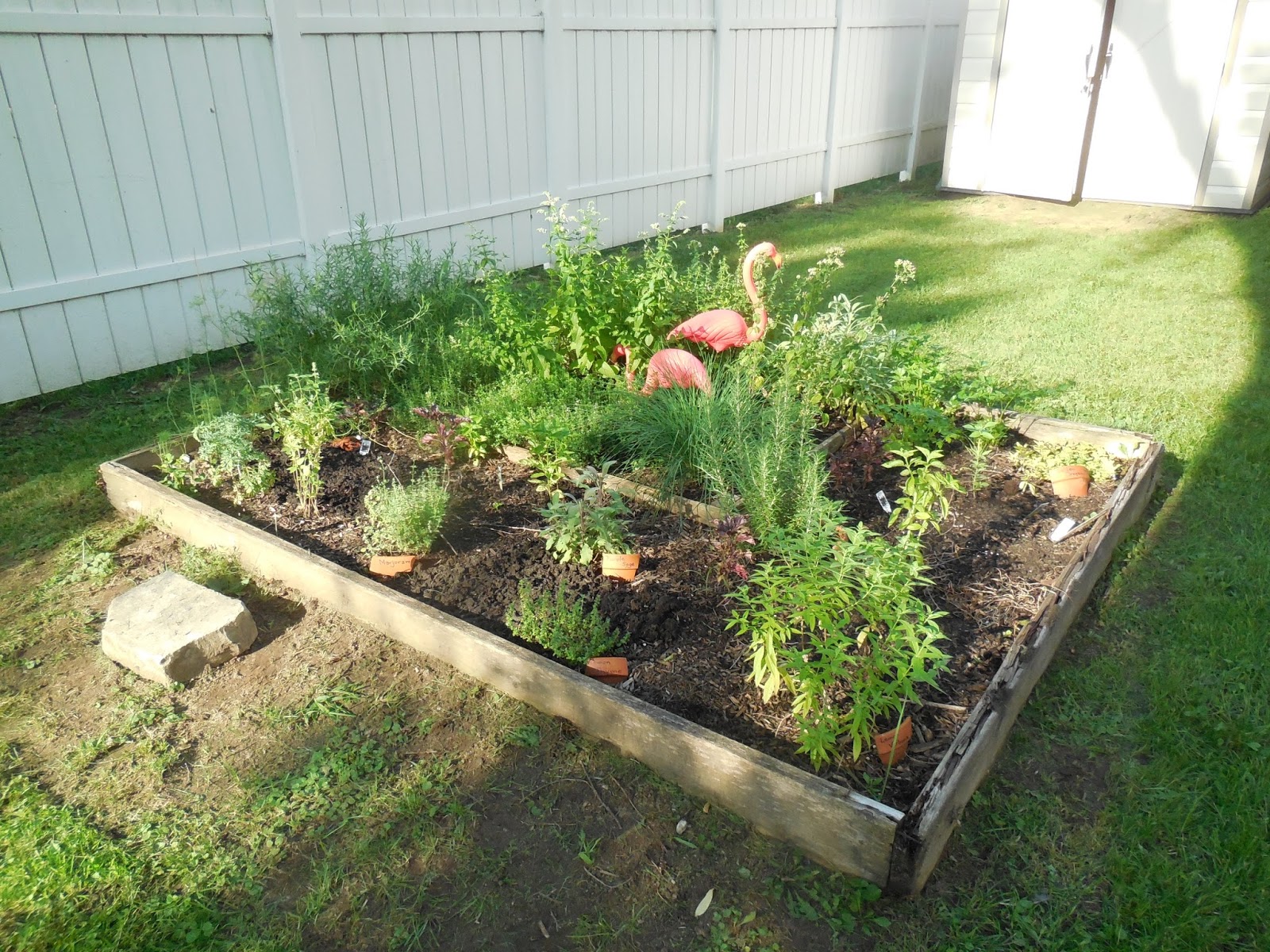
The herbs seemed to be growing more slowly than I expected so I started a program of adding compost tea and new rich soil and compost to the garden in 2 week intervals to see if there is improvement.  By month end they are beginning to get better.


 The rain garden in mid summer


 By month end the calendula and Nasturtiums joined the rest of the flowers in bloom!


Related Posts Plugin for WordPress, Blogger...