Showing posts with label hair care. Show all posts

Monday, May 4, 2026

Lemon Hair Spray - Bath Blend of the Month

 A gentle hair spray without flamible chemicals is hard to be found, but this quick to make item can add body to long tresses, keep a hairstyle in check and can be used as a setting lotion or hold hair in place after styling.

Be aware the oil from the lemon peel used to make this can lighten some hair types, especially if you spend a large amount of time in the sun.


Lemon Hair Spray

  • Zest of 1 full lemon
  • 1 cup boiling water
  • 1 Tbls witch hazel liquid (available in the skin care aisle)

Place lemon zest in a ceramic container and pour boiling water over it. Let sit for several hours, or even overnight.  Strain out the zest and sitr the witch hazel into the liquid. Pour result into a spray bottle.

TO USE: Before or after styling your hair, spray a small amount onto your hair to add body and hold the style.


Thursday, June 4, 2020

Hair Rinse perfect for Blond Hair - Bath Blend of the Month


This month I am posting a hair rinse made with calendula.  It is no surprise this herb is being used on hair and scalps. Calendula extractions are often used to hydrate dry scalps, remove dandruff, and improve the condition of the scalp. With its regenerative properties it helps the hair follicles grow abundantly allowing for a thicker mane, and the antioxidants help protect the hair and scalp against cell-damaging free radicals. It is believed to promote stronger hair by the increase of collagen production and circulation in hair follicles. The benefits are similar to a scalp massage that increases blood circulation to the hair follicles. This plant is soothing to sensitive scalps and quite popular in hair rinses for adding shine, calming irritated scalps, and bringing out naturally warm highlights in blonde hair.


Calendula Hair Rinse
1 ounce of calendula petals (about 1/2 cup)
3 cups water
1 Tbls plain vinegar or calendula herb vinegar
3 to 5 drops rosemary essential oil

Bring water to a boil, then add calendula petals to water and allow to steep for 5 to 10 minutes.  Combine 2 cups of resulting tea and add vinegar and essential oil. Makes 2 treatments for short hair, 1 for long.

To Use: Pour over hair after shampoo, leave on for a few minutes and rinse.

Friday, April 3, 2020

Herbal Hair Steam - Bath Blend of the Month

This is a great excuse to lie on your back on the bed and chill for 15 to 20 minutes.  A hair steam is a great way to energize your scalp, open the pours and improve circulation that can stimulate hair growth.  Steam is also beneficial for dry hair allowing the hair to rehydrate.  Steam lifts hair cuticle making other treatments more effective.

2 quarts water
2 tsp dried basil
2 tsp rose petals
2 tsp dried lavender
2 tsp dried lemon balm
2 tsp dried comfrey

Combine the herbs together in a small bowl.  Find a large enough stock pot or Dutch oven to hold 2 quarts of water.  Prepare the area where you will be steaming. Wash your hair and bring water to a boil.

TO USE: wash your hair as normal, add conditioner to your hair, then pin your hair up on your head.  Prepare the steam by bringing water to a boil in a saucepan. Add the dry herbs to the water, cover and continue to simmer for 2 minutes.  Uncover and place the steaming bowl on a table or stand at the end of the sofa or bed positioning it so you can lie with your head about 6 to 12 inches above the pot.  Hang a towel over your forehead to trap the steam and lie still allowing the steam to penetrate hair for as long as you are comfortable.  Sit up and allow the hair to cool.  Once your hair is cool the cuticle has closed and you can rinse the conditioner from your hair knowing that the condition has penetrated you hair well and should leave it softer, smoother and more manageable.

Tuesday, September 19, 2017

Cosmetic Vinegars

I love to teach and describe how to make vinegars with herbs.  Most of the time these vinegars are for consumption, they can then be used to flavor vegetables, make dressing and marinades or otherwise cook with them.  However, today I want to talk about Cosmetic Vinegars.  These are vinegar used after a facial steam or as a tonic or skin refresher, or even a hair rinse.  The technique is very similar, but the concentrations are different.


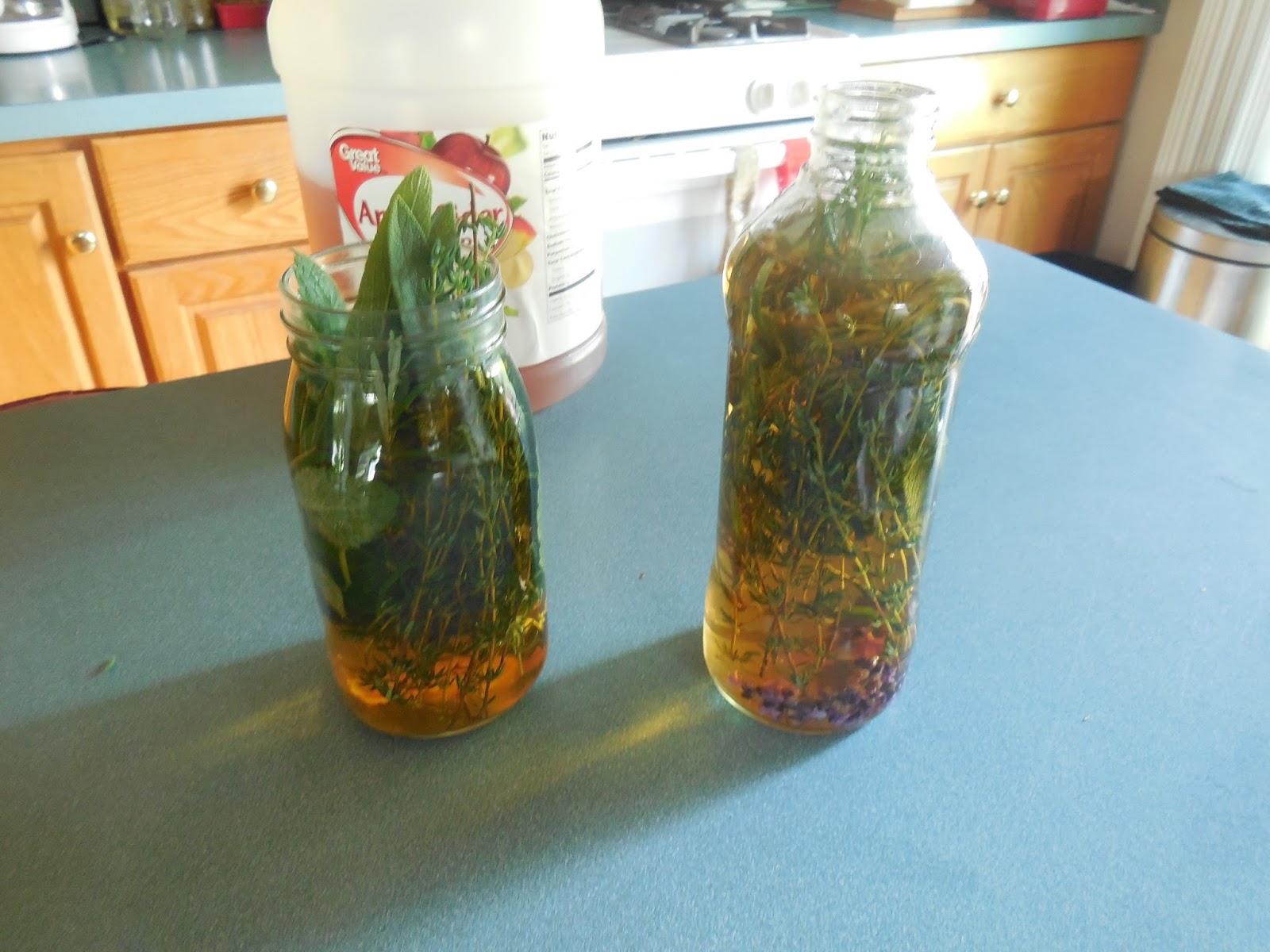
You want to use apple-cider vinegar for cosmetic vinegar.  Apples are high in antioxidants, so using anything with apples for cosmetics is highly recommended.  You want to steep these for 3 to 4 weeks.  Don’t scrimp on the steeping time, the intensity you get with a longer time period is essential to the healing benefits. You also want to add thyme and/or sage for germ fighting and rosemary because it contains volatile oils that get the blood flowing under the skin.

Marvelous Mint Cosmetic Vinegar
4 cups apple cider vinegar
1 part spearmint or apple mint
1 part sage
1 part thyme
1 part rosemary


Luscious Lavender Cosmetic Vinegar
4 cups apple cider vinegar
1 part lavender
1 part rosemary
1 part thyme

Steep the herbs in the vinegar for several weeks (at least 3) in a dark place. Then strain and bottle. 

To use:
Blend ½ cup vinegar with 3 cups water and splash it on your face after washing; warm in the microwave to steaming and place in a bowl and hover over it with a towel behind your head to open and clarify pours before deep cleansing.


Vinegar Hair Rinse
This flower, water and vinegar rinse removes soap residue and adds a sparkling healthy condition to your hair.

2 oz. Rosewater or other flower water
2 oz. Apple cider vinegar
2 oz. Water or an herbal infusion (tea)

Combine rosewater, vinegar and the water/herbal infusion, shake well before using as a hair rinse.

To Use: Massage in well, leave on for a few minutes. Rinse off as usual.

You can make an herbal infusion (tea) by steeping with herbs of  your choice, and allow to cool. Certain herbs when made into a strong infusion can bring out mild and subtle tones and highlights to your hair, depending on condition, color and texture. Some of the herbs that can be used are Chamomile, Sage, Basil, Horsetail, Lavender, Nettle or Rosemary.
Chamomile can be utilized for subtle golden tones
Rose softens and brings highlights
Hibiscus flowers or Alkanet root for slightly reddish tones
Nettle for warm tones
Rosemary, Sage or Walnut leaves bring out brown shades


Wednesday, May 20, 2015

Stinging Nettle - Herb of the Week

Recently I have been in three conversations about the benefits of Stinging Nettle, so I decided that it was time to research it for the herb of the week.

This week's Herb of the Week is Nettle, Stinging (Urtica dioica)


Found all over the world.  It is widespread on wasteland, especially on damp and nutrient-rich soil.  The scientific name comes from the Latin "uro" meaning I burn.  There are compounds in the leaves and sap called formic acid and histamine which cause allergic reactions in some that sting and cause blisters and hives.   Despite this drawback it was a popular plant in several countries.  In Scotland the plant was used to create a linen-like cloth that was used for sheets and tablecloths. It also has a history of magic, being associated with elves marking their dwelling place and as a protection against sorcery.  It was also used to protect milk from house trolls or witches.  In the 1600s it was discovered in New England having been brought over accidentally by early settlers, it became instantly naturalized. The common name stinging nettle is an Anglo-Saxon word for needles.  


To Grow
female flowers

Male flowers
Stinging nettle is the scourge of the gardener and the farmer because the leaves have the ability to cause a burning pain followed quickly by itching.  This is caused by a combination of chemicals in the leaves and hairs on the leaves. A tough spreading perennial, the stem will grow to 5 feet, and the root is much like mint and can spread infinitely.  Hardy to Zone 3, this plant really can grow just about anywhere. The male and female flowers are on separate plants and the plant wind pollinates so its flowers are not showy because there is no need to attract pollinators. The female flowers hang down in clusters, the male flowers stick out.  The color for both is yellowish green and they appear in mid to late summer.  They are actually located at the base of the leaves near the top of the plant. The leaves are dull green, with toothed edges covered on the underside by the stinging hairs.  This is the variety that can be eaten when young.

Nettles can be grown from seed sown in the spring.  But I am sure any one of your friends with a garden would be happy to give you a root.  Divide established roots early in spring before they out on much leaf growth, and the sting is least strong.  Stinging Nettle looks bushy, but it is actually an individual stalk with no branches.  The roots spread underground runners that generate new stalks giving it a bushy appearance.

The plant prefers a rich soil a bit on the moist side, however, it can grow just about anywhere and waste ground, field edgings, by ruins or pretty much in any nitrogen rich soil will support Stinging Nettles.  They are rather plentiful in the wide so in some areas it is not always necessary to grow your own. Be careful when dividing existing plants, as you can feel the plants wrath.

The plants will need to cut back in the summer to keep them from being invasive.  Before frost you want to cut them down hard to the ground.  They are fully hardy and will have no trouble returning in Spring.

To Use

The earliest uses of Stinging Nettle was as cloth.  Archaeologist found nettle fabric in a Bronze Age burial site in Denmark.  It was assumed it had medicinal properties in ancient times as well.  it was believed to be an antidote to other poisonous herbs, like henbane.  Seeds and flowers were used to create a tonic in wine that was taken to combat fevers accompanied by chills. 

Although they do cause some people unpleasant harm (I am one of those people!) Nettles are useful in the garden attracting butterflies and moths and making an excellent caterpillar food. 

A tea crafted from the leaves was combined with a sweetener to make an expectorant.  The tea is said to stimulate the kidneys, rid the body of worms, cure diarrhea, stop internal bleeding, and purify the blood. Nettles are high in vitamin C,which may account for years of using it as a spring tonic. A tea from the leaves has also been used to curdle milk in making cheese. 

Only young leaves of Nettle can be eaten.  Do not eat old plants uncooked.  Young shoots won’t sting and some people have consumed them raw, tossed into a salad.  The greens can be cooked much like kale or spinach.  Once boiled the hairs are rendered harmless. 

However, they should not be eaten in excess as they can produce kidney damage and symptoms of poisoning.  The plants must be cooked thoroughly to be safe.

It is worth the trouble of cooking them to eat, as they are rich in vitamins and minerals.  Whole plants will yield a week greenish, yellow woolen dye. It has a reputation for helping with hair loss and making the hair soft and shiny, as well as eliminating dandruff. 


The herb is considered a boost to other herbs increasing their essential oil.  It was even fed to livestock and chickens to increase the nutritional value of the meat and eggs. It is very high in nitrogen so making a strong nettle compost liquid can be used to fertilize the garden.  You can also compost it thus enriching you compost.  Take a bucketful of nettles, pour rain water over them and let soak for a week.  Strain the liquid and put it in a spray bottle, then spray on aphid infected plants to repel these damaging insects.  You can also pour the liquid into your container plants as a fertilizer.

Recipes

Nettle is an herb used in many different types of preparations, as a result I have suggested recipes using it in the past several times.  Here are a list of other recipes to look at too:

Cough Relief Tea

Herb Remedies for Hair issues

Summer Body Splash


Nettle Soup 

1/2 lb. young nettle leaves
2 ounces oil or butter
1 small onion, chopped
1/2 lb. cooked potatoes, peeled and diced
3 3/4 cups of milk
1 tsp. marjoram, fresh chopped
1 tsp. sage, fresh chopped
1 tsp. lemon thyme, fresh chopped
1/2 tsp. lovage, fresh chopped
2 Tbls. cream
2 Tbls. flat parsley, chopped

Pick only the young nettle leaves, and wear gloves to remove from the stalks and wash them.  Heat the oil in a saucepan, add the chopped onions, slowly sweat them until clear.  Then add the nettles and stew gently for about a further 10 minutes.  Add the chopped potatoes, all the herbs, and milk and simmer for a further 10 minutes.  Allow to cool then put all the ingredients into a food processor and blend.  Return to a saucepan over gentle heat.  Add a swirl of cream to each bowl and sprinkle some chopped parsley over the top.  Serve with French Bread.


Nettle Rinse and Conditioner 

Use this as a final rinse after washing your hair or massage into your scalp and comb through the hair every other day.  Keep it in a small bottle in the refrigerator.

1 big handful of fresh cut nettle stems with leaves
1 pint of water

Wear rubber gloves to cut the fresh nettles.  Wash thoroughly and put the bunch into an enamel saucepan with enough cold water to cover.  Bring to the boil, cover and simmer for 15 minutes.  Strain the liquid into a jug and allow to cool.

Wednesday, February 22, 2012

Herb of the Week - Chamomile

Again this week I am presenting an herb that you should think about having in your garden.  Chamomile is one of the most common medicinal and tea herbs that you can grow easily in your garden. With its many uses, especially as a medicinal herb, it definitely is a valuable addition to your home herb garden.

So this week’s herb of the week is Roman Chamomile Chamaemelum nobile (also Anthemis nobilis)

History

Most of us first heard about Chamomile as the tea given to Peter Rabbit after his run in with Mr. McGregor.  It is very soothing drink for nervous excitement and stomach ailments.  The ancient Egyptians use chamomile as a cure for ague.  They dedicated it to the sun and worshipped it above all other herbs for its healing properties.  Greek physicians prescribed it for fevers and female disorders.  Chamomile even inspired a proverb on energy in adversity: like a chamomile bed, the more it is trodden the more it will spread.  Through out the Middle Ages it was used all over Europe, its most popular planting was as a lawn where the resilient springy herb was a soft cushion to sit on with a pleasing scent.  Both John Gerard and Nicholas Culpepper mention in their herbal publications.  It was especially popular in Victorian times as a skin whitener. The relaxing aroma was even inhaled a snuff or smoked to relieve asthma and cure insomnia.  At beauty salons chamomile tea is often served to relax facial muscles. 

To Grow

Roman Chamomile, grown often for its apple-scented daisy like flowers, prefers full sun outdoors. It grows up to 10 to 12 inches tall and is best planted in the ground rather than in containers. Being a creeper makes it ideal for mass planting, like creating a chamomile lawn, as well as landscaping. 

Hardy in zones 3 to 8, the plant has shallow fibrous roots and a green hairy branching stem.  The leaves are finely cut and feathery and the flowers which bloom in the summer are creamy white with comical yellow centers.  The flowers show from May to July.

When used in the garden provide each plant with 6 inches of space. Soil has to be well drained with adequate nutrients (fertile) and like most sun-loving herbs, water only when the topsoil is dry to the touch.   Chamomile will continue to grow even in poorer soils.

Chamomile is a perennial and can be propagated through division of the runners.  Propagation by seed is also possible. However, starting chamomile from seed can be very tricky and challenging. For many it is better to start from a young seedling in a container then transplant in the garden once the plant has hardened. However if you plant seed indoors in individual peat pots or paper pots you can weed out those that do not germinate and sprout correctly.  When putting seeds or plants outdoors scratch in ½ inch of compost into the top few inches of soil before planting chamomile and repeat this as a top dressing for established plants.  An established chamomile plant is very hardy and can tolerate almost any growing conditions. 

Chamomile in all its varieties is pest and disease free which makes it a great plant for edges of gardens were pests attack first.

Medicinal Properties

The key element in a chamomile plant is its flowers. Chamomile flowers are used as medicinal herb, cosmetic agent, herbal tea, aromatherapy ingredient and can even be tossed in salads and beverages.

Its flowers have anti-inflammatory, anti-spasmodic, nervine or nerve-soothing properties. As anti-inflammatory, it can be used to treat skin irritations, gingivitis, rheumatism, arthritis, and other painful swellings. As antispasmodic, it can be used to relieve stomachache and gas pain, menstrual cramps, indigestion, diarrhea and ulcer. It is also a very good laxative. As nervine, it is slightly sedative and can be used to induce sleep and dull pain. It also helps to alleviate anxiety and depression.

The tea can be used as a general tonic and sedative.  Because it is so gentle it is perfect for restless children and nightmares.  The flowers are often used in sleep pillows.

As a cosmetic agent, chamomile can lend anti-allergenic and soothing properties to beauty products. It is sometimes added to soaps and lotions because it can soften the skin. It is also great for aromatherapy applications because it has a calming effect and relieves mental and physical stress. It is also used in shampoos for its sweet-smelling scent.  Chamomile is also a plant that as a compress can reduce inflammation, especially around the eyes, and eliminate fatigue.  In the bath water it can also relieve sun or wind burned skin.

However, chamomile is not recommended as an alternative medicine for pregnant and breastfeeding women. It is also anti-coagulant (blood-thinning) and vasodilative (nerve-dilating) and must be avoided, at all cost, weeks before and after undergoing surgery. Use with medications having the same effect is also highly discouraged.  Those who have ragweed sensitivities should avoid chamomile.

To Use

What this plant lacks in culinary uses it makes up for in other ways.  A Tisane of the flowers is taken for dyspepsia, flatulence, and other stomach ailments. And is used as a mild antiseptic.  It is also a good appetite restorer which makes it popular with cancer patients and those undergoing chemotherapy.  Gather the leaves and flowers anytime during the summer and dry them for later use or use fresh. If you’re in for an organic gastronomical treat, you can eat chamomile flowers fresh by tossing some into your salad or your favorite lemonade. 

This is a good companion plant and is said to revive failing plants if planted near them.  An infusion made into a spray can be used on seedlings to prevent damping off and when the leaves are added to the compost bin they speed up decomposition.

This wonderful and common medicinal herb is often use in the form of herbal tea. Dried flowers are added into boiling water then covered and steeped for at least 10 minutes. Alternatively, you can also place them in a tea bag to eliminate the need for draining.  The tea is a mild sedative that is a gentle treatment for insomnia as well as all the stomach ailments discussed earlier.

Dried flowers can also be used in a bath soak as a relaxing beauty regimen. They can also be made into potpourri and burned for aromatherapy. Commercial chamomile essential and massage oils are also available in the market. Cosmetic preparations containing chamomile are also used to soften the skin and refresh the eyes.  An infusion of the flowers can be used to make lotions to soothe sore or irritated skin.  The dried flowers are sometimes added to potpourri as well.

The uses and benefits of growing medicinal herbs in your home is plenty and truly amazing. Having chamomile, along with other common medicinal herbs will make your herb gardening more worthwhile.

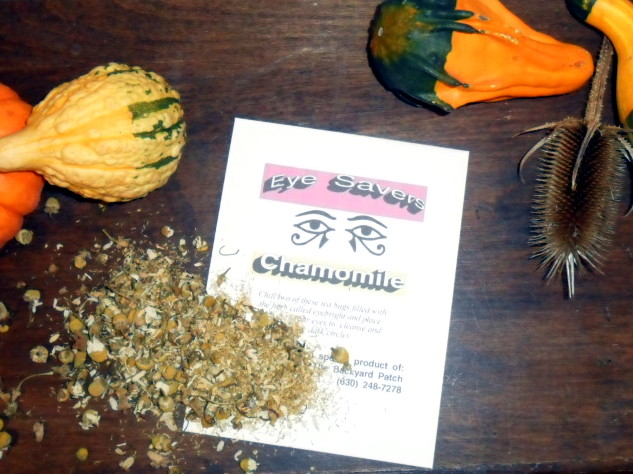
At the Backyard Patch, I have used Chamomile in a large variety of our Herbal Teas and as an eye soother, called Eyesaver, as well as including it in some of the newest Herbal Salves and Lotions.


Recipes

Perfect Chamomile Infusion
1 pint water
Handful of chamomile flowers and leaves

Bring water to a boil and pour over leaves and flowers in a bowl.  Cover and let stand for about half a day.  Strain.  Use the spray to keep seedlings from damping off.

Herbal Hair Rinse
This flower water and vinegar rinse removes soap residue and adds a sparkling healthy conditioner to your hair.

2 oz. Rose Water or other flower water
2 oz. Apple cider vinegar
2 oz. Chamomile herbal infusion (tea).
Combine Rosewater, vinegar and the cool herbal infusion.  Shake well before using as a hair rinse, then massage into washed hair.  Leave on for a few minutes. Rinse off as usual. Chamomile will provides subtle golden tones for blond, light brown and auburn hair.

Perfect Chamomile Tea
one heaped tsp. of fresh or dried chamomile flowers
1 tsp. honey
slice of lemon
hot water

Place the flowers in a mug and pour boiling water over.  Cover and leave to steep for 3 to 5 minutes.  Strain, and then add honey and lemon.  Can be drunk hot or cold.

Blossoms of Health Tea
Beautiful to look at, nectar to taste and good for you too. This is an uplifting and energizing blend.
1 part ginkgo leaves
1 part red clover tops
1 part nettle leaves
1 part meadowsweet leaves
1 part calendula
2 parts chamomile
2 parts lavender flowers
1 part gotu kola leaves
a pinch of stevia.

Place all herbs in a tea ball or bag, put in your nicest or most favorite cup or mug, and cover with boiling water. Steep for 10 minutes.

Pleasant Dreams Pillow Sachet
8 parts rosebuds & petals
3 parts chamomile
3 parts lemon grass
3 parts mugwort
1 part cellulose fiber
1 part lavender
1 part spearmint
Lavender Essential Oil (optional)

Sachets are attractive cotton, silk or linen bags filled with herbal scents and tied with ribbon.  Sachets are often small, traditionally about 3 to 5 inches (but you can make them any size.) Blend the ingredients together in a tightly lidded container and allow to cure a minimum of 4 weeks before filling sachets to maximize aroma.


Relaxing Bath Blend
5 parts chamomile
3 parts lemon grass
3 part rose petals pink
2 ½ parts passion flower
2 parts orange peel
2 parts jasmine flowers
ylang ylang Essential oil (optional)

Blend the herbs together and store in a tightly lidded container.  Fill a small muslin drawstring bag or large sealable tea bags with about 4 Tbls. of the mixture.  Add 4 cups of boiling water to bath sachet and steep for 15 minutes.  Pour into hot bath using sachet as sponge to massage skin.  Discard herbs after use.  Keep dry bath herbs blends in jars away from light and heat.


Saturday, June 25, 2011

Herbal remedies for Hair Issues

My sister-in-law has well water that is high in iron, so they have a water softener to cut the iron content.  The result is her hair is brittle and frizzy from the drying effects of hard treated water.  I suffered with this for years, so I quickly agreed to work on something herbal to help her hair.  There are a few herbal treatments that can soothe your scalp and enrich your hair thus reducing the effects of hard or treated water, like hers.  These are the recipes I put together for her.

Luxurious Hair Rinse

Relieve scalp itch and revitalize brittle hair with this blend of moisturizing oils and herbs.  A hint of lavender scent makes a perfect finish.

1 Tbls. cut or powdered comfrey root
1 Tbls. violet leaf
1 Tbls. cut or powdered marsh mallow root
1 Tbls. plantain leaf
2 cups water distilled or filtered water
¼ tsp. jojoba oil
2 drops lavender essential oil

Place dried herbs in a non-reactive container.  Boil 2 cups water and pour over herbs.  Steep, covered for 6 to 8 hours.  Strain the infusion through a fine strainer or cheese cloth.  Discard solids.  Gently warm the infusion, then add the jojoba and lavender essential oils.  Cool and use as a rinse after washing hair.

To USE: Work ½ cup of rinse into your scalp and hair.  Then holding your hair over a large bowl, pour a cup over your head.  Pour the liquid that collects in the bowl back into the cup and reapply.  Repeat several times, working the infusion through your hair.

Herb-filled Vinegar Hair Rinse

A vinegar rinse will cut soap residue and leave your hair shiny.   It will also reduce the build up of iron deposits from hard water.

1 Tbls. nettle leaf
1 Tbls. cut or powdered comfrey root
1 Tbls. basil
¾ cup apple cider vinegar
2 drop basil essential oil
4 drops lavender essential oil
distilled water

Place the herbs in a non-reactive container.  Heat, but don’t boil the vinegar and pour over herbs.  Steep the mixture in a covered container, for 3 to 6 weeks, shaking or stirring it daily.  After it has steeped, strain the infusion through a fine strainer or cheese cloth, saving the liquid.  Discard the solids.  Add 1 drop basil oil and 2 drops lavender oil for every ¼ cup of vinegar.  Use as a rinse after shampooing hair.

To USE: Massage 1 to 2 Tbls. of full-strength vinegar infusion into the scalp and hair.  Wait a few minutes, and then rinse with plain water.  Or you can dilute the vinegar infusion (1 Tbls. vinegar to 1 cup distilled water) and pour one cup of the solution for short hair, 2 cups for long hair.  Repeat several times, then rinse with plain water.

I will be making this vinegar rinse soon because I liked the way it worked on my hair.  Up until now I only made a Rose Hair rinse which you can find on the site by clicking HERE!

Related Posts Plugin for WordPress, Blogger...