Showing posts with label Apple Mint. Show all posts

Monday, June 29, 2026

Nature's Coolest Helpers: Beating the Heat with Herbs

When the temperatures climb like they are this week in Illinois and surrounding areas, it's tempting to retreat indoors with the air conditioner running full blast. But herbs have been helping people stay cool, hydrated, and refreshed for centuries and are worth a try. Whether you're sipping a glass of herbal iced tea, adding cooling herbs to your meals, or harvesting from your garden in the early morning, herbs can make even the hottest summer days more enjoyable.

Cool from the Inside Out

Many herbs have naturally refreshing flavors that make them perfect for summer drinks.


Mint

Perhaps the king of cooling herbs, mint creates a refreshing sensation thanks to its natural menthol. Add fresh sprigs to water, lemonade, iced tea, or fruit salads. Mint also makes an excellent herbal tea that's just as delicious served over ice.

Lemon Balm

With its gentle lemon aroma and calming qualities, lemon balm is wonderful for stressful, hot afternoons. Brew it into an iced tea or combine it with mint for a refreshing summer blend.


Hibiscus

If you're looking for something colorful, hibiscus makes a beautiful ruby-red iced tea. Its tart, cranberry-like flavor pairs well with honey, citrus, or berries and is wonderfully thirst-quenching.

Lavender

A small amount of lavender adds a floral touch to lemonade or iced tea. Just a little goes a long way, creating an elegant summer beverage perfect for entertaining.

Add Herbs to Summer Meals

Heavy meals can feel overwhelming in hot weather. Fresh herbs brighten lighter dishes and add plenty of flavor without extra salt.

Try adding:

  • Basil to tomato salads and pasta. We love to slice tomato and cucumber and spread them on a plate.  Sprinkle them with our Greek Blend and drizzle with olive oil and/or balsamic vinegar.  Cool, refreshing and filled with summer goodness.
  • Dill to cucumber salads and yogurt dips.
  • Parsley to grain bowls and potato salad, perfect with our Summer only Potato Salad Seasoning.
  • Chives over grilled vegetables.
  • Cilantro in fresh salsa and tacos.

Herbs allow simple seasonal produce to shine.

Make Your Own Cooling Infused Water

Skip sugary drinks and make a naturally flavored herbal water.

Some favorite combinations include:

  • Mint + cucumber
  • Lemon balm + lemon slices
  • Basil + strawberries
  • Lavender + blueberries
  • Rosemary + orange slices
  • Borage + cucumber

Let the mixture steep in the refrigerator for several hours before serving over ice.

Zesty Citrus Cooler (Made with Zesty Lemon Tea)

  • 2 Tbsp Backyard Patch Zesty Lemon Tea
  • 2 cups hot water
  • 4 cups cold water
  • Lime slices
  • Lemon slices
  • Cucumber ribbons
  • Mint

Brew tea in two cups water and allow to steep 15 minutes.  Add cold water along with lemon, lime and cucumber and allow to chill several hours.  Then serve with ice and a sprig of mint. Perfect after gardening or spending time outdoors.

Harvest Smart During Hot Weather

Summer heat can be tough on herbs too.

For the best flavor:

  • Harvest early in the morning.
  • Water deeply rather than frequently.
  • Mulch around plants to keep roots cool.
  • Pinch flowers on leafy herbs like basil and mint to encourage fresh growth.
  • Dry herbs indoors where temperatures are moderate.

A little care keeps your herb garden productive throughout the hottest months.

Herbs Beyond the Kitchen

Cooling herbs aren't limited to food and drinks.

Fresh herbs can also be used to make:

These simple projects help you enjoy your harvest in new ways while making hot summer days feel a bit more comfortable.

Stay Cool Naturally

Summer doesn't have to mean simply enduring the heat. Herbs bring fresh flavors, beautiful aromas, and cooling refreshment to everyday life. Whether you're harvesting from your own garden or picking up a bundle at the market, there's always another delicious way to let herbs help you beat the heat.

So pour yourself a glass of iced herbal tea, head outside in the early morning to gather a few sprigs from the garden, and enjoy one of the season's greatest gifts—fresh herbs at their peak.


Saturday, November 15, 2025

Elderberry and Fresh Mint Tea - Tea Blend of the Month

Cooler weather, being indoors and vissiting with family and freinds often brings many airbourne illnesses, so I thought a tea you could keep in the refrigerator to use as an energy and immuity booster.  This is a two part tea you brew separately and mix together to serve. You can use any combination of fresh mint leaves you may have on hand to create this.


ELDERBERRY AND FRESH MINT TEA

Make a concentrated elderberry tea:

1 1/4 cup water
1 tsp dried elderberries
1 Tbls raisins

Bring water to a boil.  Reduce heat to simmer, add elderberries and raisins, close pot and simmer for 15 minutes.  Remove from heat, allow to come to room temperature and strain off the liquid.  You can keep the concentrate in the fridge for a week.

Make mint tea:  

Any combination of mints will work, so if you have a flavored mint, like lime, chocolate, orange or more, add those.  For a base I used spearmint and applemint in mine.

With fresh herbs we used 1 Tbls of fresh mint per cup of water (1 tsp of dried mint).  Bring water just to a boil, turn off heat. Place herbs in a teapot and pour over water.  Steeping with the lid closed on the pot for 3-5 minutes.  Remove the herbs.

Mix the two teas together, altering the ratio depending on whether you want more mint or more fruit flavor.  The raisins will give some natural sweetness, but you can also add honey.  Great as an iced tea, but excellent to keep handy in the fridge to heat up in the winter for your daily boost.  Drink daily 


Wednesday, July 13, 2022

Tea Ideas for the Month of July

July is the height of the gardening season.  The herbs are growing, the flowers are blooming, and the vegetables are ready for harvest.  Everything is in its prime. The perfect time to make a tea that is filled with flowers and aromatics.  So this month I have two tea recipes and a scone mix that will let you take advantage of nature's bounty.

Aromatic Tea

Chamomile provides calming effects, catnip for relaxation and marjoram for its sweet mellow taste. And if you use mint it will be both cooling and relaxing.

    bunches of herbs on a slate
  • 5 parts chamomile
  • 4 parts marjoram
  • 3 parts catnip
  • 2 parts mint (optional)

Combine herbs if dried in glass jar for storage to use later.  If using fresh, tear the leaves from stems before measuring and use a small enough amount that you can make and use on the same day to get the best flavor from your fresh herbs.

For dry: Use 2 tsp per cup of hot water and allow to steep for 5 to 7 minutes.

For Fresh: Use 2 Tablespoons per cup of hot water and allow to steep 10 minutes.


Bright Mint Tea

This is a different way to make a mint tea.  You are in essence making a concentrate, then straining out the herbs and crafting an iced tea with the intense remaining liquid.

Wash 8 sprigs of mint, twelve inches long (any mint, spearmint, peppermint, applemint, orange mint, chocolate mint.  This one is perfect for the exotic varieties of mint.)

 Remove the leaves from the branches and place in a blender with four cups of water and liquefy. Allow it steep for at least 1 hour up to 2 hours and then strain out the solids.  The resulting green liquid can then be served with ice and diluted as needed to taste.

Here is a perfect recipe for making scones from fresh herbs,  you can use any combination you want. Chives are always good in a savory scone as is marjoram, savory, rosemary and dill.

Fresh Herb Scones

  • 1 1/2 cups all-purpose flour
  • 2 teaspoons kosher salt
  • 1 tablespoon baking powder
  • 6 tablespoons very cold unsalted butter cubed
  • 2 large eggs
  • 1/4 cup assorted fresh herbs, finely diced 
  • 1/4 to 1/2 cup whole milk or heavy cream
  • 1 egg beaten for egg wash or substitute heavy cream

herb scones sporting butter on a white plate

Preheat your oven to 425 F degrees. Using a large mixing bowl, whisk together the flour, salt, and baking powder. Toss the cold butter cubes into the flour mixture and rub in the butter throughout the flour using your fingers. Continue until you have tiny pieces of butter throughout. And the dough looks like a coarse meal. Make a well in the center of your bowl, whisk the eggs together and add them directly into the center of the bowl, into the well, and pour in the milk (starting with a ¼ cup and use more milk as you need it. Add more milk if the dough isn’t wet enough or if needed.) and the fresh herbs. Using your hands like a claw, mix together all of the ingredients until just combined.

Transfer the dough to a lightly floured work surface. Sprinkle a little bit of flour on top of the dough as well so it’s easier to work with. Do not knead the dough but shape just enough to make round and flatten.

To make scone wedges: Once you have your dough in a round shape, use a bench scraper or knife to cut your dough into 8 wedges or triangles.

To make round scones: Flatten your dough by hand and use a round biscuit cutter to make round scone shapes. Continue until all of the dough has been used.

Transfer to a lined baking sheet and brush the tops of the scones with your egg wash. Bake for about 14 to 15 minutes until golden brown. Enjoy!


Wednesday, May 11, 2022

New Feature - Monthly Herb Tea Crafting Ideas

I have a boat and a garage and a house full of tea recipes.  Some I learned, some I crafted from scratch some I created by accident. I share them regularly on the blog (you can find them by searching Tea Recipes on the blog) but I thought it might be nice to be more organized about it and share some tea creating ideas every month. These will include recipes for tea, recipes for items to serve with tea and highlights on herbs to grow for making tea. 

I started my first herb garden in 1992, because I love herb tea.  However I wanted my herb (caffeine-free) tea to be as nuanced in flavors as the black teas I also enjoy, like Earl Grey with a hint of orange from bergamot oil, or Assam Tea which has a chocolaty finish to go with the malty strong flavor. What was available in the stores were generally single herb teas like peppermint or chamomile and those were not subtle. So I began experimenting with herbs and their flavors and creating combinations.  

Raised bed herb garden with bird bath and purple blooming chives

I started with two-herb combos like Lemon balm and Lavender (now called Lemon Lavender Splash and made with multiple lemon herbs) or Lemon balm and peppermint (called Lemon Peppermint and made in the winter because of its throat-soothing properties.) Then I moved to three and four herb combinations like Dreamtime (chamomile, lavender and catnip,) Headache Relief  a combo of lavender, rosemary and thyme and Nerve Soothing (sage, thyme, marjoram, chamomile, because you can be soothing without lavender.)

tilted tea cup spilling out dry herb tea blend nerve soothing

Once I gained confidence in my blending skills, I began making multi-herb blends like my popular hot and iced tea called Calming Spirit named so because it is made with relaxing herbs of spearmint, lavender, chamomile, rosemary and cloves for color. Now I can create a tea with any number of herbs and spices and enjoy a side hustle of custom tea blends for groups, events and weddings.  If you have questions about herbs for your tea, please ask in the comments down below.

There are many recipes I have made or adapted to try at home, use in cocktails and tryout for programs so I thought I would share some of these experiments and perhaps a few of my commercial failures with you and let you judge them for yourself. And since herbs are best with shortbread and scones, I will share a few of those recipes along the way as well.

As it is May I decided to start with an iced teas, you can then enjoy a cooling blend as summer heats up. Although as I write this is is not yet very warm, I am hopeful that by publication it will be warm enough outdoors for you to enjoy these recipes on your porch or deck.

Tea Idea to Start

Lemon Verbena-Apple Mint Tea
Nothing is more refreshing in the summer than lemon verbena iced tea, and a hint of apple and mint adds a twist.

1 cup fresh lemon verbena leaves, loosely packed
½ cup fresh apple mint leaves, loosely packed
2 quarts water

Bring water to a boil.  Turn off water and add the herbs, bruising them slightly.  Cover pot and let sit for 10 minutes.  Strain out herbs, allow to cool and add ice.

Another Tea Idea

Now if you do not bring in your lemon verbena plants for winter like I do , you might not have any of that herb just yet, so here is a recipe you can make with kitchen herbs, or those you can gather at the grocery. I shared this years ago in my herbal newsletter - which is now called the Good Thymes....

Nippy Iced Tea  

  • 5-6 stems catnip
  • 4-5 stems peppermint
  • 4-5 stems lemon balm
  • A bit of sage 1-2 leaves

Because you are dealing with stems of herbs, place the stems in a roaster pan pour boiling water of them and let steep 20 to 30 minutes.  Chill and serve over ice with a splash of fresh cool water. Start with one quart of water and if it is too strong add another quart.  Allow to cool then serve with ice.  The mint is cooling and refreshing while the lemon balm is uplifting.  The catnip and sage will help with allergies too!

Stop back next month for more tea ideas!

Sunday, September 1, 2019

Final Harvest Season is Starting

I harvest herbs all year.  I judge a year by how soon I can take my first harvest.  This year it was not until mid May and that, to me, is late.  I lost at least two possible harvests in the spring.  Come mid summer I need to harvest regularly to get the plants more bushy and larger for improved and better harvests.
                               

By September I am doing what I call the final harvests.  Once the days get shorter I can no longer be as ruthless on my plants. During the height of the growing season I will cut between 2/3 and 3/4 of the height of a plant without fear that it will return with new growth.  That was evidenced by my harvest of lemon balm this year.  I kept cutting it back to 3 inches in height and I kept getting plants this big.
Lemon Balm, new growth after harvesting

Today I was harvesting Apple Mint to use in a program in a couple weeks at Schaumburg Library.  We will be using it in a tea blend.


My general rule with harvesting is cut the herbs, bundle the stems anywhere between 10 and 12 stems minimum and hang them.  I don't do anything special except line up the bases of the stems and wrap with a rubber band.

However, when harvesting mint, especially a large leaf mint like apple mint, I change my technique just a bit. Here is the Apple Mint haul.


The plants are large 3 to 4 feet tall, the leaves can get 2 to 3 inches in length and are thick and filled with moisture. Yes, I do say cut your herbs before they flower, but that rule never applies to Mint.  If the flowering is reducing the flavor or scent, I can't tell which means I can let these mature undisturbed until I am ready to harvest.

I cut the branches about 1 foot from the ground and stack them on a table out of direct sun to wilt for a while.  An hour or two depending on how busy I am.  The wilting gives me a better feel for how thick and large the stems are before I bundle them.  I want them to dry quickly so a smaller bundle is preferred.

With mints the leaves have a lot of moisture as do the larger square stems.  As a result I do two things while prepping the mints to dry.  I strip off the leaves at the base of the stem.


And I only use 6 to 8 stems, never the 10 to 12 average I use with other herbs.

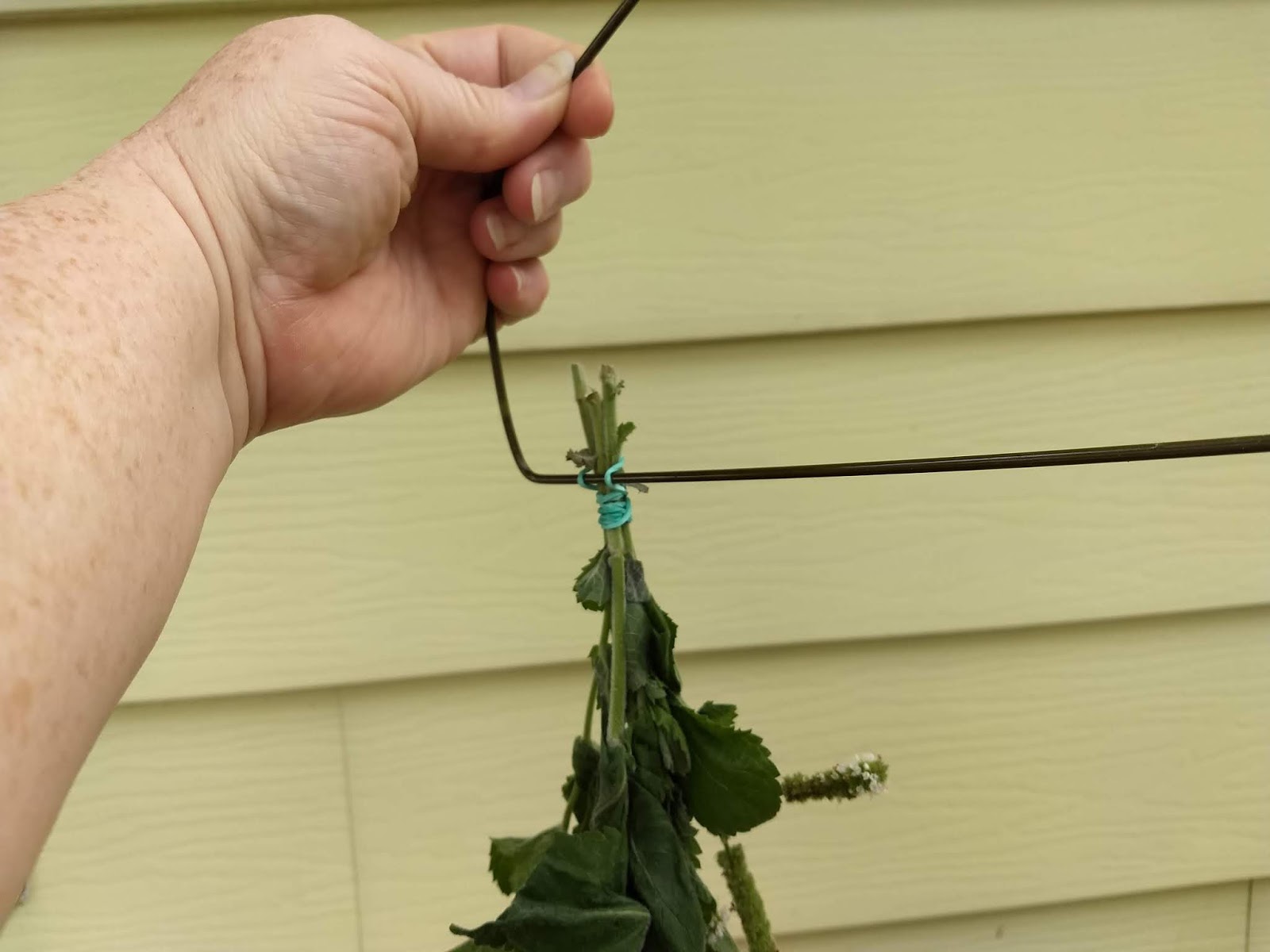
I bundle them with a rubber band.  Sure you can use string, but as the stems shrink in drying, the herbs will fall and I dislike cleaning up that mess.


Then stretch the band over the arm of a hanger and suspend the herbs.  In my herb drying shed I use the same technique over dowel rod arms on a large frame where the dowels are 12 inches apart.


Sometimes I dry on two racks hung over one another, but with a bundle as long as this I only dry on one rack.

The time it takes for the herbs to dry varies depending on heat and humidity.  Right now humidity is low, but temps are cool, so the drying time I expect to be 2 weeks.  Just in time for the program on September 12.

I saved the leaves I stripped off and stems.


Then sorted through them.  Those that were in good shape, I saved and laid out on a paper towel on the kitchen counter.  I do this often and have a small collection of drying leaves most days.  You can lay them very close together, because in a couple days they will shrink leaving plenty of space between the leaves.

Dried branches of lemon balm show what I mean.

Once the herbs are dry, they should be stored in a glass jar so they do not re-absorb water from the environment.  You know they are completely dry when they crumble easily in your hand when you scrunch the tips of the leaves.


Tuesday, August 7, 2018

Pineapple Mint Ice

Yesterday we shared a Basil-Lime Sorbet recipe.  Today I have a Pineapple Mint Ice which is simpler to make with just a blender and a pan to freeze the ice.


Pineapple Mint Ice
1 cup cubed fresh pineapple (or 1-8.25 oz. can unsweetened chunks)


1/4 cup honey

1/2 cup grapefruit juice
15 to 20 fresh pineapple or apple mint leaves
1/2 tsp grated fresh lemon peel

2 Tbls fresh lemon juice
Springs of fresh mint for garnish

Mix all ingredients together.  Puree until pineapple is completely blended and mint leaves are finely chopped.  Place in the freezer in a backing pan until mixture is firm but not solid, about 1 to 2 hours.  Scoop out into sherbet or tall parfait glasses.  Garnish with mint sprigs and serve.


To find any recipe featured this month - use the search box and type: GardAug

To find any theme recipe from this year type: recipe2018

For 2018 the monthly recipe themes will be:
   January - Chicken Soup (ChickJan)
   February - Beef Stew (StewFeb)
   March - Jambalaya (JambMar)
   May - Ham and Shrimp Dishes (ShrHamMay)
   June - Bread recipes (BreadJun)
   July - Grilling (GrillJul)
   August- Garden Delights GardAug
   September - Salsa, Corn and Jelly 
   October - Squash Dishes 
   November - Pumpkin Recipes 
   December - Herbal Cocktails 

Monday, March 12, 2018

Not all Herbs are created Equal - Annuals, perennials, tender perennials, biennials and shrubs

When choosing herbs to go into your garden or herb garden you must recognize that not all herbs are the same.  They need different growing conditions, they have different habits, they even come in different colors.  For the most part all herbs need full sun which is defined as 6 to 8 hours of sunlight a day, they enjoy a well-drained soil with a moderate amount of water.  Herb as weed-like so they can survive less than perfect conditions by growing more slowly or producing less leaves and flowers.  However, some actually thrive in different conditions, so it helps you know your plants a bit better.  I am going to present few terms you might find in books or on seed packets and what that means to growing certain herbs.

Annuals

Some herbs are annuals, these herbs are not cold hardy and have a single season growing habit that produces flowers and seeds for next year.  Many, like dill, have seed you can use to cook with as well as the leaves.  However, these plants are always trying to make seed so harvesting and cutting flowers off will increase their size and deter their natural habit.  Chervil, summer savory, any basil, cilantro, and dill are all annuals, but are easily grown from seed sown directly into the garden patch.


Dill – sow seeds bi-weekly for a continuous crop of this annual, giving you leaves and seeds to use in cooking.


Fennel - bronze Fennel is pretty with darker leaves than it green cousin and it is an annual you can grow easily from seed. Here it looks great flanked by Swiss Chard

Hardy Perennials

Some are hardy perennials, these will come back year after year producing many branches to be cut and used or dried.  They sprout early and sometimes depending on the weather you can actually get a hefty harvest in April even in the colder north. Mints, lavender, catnip, lemon balm, oregano, all are hardy perennials.

Apple Mint

Pineapple Mint
Mints – you can enjoy the many sub species to get different flavors, like Orange Mint, Mojito Mint, Chocolate Mint or Lemon Mint.

Tender Perennial

Tender perennials can come back year after year, but generally are not hardy below 32 degrees so if you live in the north you treat them as an annual or bring them in for winter, but in the south you may, with protection, be able to winter them over. Examples of a tender perennial include, rosemary, scented geraniums, pineapple sage, bay laurel and marjoram.

Marjoram -- is a tender perennial and many people grow it as an annual and harvest it to the ground before the first frost in the fall.

Biennial

parsley
Between tender and hardy perennials are the biennials.  These are herbs that come up a second year, but in that second year they are planning to flower and produce seed and not much else.  Many, like parsley and angelica, become less tasty during the second year and are often grown as annuals.

Parsley - this leafy plant grows in whorls close to the ground, but sprouts into a stock in the second year when producing seed.


Woody Shrub

Woody shrubs are herbs with a strong woody stem and can be grown in the landscape as a shrub or in the herb garden as a perennial.  These would include sage, winter savory and even the tender perennial lemon verbena. Some people consider lavender a woody shrub because it is often grown as a hedge, but the stems rarely get woody.

Common Garden Sage

Sage is attractive and comes in several varieties including purple and tri color, however the colored varieties are not as hardy as the original.

Tri-color Sage

Other Textures and Conditions

Some familiar herbs come different colors or textures, like tri-color sage, bronze fennel, golden oregano, variegated lemon balm.
Golden Lemon Balm
Some herbs love a dry area, like thyme which works great in a path or a rock garden.  

thyme in a stone walkway

You can also enjoy some great varieties here, with creeping thyme that has a great pink/purple flower; or variegated lemon thyme that adds color and other thyme varieties with different shades of green or white highlights like silver thyme, or Wedgewood thyme.
Golden Thyme
variegated lemon thyme
A few herbs even like wetter conditions, like Marsh Mallow or Meadowsweet.

Marsh Mallow - This bog dweller sends up tall spikes of lovely pink flowers and stately foliage. Reaching up to 6 feet in height, marsh mallow prefers full sun. Its seeds, flowers and leaves are edible, and yes its root is used to make marshmallows


Meadowsweet - Meadowsweet’s frothy cream-colored flowers and fragrant leaves are very useful. The plants grows 2 to 6 feet tall and is happy in moist or wet soil, in sun or part shade.


Related Posts Plugin for WordPress, Blogger...