Showing posts with label potpourri. Show all posts

Tuesday, February 11, 2020

6 Season Saving Herb Room Fresheners - How To-sday

I posted a blog with these 6 ideas back in 2011.  I was recently reading old blogs and adding photos to those that did not have pictures originally.  When I found this one, my immediate thought was, I should have shared recipes with this list.

So here is a recycled post with some great recipes that probably shows how far I have come since 2011!

Six Season Saving Herb Room Freshners


1. Hang sachets of aromatic potpourri from door handles or sunny windows.
Floral Sachet
This will make you think of spring with this amazing mix of floral scents.

½ cup rose petals
½ cup lavender blossoms
½ cup sweet woodruff
¼ cup mint
2 teaspoons orange peel
2 drops each of lavender and rose essential oils (optional)

Combine all the ingredients in a glass jar and allow to meld for a week, shaking every day.  Place in organza or muslin bags.


2. Push herb or spice sachets down the sides or back of couch cushions or inside cushion covers.

Sofa Sachet

This blend is part of my Make and Take portion of the Herbology 101 program.  Blend it up and place in a coffee filter closed with a rubber band and slip into the couch or chair and every time you sit down or get up you get a great burst of scent.

2 parts lavender
1 part rose petals
1 part mixed mint

Combine in a glass jar and shake.  Store tightly lidded until ready to use.
To Use: Place 1 to 2 Tbls in a sachet or coffee filter.  Place under or behind sofa coshions. Replace every 3 to 6 months.


3. Place a container of potpourri in the living room or bedroom.  Remove lid and stir potpourri and let scent fill the room.

Fragrant Potpourri

1 cup lemon verbena
¾ cup coneflowers
½ cup white sage
½ cup thyme leaf
½ cup lavender flowers
½ cup pink rose petals

Mix all herbs together in a bowl.  Scent with 5 drops each cedar, sage and lavender essential oils.  Toss until well combined.  Place in a bowl and stir or mist occasionally to keep fragrance alive.

4. Keep a small porous pottery bottle filled with a favorite essential oil near a sunny window so that the heat will cause the oil to evaporate.  


I used a terra cotta oil lamp.  It is an heirloom, so I never wanted to burn oil in it. Using sun to evaporate the oil works just as well.

This is in my bedroom window so the oils I use are uplifting and stimulating:
     peppermint (Mentha xpiperita)
     clove (Syzygium aromaticum)
     cinnamon (Cinnamomum zeylanicum)
     ginger (Zingiber officinale)
     rosemary (Rosmarinus officinalis)

5. Dab a little essential oil on a light bulb before turning it on. With the advent of LED lightbulbs this does not work as well, so you may want to try a stick diffuser instead.

To craft a stick diffuser, you need a small glass or porcelain vase and a package of bamboo skewers.

Carrier oils
Essential oil blend

Place at least 2 Tablespoons of carrier oil in the vase and add 4 to 7 drops of essential oil blend to the carrier oil.  Good carrier oils are almond or jojoba. Stir. Insert the sticks which will allow the scent to be carried into the room.

Recommended blends:

Relaxing Blend
12 drops lavender essential oil
6 drops marjoram essential oil
6 drops clary sage essential oil
3 drops bergamot essential oil

Keep combined oil in a small glass jar and use a couple drops at a time.

Romance Blend
6 drops jasmine essential oil
12 drops sandalwood essential oil
6 drops sweet orange essential oil
3 drops rose essential oil
3 drops vetiver essential oil

Keep combined oil in a small glass jar and use a couple drops at a time.

6. Put a couple drops of spicy essential oil on a cotton ball and wipe over your heater vent in wintertime for a comforting fragrance.

Use one of these antidepressant, yet relaxing aromas:
    bergamot (Citrus bergamia)
    scented geranium (Pelargonium graveolens)
    neroli (Citrus reticulata)
    rose (Rosa spp.)
    sandalwood (Santalum album)
    tropical flower ylang ylang (Cananga odorata)


So enjoy your scents and make your home fell and smell spring like since it doesn't look like winter is ending anytime soon.


Tuesday, December 6, 2016

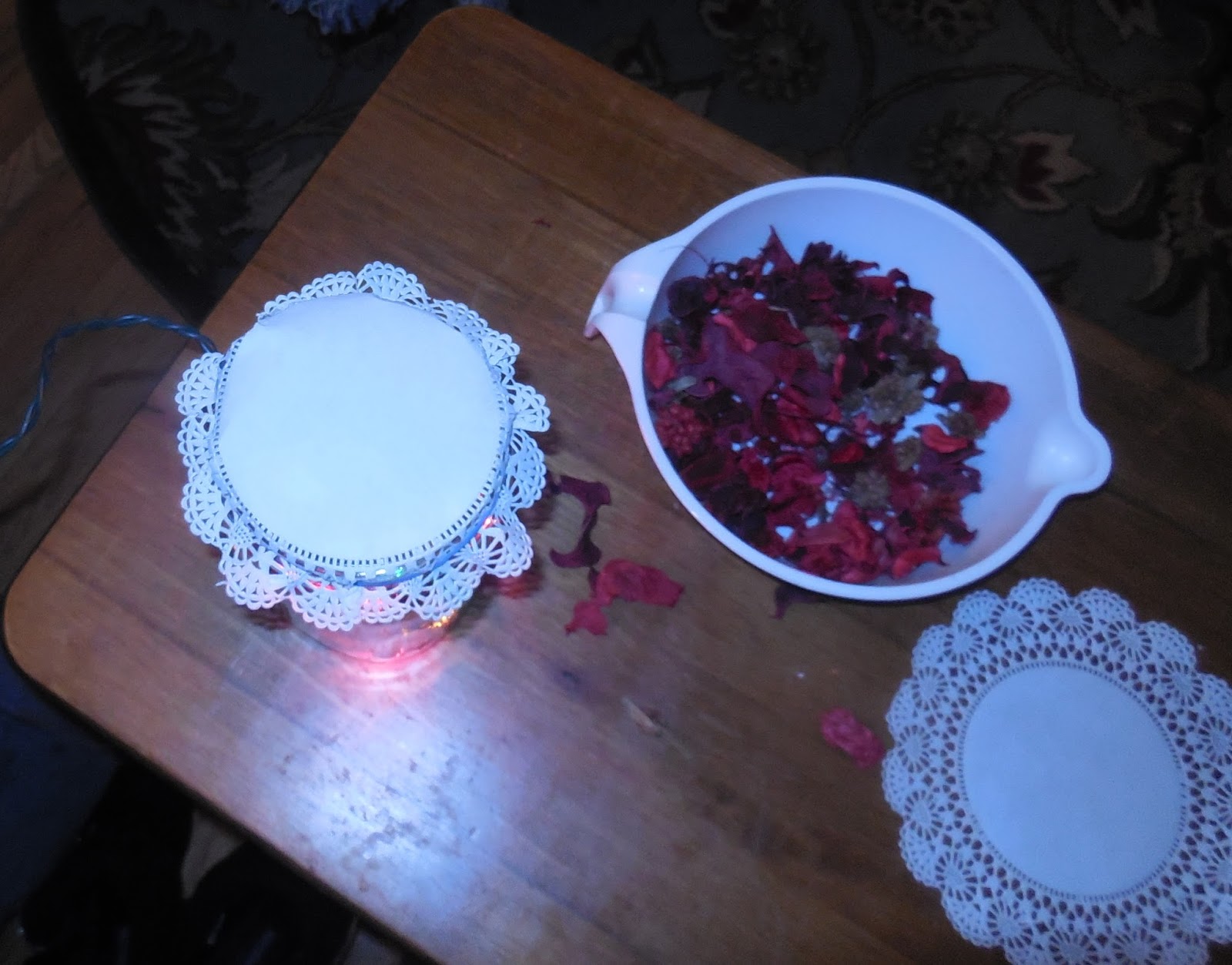
How Tuesday - Lighted Potpourri Jar

This is such a great item to make quickly and place in the bathroom.  It is festive, holiday themed and leaves a great scent when you have guests in the delicate room!


How to -

Step one - Gather your supplies.  You will need:


  • 1 wide mouth 1 quart canning jar
  • 1 string of 20 to 30 christmas lights (I got mine from the dollar store)
  • potpourri
  • two rubber bands
  • a paper or cloth doily
Step two - Potpourri
       I suggest making your potpourri rather than buying it, but in the essence of time, you can get some store-made at your local hobby center.  Here is recipe for seasonal potpourri if you want to try your hand at homemade.

Potpourri for the Holiday

  • 1/2 cup dried cranberries
  • 2-3 cinnamon sticks, crushed
  • 1 to 3 star anise, broken is fine
  • 1 tablespoon cardamom pods, crushed
  • 2 teaspoons whole cloves
  • 1/4 cup candied ginger or 1/8 cup dried ginger root pieces
  • Needles from a pine branch, or from one sprig of rosemary (about 1 tsp. dried rosemary)
  • 5 to 7 slices of dried orange
  • 1 to 2 tsp dried mint leaves
  • 1 Tbls. dried bay leaves
Combine ingredients in a jar and shake to blend.  Store in the jar for a few days to meld the scents.
Use as the potpourri in this project or add 1 cup mixture to a medium saucepan and fill 3/4 full with water and use as a potpourri simmer on the stove.

Step three - Fill the jar with lights and potpourri

Place a layer (about 1 inch deep) of potpourri in the bottom of the quart jar.  Thread in the lights and arrange on top of the potpourri.  Plug them in while you are working so you can see your progress. 

Add more potpourri as you thread in the lights and arrange the lights and potpourri artfully so you can enjoy the lights and the colors of the potpourri together.

Top off the jar with potpourri, leaving the tail end of the light cord outside the jar.


Step four - top the jar

Place a rubberband around the top of the jar to hold the string of lights in place over the rim.  Add the doily to the top and, using the second rubber band, secure the doily in place.   Now you have a scent opening.  Tie a bit of ribbon around the rubber band to cover it.


Step five - plug in to final resting place and enjoy!

We also had the one with the multi-color lights on the book shelf in the livingroom.


Wednesday, May 15, 2013

Sweet Woodruff - Herb of the Week

The planets seemed to align and tell me to choose this herb this week.  Tina Sams from The Essential Herbal Magazine, said they served May Wine (which is made with Sweet Woodruff) at an Herb Festival back in the early days.  I took pictures of Sweet Woodruff that has volunteered in my herb garden. Then author Susan Wittig Albert focused on Sweet Woodruff in her weekly herb newsletter “It’s About Thyme.” 

With all that karma it has to be this week’s
      Herb of the Week  -- Sweet Woodruff (Galium odoratum)


This herb has many names in some cases it is known as Sweet Bedstraw or Wild Baby’s Breath.  In France it is known as Asperule Odorante which is sometimes incorrectly given as its scientific name.  The name woodruff grew out of the earlier wuderove, or "wood-wheel" (rove comes from the French word for wheel). Master of the woods would be a literal translation of the German name Waldmeister.

The plant contains the plant chemical coumarin, and when it is dried smells like a cross between freshly-mown hay and vanilla. It is this aromatic quality that give it the scientific name odoratum.  This scent increases on wilting and then persists on drying. It has long been valued for potpourris and perfumes and is a favorite in both sleep and moth repellant sachets. It was once used to stuff mattresses and pillows (hence the name, bedstraw).  For gardeners with a shady, wooded area, sweet woodruff can be an ideal groundcover.

Historical Uses

In the language of flowers Sweet Woodruff means "Be cheerful and rejoice in life."  It is used in Wedding bouquets to communicate that sentiment.  Those born under the sign of Capricorn  count Sweet Woodruff among their useful pants mostly because during the Middle Ages, the herb gained a reputation as a wound healer and was used to treat digestive and liver problems.  To celebrate St. Barnabas (patron saint of peace makers) on his feast day in June one can where a garland of roses, sweet woodruff, and wild William as the Saint once did.


 “From my youth I recall that elusive smell of woods in spring—a sweetness ascending from mold and decay but with the breath of young life rising from it.”
            ~ Adelma Grenier Simmons, Herb Gardening in Five Seasons referring to Sweet Woodruff and May Wine


To Grow

Sweet Woodruff is a flowering perennial plant in the family Rubiaceae, native to Europe, North Africa and Western Asia. An herbaceous plant, it grows to 8 to 10 inches long, often lying flat on the ground or supported by other plants. This is the time of year we see the wheel-shaped spirals of leaves on a square stem that are the signature of Sweet Woodruff.  Small, fragrant, glossy-green leaves grow in whorls around the slender, many-branched stems.  Loose clusters of small, white, star-shaped, fragrant flowers arrive in late spring.  These Spring flowers are edible.  A low growing shade loving plant, it makes an excellent ground cover. Sweet woodruff grows in shady patches at the edge of forests. It has star-like whorls of narrow, bright-green leaves on 8 to 10-inch high stalks. 

Sweet woodruff is a low, rapidly-spreading, perennial plant that forms clumps about 8 inches in height. The slender leaves are borne in starry whorls. The flowers are tiny and white and form in loose clusters.  Sweet woodruff can be grown as a perennial down to Zone 4, but it needs winter protection in Zone 3 and lower. It will thrive in semi shade and makes an attractive ground cover under taller plants. It prefers a Moist, well-drained soil.  I noticed that it does not seem to mind a more acidic soil as it grew well surrounding my Pine Trees at the front and back of my property. 

Try to plant in a location that enjoys full shade / dappled sun and remember to water very often. Use Zone 4 - Zone 8 as your guideline for the appropriate climate for this plant. Sweet woodruff is generally regarded as a hardy plant, so it can be safe to leave outdoors for the majority of winter (although if in doubt, using a row cover is often a good idea).

Sow seeds directly in the garden during late spring, or select bright green seedlings that haven't flowered.  Transplant Sweet Woodruff from established areas in spring before the weather gets hot.  Place plants five to nine inches apart and mulch them well if they will receive more than four hours of full sun each day. The plants will spread and grow into one another, creating a dense mat. It is shallow rooted so a little judicious thinning is fast and easy to do of the plants begin to overtake an area.

Uses

The sharpness of woodruff is seen by those who make their own beer ad being mildly reminiscent of hops. In Germany they will use it not only to craft May Wine, but also craft a woodruff-flavored sugar syrup used to balance the lactic acidity of a spritzy Berliner Weisse.

Traditionally used to make May Wine in Germany, with strawberries and sweet white wine, the aroma is used for flavoring and coloring bright green waldmeister jelly.  This strongly scented plant, gets it sweet smell from coumarin. It is also used, mainly in Germany, to flavor May wine, beer (Berliner Weisse), brandy, sausages, jelly, jam, a soft drink called Tarhun, ice cream, and an herbal tea with gentle sedative properties. High doses can cause headaches, due to the toxicity of coumarin. Very high doses of coumarin can cause vertigo, somnolence or even central paralysis and apnea while in a coma. Since 1981, woodruff may no longer be used as an ingredient of industrially produced drinks and food stuffs in Germany.

Harvest the leaves for tea or for May Wine. Select blemish-free, young growth and try to harvest and dry plants in the spring when fragrance is the strongest.   As ever, when harvesting from the wild you should use a good field guide, be aware of look-a-like plants.  It is possible to confuse Sweet Woodruff (Galium odoratum) with Cleavers (Galium aparine) Cleavers is also a medicinal plant so confusing the two will not be harmful.  You will know the Sweet Woodruff by the stronger aroma.  Sweet Woodruff is darker green and has sticky hairs on its seeds, but the leaves tend to be smooth and more pointed. Sweet Woodruff is a perennial whereas Cleavers is an annual.

Recipes
 

May Wine Punch
    recipe from Susan Wittig Albert  

1 gallon of Rhine wine
12 to 16 sprigs of sweet woodruff
1 package of frozen strawberries, thawed
1 cup sugar
Fresh whole strawberries

Directions:
Dry the sweet woodruff sprigs overnight in an off but warm oven.  Then steep the Sweet Woodruff in the wine for 3 to 6 days.  Chill before serving.  Remove the herbs and pour the chilled wine in a punchbowl over an ice ring.  Mash thawed strawberries with a cup of sugar and stir into the wine.  Add champagne for a bit of bubbles and garnish each glass with a fresh slice of strawberry.

Wedding Potpourri (to toss on the Bride and Groom)

Amaranth: "Everlasting love"
Chamomile: "May your wishes come true"
Coriander: "Your closeness is welcome"
Feverfew: "You light up my life"
Lavender: "Devotion; loyalty"
Marjoram: "Joy and happiness"
Mint: "Warmth of feeling"
Rose: "Love; beauty"
Sage: "Long life and good health"
Thyme: "Strength and courage"
Woodruff: "Be cheerful and rejoice in life"

Directions:
Combine these dry ingredients and place inside paper doilies or tissue tea bags so guests can easily tear them open to toss the contest over the bride and groom.  The rich symbolism of the language of herbs and flowers makes this a special part of the ceremony.

If this is just a symbolic potpourri not used to toss, Rosemary "Remembrance" can be added.

Aromatic Mint Tea
Remember that Sweet Woodruff is fine in moderation but excessive amounts can cause a build-up of coumarin which causes headaches and vertigo.  Enjoy this tea only occasionally and in small amounts.

2 parts Spearmint
1 part Marjoram
1 part Sweet Woodruff
1 part Sage

Directions:
Blend herbs together and keep in a jar with a tightly fitted lid.  Use 1 tsp. per cup of boiled water and allow to steep 5 to 7 minutes.
Scented Pillows
One of the best ways to enjoy Sweet Woodruff is to use it in pillow or a sachet.  The herb is considered a fixative in moth repelling sachets, as it does not attract insects so its nice aroma can be used to offset the smell of insect repelling herbs like eucalyptus and penny royal.

Dream Pillow Blend
Jim Long in his book Making Herbal Dream Pillows suggested this combination of herbs to create romantic dreams. Which according to Jim are the type you fondly recall but do not share aloud.  At the Backyard Patch, I use Sweet Woodruff in several Household Sachets.

 2  cups calendula flowers
 2 cups rosemary
 2 cups rose petals
1/2  cup lemongrass, cut in short pieces
 1 /2 cup sweet woodruff
 1/4 cup mugwort
 ½  tablespoon mint
 1/2 tablespoon marjoram
 1/2 teaspoon fennel seed
 1 lemon geranium leaf (such as ‘Mabel Grey’)
 1 piece cinnamon bark, about 1/2 inch long, broken

Directions:
Combine the herbs in container and allow to meld for 2 to 3 weeks before placing about ½ cup into a sachet or using to stuff a pillow.

Orange-Eucalyptus Scented Sachet
2 oz. hops
1/2 oz. Eucalyptus
 1 oz. meadowsweet
1 oz. woodruff
 1 oz. crushed cloves,
1 oz. crushed orange peel
1 oz. orris root
few drops sweet orange essential oil

Directions:
Mix all ingredients and store in a covered jar for 2 weeks, shaking container daily. Pack the dried flower mixture into a small pillow made of closely woven fabric.

Thursday, October 4, 2012

Five ways to use Lavender in Your Home this fall

No other herb is quite so prized for its fragrance and beauty, or more evocative of romance than lavender.  The season for harvesting lavender has just passed and I have a number of screens full of dried buds.  
Lavender has a laundry list of good-for-you properties.  It is antiseptic, anti-bacterial, anti-fungal, anti-inflammatory, anti-convulsive, and anti-depressant. Lavender benefits stress, anxiety, exhaustion, irritability, headaches, migraines, insomnia, depression, colds, digestion, flatulence, upset stomach, liver and gallbladder problems, nervousness, and loss of appetite.  With this in mind, I glanced through just a few notes in my file drawer and came up with five great ways to put lavender to work for you.
Relaxing Lavender Bath
Make a strong infusion by adding a handful finely chopped lavender leaves and flowers to a cup of boiling water. Let it steep 10 minutes, strain and add to your bath.  Lavender will not only relax you with its scent but will reduce the stressful feelings with it essential components.
Drowsy Potpourri
Fill a bowl by your bedside with rose petals and dried lavender flowers. Add a drop or two of lavender essential oil. Finger the bowl before drifting to sleep.
Sleepy Sachets
Put lavender flowers and a few drops of essential oil in sachets to slip beneath pillow or inside the pillow case for a soothing release of scent if you wake or turn in the night. Or if you don’t have time pick up a few Lavender Sachets from the Backyard Patch to slip into Birthday cards and hostess gifts.


Lavender Moth BagsMix equal parts of the herbs from the following list. Place them inside muslin bags or if you are feeling especially crafty, sew squares of thin cotton or use heat seal tea bags to create sachets.  Lay them in with your blankets and towels or put them in between your clothes in the drawer.
Dried Herbs to use:
lavender flowers
lavender leaves
mint
rosemary
southernwood
santolina
marjoram
  
The Backyard Patch makes two different Moth Sachets as part of our Green Cleaning line and one has a recipe very similar to this one, using lavender to combat bugs in storage.

Lavender Room SprayAdd 5 drops lavender essential oil to 50 ml distilled water in an atomizer. You will need to shake the atomizer vigorously before each use. Do not make large quantities as the keeping time is relatively short.
Hope you enjoy this short list and remember to use your lavender for all the seasonal effects of shorter days and time changes.

Wednesday, November 23, 2011

Day Before Thanksgiving Potpourri Simmer


Do you want your home to spell great when the guests arrive and set the stage for the holiday?

Try this --

Grab a small sauce pan or an old mug and a mug warmer.  Then slice 1/2 an orange and 1/2 a lemon.  Add ten cloves, two bay leaves, and two cinnamon sticks.  Add enough water to the container to cover.  Then simmer mixture on the stove or the warmer.  Add more ingredients as desired to keep your house smelling delightful for the holiday season even after Thanksgiving!

Come back Saturday to learn about our special Advent Calendar...


Saturday, March 19, 2011

Tidbits from Phyllis Shaudys on using herbs

Recently I was cleaning off my desk and found I had pulled out my copy of Phyllis Shaudys' The Pleasure of Herbs: A Month-by-Month Guide to Growing, Using and Enjoying Herbs (Storey Communications, 1986).  This was the first book I had on herbs when I started growing and using them.  It was recommended by my friend Elizabeth and I still refer to it on a regular basis.  I now have two copies, this one, and a hardback reprint from Barnes and Noble from 1997.  That means that I can truly use this as a resource and carry it out to the garden, haul it around to lectures and bring it with me to farmer’s market and other shows I do.  It is beginning to look well loved as you can see.

Phyl (as she called herself) recommended actively marking your herb books so you could easily find things you wanted again in future.  However, she suggested you mark the books with a marker or a highlighter.  I cannot do that!  It is probably the historian in me, or maybe the museum curator I was for more than 20 years, but marking a book in any permanent way is beyond my sensibilities.  Instead I fill them with slips of paper marking the pages.  Occasionally I also write in them in pencil. 

The great off shoot of marking a page this way is the rediscovery of what I was thinking when I marked it the first time.  Was it the recipe, the clever wording, or the gardening suggestion which can all be found on the same page?  I realize quickly that this method gives me a fun way to reinvestigate my books.  I open to a marked page and try to remember what I was thinking on the day I slipped in the marker.  In the process I usually find something I overlooked the first time or some tidbit I am now curious about which I may not have been at the time.

I am willing to admit that perhaps there are too many slips in some books, and in a desire to remove some from Phyl’s book I started going from marker to marker so that I could collect the ideas in my computer or in a notebook and take the slips out to save the binding.  I spent several hours on a cloudy rainy March Saturday doing just that, but I am not sure I saved the book much wear and tear.  The top photo is the slips when I started; at the bottom is when I finished.  Oh well!  A well-written herb book is full of discoveries!

Here are a few things I discovered (or rediscovered as the case may be) as I went through Phyl’s book looking at my previously placed book marks.

  1. If you love silver, have you though of a Silver Garden?  Plant gray santolina, dittany of Crete, eucalyptus, horehound, lamb’s ear, lavender, mugwort (Artemisia vulgaris) and other artemisias like Silver King, Silver Queen, Silver mound and wormwood.  Come fall you can weave these silver plants into amazing seasonal wreaths.

Quick Caraway Cheese Bread
4 cups flour
½ cup sugar
2 Tbls. baking powder
2 tsp. salt
2 eggs, slightly beaten
½ cup vegetable oil
2 cups grated Cheddar Cheese
2/3 cup crumbled bacon
2 tsp. caraway seeds

Grease bottom and sides of two of a 9x5x3” loaf pans.  Place all ingredients, except bacon, cheese and caraway in a large mixing bowl.  Beat on medium speed ½ minutes scraping sides and bottom constantly.  Stir in remaining ingredients, divide batter into prepared pans.  Bake at 350 degrees for 45 to 50 minutes.  Cool in pans for 10 minutes, remove from pans and cool thoroughly.  Makes two loaves and freezes well.

  • 2.   Closet bouquets of moth repellant herbs make interesting and timely gifts for the coming season.  Dried branches of rue, tansy, wormwood, southernwood, mint, lavender, rosemary, pennyroyal and thyme can be used alone or in any combination.  Best if wrapped lightly in cheesecloth (so dried leaves don’t mess up the closet floor) and tied with colorful loops of ribbon for hanging.

  • 3.   The enjoyment of lavender and roses extends far beyond their beauty and fragrance in the gardens; as fresh arrangements in potpourri and for years to come in sweet sachets, bags and pillows.

  • 4.   Treat yourself and others to fresh or dried “Mixed Cooking Herbs” equal parts of thyme, savory, and parsley with smaller amounts of marjoram and / or lemon thyme.  This can be used for everything!  Try it instead of salt on meats, fish, vegetables, eggs.  Add chives or onions or lemon juice or peel if desired.

Monday, February 28, 2011

Herbal Room Fresheners - Early Spring

In winter I long to throw open the doors and let the fresh air in, but when the temps are still giving us freezing rain, like they will be this week, I have to try something else to refresh my home.

I try these herbal room fresheners:

  1. Hang sachets of aromatic potpourri from the door handles or sunny windows.
  2. Push herb or spice sachets down the sides or back of couch cushions or inside cushion covers.
  3. Place a container of potpourri in the living room or bedroom.  Remove lid and stir potpourri and let scent fill the room.
  4. Keep a small porous pottery bottle filled with a favorite essential oil near a sunny window so that the heat will cause the oil to evaporate.
  5. Dab a little essential oil on a light bulb before turning it on.
  6. Put a couple drops of spicy essential oil on a cotton ball and wipe over your heater vent in winter time for a comforting fragrance.
Related Posts Plugin for WordPress, Blogger...