In August 2016 my husband took me on a road trip when we were quite a ways from home we decided to spend the night and go home the next day. On the voyage home we stopped in Peoria. It was raining, so we decided to go to the Luthy Botanic Garden and Conservatory because the building was indoors, so I could look at plants in a heavy rain. While we were there, the rain stopped and I was able to take in the Herb garden and the other outdoor displays.
 The Luthy Botanic Garden opened in 1951 and is run by the Peoria Park District. It off the main road on a side street you would never guess was taking you to a glass conservatory set among trees and flowers.
Living in Illinois I do not get the chance to grow or enjoy many tropical plants so I was fascinated with the offerings inside the Conservatory. The Bird of Paradise was in bloom and I must have taken 30 pictures of it trying to catch the best view of the blooms.

There were plants I'd never known about like the miraculous plant that changes your tastebuds (temporarily) to make sour things taste sweet called Miracle Berry.

There were blooming orchids and other tropical plants I cannot identify that have exceptional flowers.

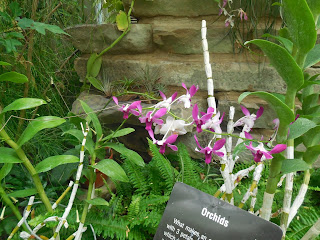

There were banana and plantains almost ready to be harvested.


And this lovely variegated shrub that I think I know the name of?

There were umbrellas made available that we used to go outside when the rani slowed down. This is Hubby approaching a green house that I am guessing was the original 1951 era conservatory.


Now to the herb garden. This was a pretty garden tucked along the side of the conservatory that had a metalwork entrance arch that spelled out "Herbs." The center sported a sundial and the formal four square layout had a variety of herbs and garden art to explore and enjoy.

The garden included Lemon Verbena and Rosemary planted in the ground, looking like they wintered over in place. I was curious if this was true, but no one working that day was well versed in herbs to be able to answer that inquiry.
There were some unusual plants like Lungwort, Hyssop and Rue.

Being August the Garlic Chives were ready to bloom.
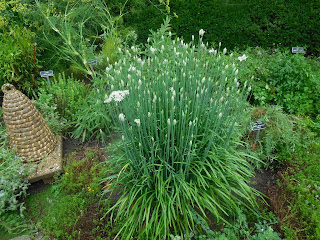
There was a bush of Meadowsweet an herb I would like to grow when I have more room for it to spread out like this one has. The herb is a go-to for stomach and intestinal ailments and can be used in tinctures as well as dried and taken in tea form.

I don't have another picture of it, but you can see the willow branches placed diagonally in the ground to the right of the Meadowsweet that were keeping other herbs like Yarrow from creeping into the space. I thought it was clever and not at all distracting.
There was a Costmary (Bible leaf) plant. This lastly minty smelling and tasting leaf can be sniffed to increase wakefulness.

And the most interesting Thyme Bed -- Sofa? A most clever way to display Thyme and a perfect memorial sculpture - a scented seat. The "planted seat" is an old herb garden item, used often before the 1800s to scent clothing. It was created of carved stone, much like a heavy church pew. The seat was hollowed out into a cavity about 6 inches deep and into this was packed earth planted with either chamomile or thyme. When a person sat down and crushed the plants, resulting oils soaked into breeches or skirts. The seat would be replenished as needed.


The George L. Luthy Memorial Botanical Garden, usually just Luthy Botanical Garden, is a 4.5 acres botanical garden and conservatory located in Glen Oak Park, near the corner of Prospect Avenue and Gift Avenue in Peoria, Illinois, United States. The garden was established in 1951. The street address is 2520 N Prospect Rd, Peoria, IL 61603

Living in Illinois I do not get the chance to grow or enjoy many tropical plants so I was fascinated with the offerings inside the Conservatory. The Bird of Paradise was in bloom and I must have taken 30 pictures of it trying to catch the best view of the blooms.

There were plants I'd never known about like the miraculous plant that changes your tastebuds (temporarily) to make sour things taste sweet called Miracle Berry.


Tucked away under the trees in the outdoor area was a children's garden. Some of it had been put to bed for the year, but there was the cutest train and other fun garden art and play areas.

There was a lovely display garden of Dwarf Conifers installed in 1997.

Now to the herb garden. This was a pretty garden tucked along the side of the conservatory that had a metalwork entrance arch that spelled out "Herbs." The center sported a sundial and the formal four square layout had a variety of herbs and garden art to explore and enjoy.

The garden included Lemon Verbena and Rosemary planted in the ground, looking like they wintered over in place. I was curious if this was true, but no one working that day was well versed in herbs to be able to answer that inquiry.
 |
| Rosemary |
 |
| Lemon Verbena surrounded by catnip and lavender |

Being August the Garlic Chives were ready to bloom.

There was a bush of Meadowsweet an herb I would like to grow when I have more room for it to spread out like this one has. The herb is a go-to for stomach and intestinal ailments and can be used in tinctures as well as dried and taken in tea form.

I don't have another picture of it, but you can see the willow branches placed diagonally in the ground to the right of the Meadowsweet that were keeping other herbs like Yarrow from creeping into the space. I thought it was clever and not at all distracting.
There was a Costmary (Bible leaf) plant. This lastly minty smelling and tasting leaf can be sniffed to increase wakefulness.

And the most interesting Thyme Bed -- Sofa? A most clever way to display Thyme and a perfect memorial sculpture - a scented seat. The "planted seat" is an old herb garden item, used often before the 1800s to scent clothing. It was created of carved stone, much like a heavy church pew. The seat was hollowed out into a cavity about 6 inches deep and into this was packed earth planted with either chamomile or thyme. When a person sat down and crushed the plants, resulting oils soaked into breeches or skirts. The seat would be replenished as needed.

I did not notice the arch with HERBS until I was leaving the herb garden as I entered from the back side like this view.

The sundial in the center is registered with the North American Sundial Society is said to be only one of two designed by Grant Hood of the Bradley It is inscribed "TIME FLIES LAT 40 43 DESIGNED BY GRANT HOOD, PEORIA, ILL." The granite pedestal includes a dedication plate reading, "Presented by - Mrs. S. A. Kinsey - October 1905" Grant Hood worked for Parson School of Horology (founded in 1886.) Horology is the study of watchmaking and time keeping the school was part of what is now Bradley University in Peoria. The other sundial was at the school but was later removed and sold.

The George L. Luthy Memorial Botanical Garden, usually just Luthy Botanical Garden, is a 4.5 acres botanical garden and conservatory located in Glen Oak Park, near the corner of Prospect Avenue and Gift Avenue in Peoria, Illinois, United States. The garden was established in 1951. The street address is 2520 N Prospect Rd, Peoria, IL 61603


